

Most paint plants still rely on lab samples to check viscosity. Someone walks to the mixing tank with a cup, pulls a sample, carries it back to the lab and runs it through a Brookfield viscometer. The whole process takes ten to fifteen minutes. By the time the result comes back, the batch has already moved on.
If the reading is out of spec, the operator has to guess how much thinner to add, because the batch has already changed since the sample was taken. That is the fundamental problem with lab-based viscosity control in paint production. Inline measurement solves it.
The Real Cost of Lab Sampling
It is not just the delay. Lab sampling introduces variability that is hard to see until you run production data. The operator who pulls the sample might take it from a different depth each time. Temperature in the lab bench is rarely the same as the process temperature. And between the sample and the result, solvent evaporation changes the viscosity slightly.
In practice, this means your lab result is already an approximation by the time you read it. Two operators sampling the same tank at the same time will often get numbers that differ by several centipoise. That is acceptable for quality records, but it is not good enough for real-time process control.
What Inline Viscosity Measurement Actually Delivers
An inline viscometer mounted directly in the process line gives you a continuous reading updated every few seconds. No sampling, no transport delay, no temperature drift between the process and the measurement.
For paint and coating production, this matters at two specific points in the process. During mixing, it tells you in real time when the batch has reached target viscosity so you can stop adding solvent. During transfer, it confirms that the product leaving the tank is still within spec.
Typical Viscosity Ranges in Paint Production
Different paint types operate at very different viscosities, which is one reason a single viscometer technology does not cover everything.
| Paint Type | Viscosity Range | Measurement Point |
| Water-based emulsion paint | 80 – 200 cP | After dilution, before fill |
| Solvent-based industrial paint | 500 – 5,000 cP | Mixing tank discharge |
| High-solid coating | 5,000 – 20,000 cP | Mixing vessel |
| Ink and pigment paste | 2,000 – 50,000 cP | Milling and blending |
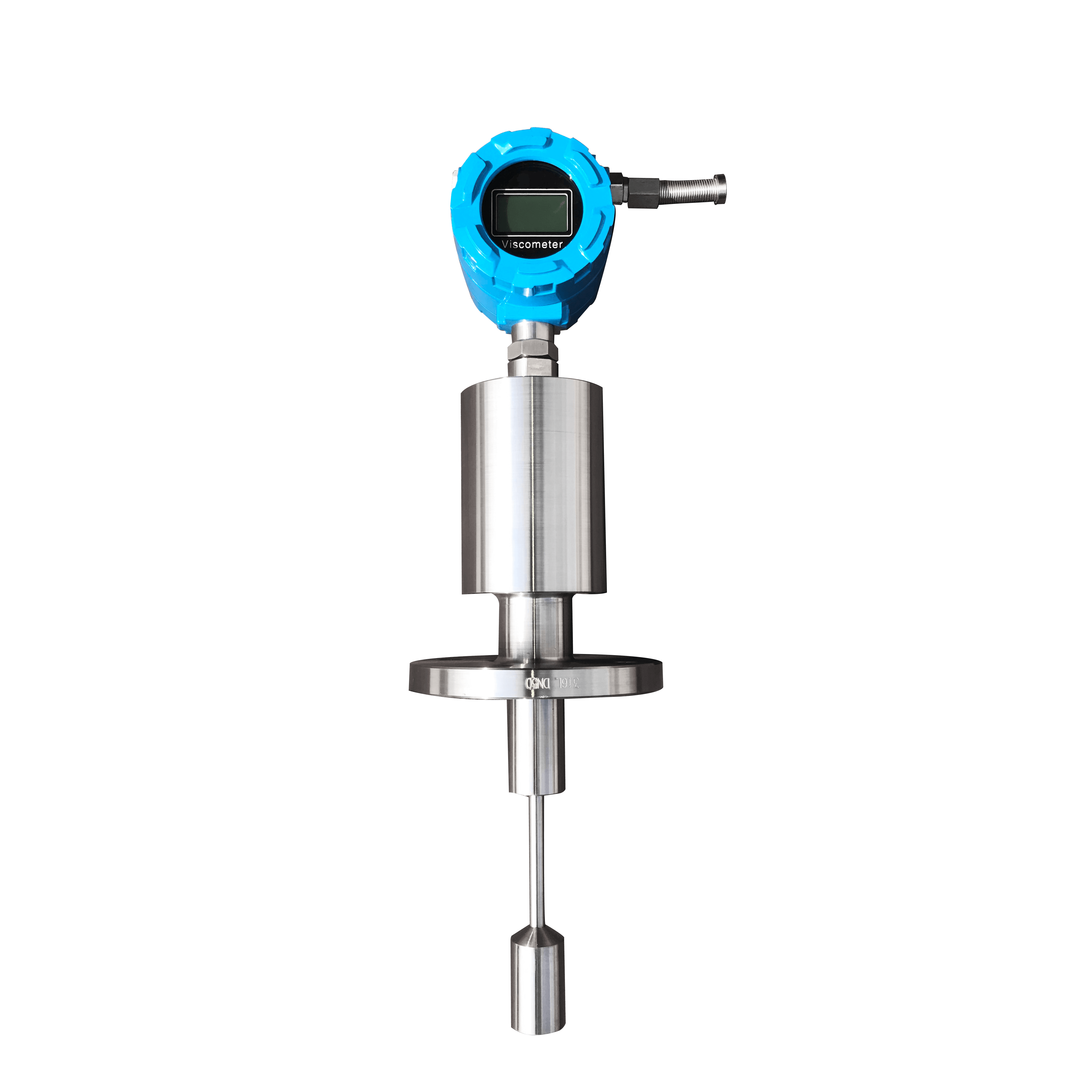
Vibrational inline viscometers, like the LONNMETER LONN-DN100, cover the range needed for most water-based paints, solvent-based industrial paints and high-solid coatings. For the heaviest pigment pastes at the upper end, check the instrument is rated for the specific viscosity range.
What to Watch for in Paint Applications
Paint processes have a few quirks that make instrument selection different from, say, a refinery application.
Cleanability matters. Paint residue builds up fast. If the sensor has crevices or deep threads, it becomes a maintenance headache. A smooth, simple sensor profile makes cleaning between batches much easier.
Solvent resistance. Solvent-based paints can degrade some seal materials. Check that the wetted materials and any seals are compatible with your solvent system.
Temperature compensation. Paint viscosity is highly temperature-sensitive. A 5 degree change can shift viscosity by 10 percent or more. The viscometer needs good temperature compensation to avoid false readings.
The LONNMETER LONN-DN100 for Paint Production
The LONNMETER LONN-DN100 vibrational inline viscometer is designed for the kind of continuous operation that paint production demands. The tuning fork sensor has no rotating shaft, no seals to wear, and a clean profile that resists paint buildup.
Built-in temperature compensation handles the normal process temperature range, so the viscosity reading stays stable even when ambient conditions shift. The 4-20mA output integrates directly with existing process control systems, and the RS485 Modbus RTU option provides access to diagnostic data for predictive maintenance.
For paint and coating manufacturers looking to move from periodic lab sampling to continuous inline viscosity control, the LONNMETER technical team can help size and configure the right installation.
Post time: Jun-03-2026


