

The hydrocyclone is one of the most misunderstood pieces of equipment in mineral processing. Operators watch the overflow and underflow. They adjust the feed pump. They watch the pressure gauge. They rarely watch the density. That is a mistake, because the single most important variable for classification efficiency is the feed density — and the single most common reason for hydrocyclone short-circuiting is an unmeasured, uncontrolled shift in that density.
This article is about three places in the mining circuit where slurry density measurement changes what happens next: the hydrocyclone feed, the grinding circuit underflow, and the tailings or concentrate thickener. Three different measurements. Three different accuracy requirements. Three different reasons why the reading matters.
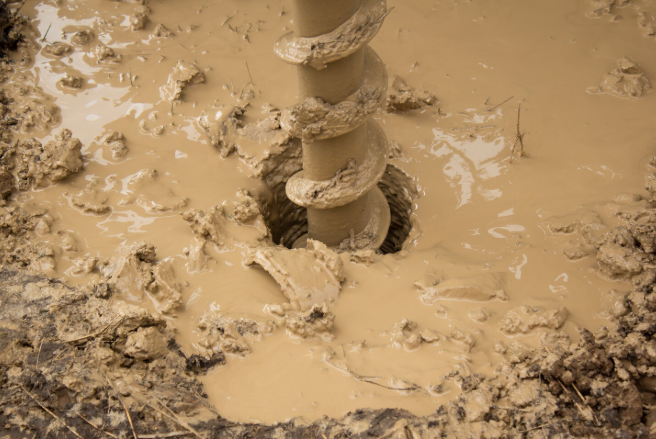
Decision 1: Hydrocyclone Feed Density
The hydrocyclone classifies particles by size. Coarse particles report to the underflow (the cyclone apex); fine particles report to the overflow (the vortex finder). The key variable that determines where a particle goes is not just its size — it is the settling velocity, which is a function of both particle size and slurry density.
If the feed density is too high, the slurry becomes so viscous that the settling velocity of even the coarse particles drops. They stop reporting to the underflow and go over with the fines. The circuit loses its classification efficiency. The mill grinds material that should already have been sent to the next stage, wasting energy.
The operating window for most sulfide ore grinding circuits is a feed density of 45–65% solids by weight. Below 45%, the slurry is too dilute and the mill does not fill properly. Above 65%, the viscosity becomes the limiting factor. The hydrocyclone feed density meter gives the operator a real-time window into whether they are inside that window.
| Hydrocyclone feed density: key specs
Typical range: 1.30 – 1.75 g/cm³ (45–65% solids by weight for most sulfide ores) Required accuracy: ±0.01 g/cm³ (1% solids resolution is sufficient for control) Solids type: highly abrasive (P80 100–300 µm, silica content 60–75%) Key output: feed density, calculated % solids, alarm if density exits operating window Measurement location: on the feed line before the cyclone manifold Sensor option: nuclear (gamma) gauge or ultrasonic (non-contact) |
Decision 2: Grinding Circuit Underflow
The hydrocyclone underflow (also called the cyclone underflow or the ball mill feed) is the material that reports back to the grinding mill. If the underflow density is too low, the ball mill is underfilled and the grinding efficiency drops. If it is too high, the balls cannot fall freely and the mill power draw falls while the wear rate goes up.
In a typical closed-circuit grinding arrangement, the underflow density is the primary control variable for the cyclone. The target is usually 70–80% solids by weight, which corresponds to roughly 1.80–2.00 g/cm³. The operator adjusts the water addition to the sump (or the feed rate) to hold this density.
The underflow is the most abrasive location in the grinding circuit. The material is at its coarsest, the solids content is at its highest, and the particles are angular and silica-rich. Any sensor that contacts this slurry directly will wear out faster than the same sensor in the feed or overflow.
| Grinding circuit underflow: key specs
Typical range: 1.80 – 2.00 g/cm³ (70–80% solids by weight) Required accuracy: ¹0.02 g/cm³ (control resolution of 2–3% solids is acceptable here) Solids: P80 200–800 µm, silica content up to 75%, highly angular Sensor option: nuclear gauge preferred (contact-free, abrasion-resistant) Nuclear option: Am-241 or Cs-137 source, calibrated for specific ore type Alternative: ultrasonic gauge if line pressure and solids loading allow |
Decision 3: Tailings Thickener Underflow
The tailings thickener is about water recovery. The higher the underflow density, the less water is sent to the tailings storage facility (TSF) and the more water is recycled to the plant. At a target underflow density of 55–65% solids, every 1% increase in underflow solids saves roughly 10–15 m³ of water per day in a 50,000 tpd operation.
The tailings thickener underflow is a flocculated suspension. Polyacrylamide flocculants are added at the thickener feed to accelerate settling. The challenge for density measurement is the same as the grinding circuit: the fluid is non-Newtonian (it behaves like a Bingham plastic or a shear-thinning fluid), and the density can vary significantly within the cross-section of the pipe.
The thickener underflow density also determines whether the tailings behave as a conventional slurry (low density, flows easily) or as a paste (high density, does not flow without shear). Paste tailings are increasingly common in water-scarce regions because they reduce water losses to the TSF. But paste behaves differently in the pipeline, and the transition point from slurry to paste is density-dependent.
| Tailings thickener underflow: key specs
Typical range: 1.50 – 1.90 g/cm³ (45–65% solids by weight, varies by ore type) Required accuracy: ¹0.01 g/cm³ Fluid type: flocculated (polyacrylamide), non-Newtonian, Bingham plastic behavior Key output: underflow density, % solids, calculated water recovery rate Decision point: slurry vs paste transition (typically 60–65% solids by weight) Sensor option: nuclear gauge (non-contact preferred), or tuned-prong sensor in bypass |
How to measure slurry density: nuclear vs ultrasonic
There are two viable technologies for online slurry density measurement in mining: nuclear gauges (gamma attenuation) and ultrasonic sensors. Microwave is sometimes mentioned but is less reliable in high-solids, high-abrasion environments.
Nuclear gauges (Am-241 or Cs-137 source) measure the attenuation of gamma radiation through the slurry. They are non-contact: the source is mounted on one side of the pipe, the detector on the other. The attenuation is proportional to the mass per unit area, which is a function of both density and the pipe wall thickness. They are unaffected by abrasion, entrapment, or coating, which makes them the standard in grinding and classifier circuits.
Ultrasonic sensors measure the speed of sound in the slurry. Sound velocity in a slurry is a function of the sound velocity in water, the solids fraction, and the compressibility of the solid particles. At low solids fractions (<20%), the relationship is relatively linear. At high solids fractions (>50%), the relationship becomes non-linear and is sensitive to particle size distribution and particle shape.
For the hydrocyclone feed and thickener underflow, ultrasonic gauges are adequate if the solids are below 40% and the particles are well-suspended. For the grinding circuit underflow (70–80% solids), the non-linearity of the ultrasonic relationship becomes a problem. Nuclear gauges are the reliable choice at high solids fractions.
The entrapment and abrasion problem
Any in-contact sensor in a mining slurry faces two mechanical challenges. Abrasion wears the sensor surface. Entrapment occurs when a coarse particle gets lodged between the sensor and the pipe wall, creating a localized high-density zone that biases the reading.
The tuning fork density meter, which is common in chemical and food applications, is not suitable for grinding circuit underflow at high solids fractions. Coarse particles (500–1000 µm) can wedge between the fork tines, damping the vibration and creating a persistently high reading. For the underflow, nuclear gauges are preferred for exactly this reason: they measure through the pipe wall and never touch the slurry.
If nuclear gauges are not permitted at your site (some sites have banned open radioactive sources for safety and regulatory reasons), the alternative is a bypass loop with a nuclear gauge or a sampling loop with a manual measurement point. Do not install a tuning fork sensor in the underflow line unless you are prepared to clean it every shift.
LONNMETER instruments for mining slurry applications
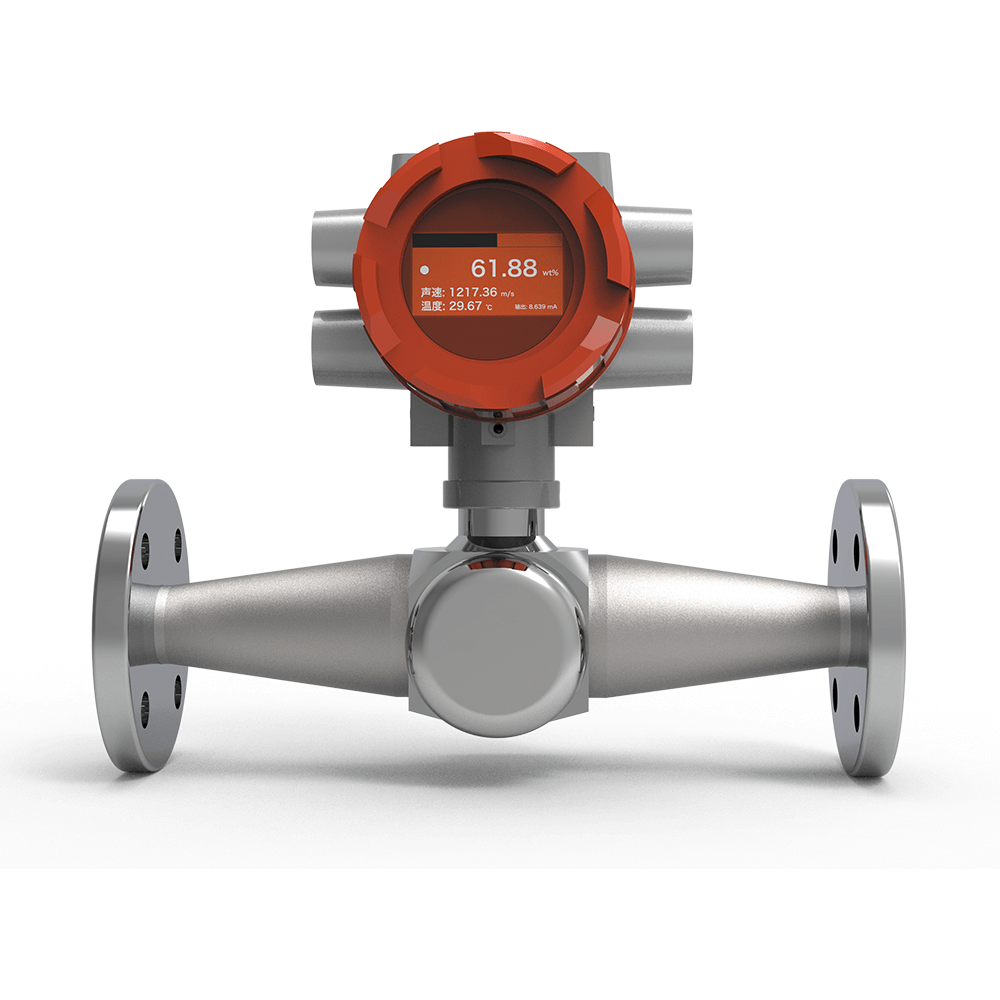
For mining applications, LONNMETER supplies density measurement systems that can be configured for nuclear gauge integration or for in-line applications where nuclear gauges are restricted. The LONN700 series covers the full density range from hydrocyclone feed to thickener underflow, with Modbus RTU or 4-20 mA output for integration with plant DCS or SCADA.
If you are specifying a density measurement system for a grinding or classification circuit and need to review the technology options, the solids fraction range, or the installation approach for your specific ore type, the LONNMETER technical team can walk through the circuit P&ID with you.
Questions on mining slurry density measurement
Can I use a tuning fork density meter in the hydrocyclone feed?
Possibly, if the solids are below 30% and the P80 is below 200 µm. Above that, particle entrapment between the fork tines becomes a reliability issue. For the hydrocyclone feed at 45–65% solids, use a nuclear gauge or an ultrasonic sensor. For the underflow at 70–80% solids, nuclear is the only reliable choice.
What is the difference between Am-241 and Cs-137 for mining applications?
Am-241 (Americium) has a lower gamma energy (60 keV) and is better suited for thin-walled pipes and low-density slurries. Cs-137 (Cesium) has higher energy (662 keV) and penetrates further, making it suitable for larger pipes and higher-density materials. Cs-137 is more common in heavy mineral processing and coal. Am-241 is preferred for base metal grinding circuits with smaller pipe diameters.
How does flocculant affect density measurement in the thickener underflow?
Flocculant (polyacrylamide) changes the particle size distribution: it causes fine particles to aggregate into larger flocs. The density of the flocculated slurry is slightly lower than the unflocculated slurry at the same solids loading because the flocs contain entrained water. The density meter measures the flocculated state, which is the correct measurement for process control. Calibrate the meter after the flocculant is confirmed as dosed.
What is the approximate cost difference between nuclear and ultrasonic for a single measurement point?
Ultrasonic gauges are typically 30–50% of the cost of a nuclear gauge system (including source, detector, and installation). However, the operational cost of a nuclear gauge is near zero if it is correctly specified, while an ultrasonic gauge in a high-solids application may require more frequent calibration and cleaning. Total cost of ownership over 5 years often favors nuclear for high-solids applications.
How does ore type affect the slurry density target?
Ore specific gravity varies significantly: iron ore is dense (5.0 g/cm³ solids SG) and produces high-density slurries even at moderate solids fractions. Copper sulfides are lighter (3.5–4.5 g/cm³). Gold ores vary widely. The density-to-solids relationship is not linear across ore types. Calibrate the density meter against the actual ore being processed, not against a generic value.
Post time: Aug-03-2026


