

Riboflavin does not care about your accuracy class. Painted on the inside of a vessel before a cleaning cycle, it fluoresces wherever the spray never reached, and the patch that lights up under UV is nearly always a branch, a thread or a recessed cavity. It is never the flat run. A pressure instrument holding 0.075 % of span can still be the reason a batch sits in quarantine. The sanitary pressure transmitter exists because the wetted side of an ordinary instrument is a place product can hide, and no amount of calibration accuracy cleans a cavity. Our pressure transmitter range spans gauge, absolute and differential families for general industry. Hygienic variants change what touches the product, not the physics of the measurement.

That distinction decides almost every purchase on a validated line. Buyers who compare datasheets by accuracy and price are solving the wrong equation, because a conventional unit and a hygienic one can post identical numbers on the bench and behave completely differently on the third batch. What follows is the specification logic we walk through with process engineers, from the fitting geometry to the paperwork an auditor will ask for.
The dead leg that fails the swab
Standard process instruments measure through a threaded port. Product travels down a narrow bore, crosses a thread, and enters an internal chamber before it reaches the isolation diaphragm. On water or clean instrument air that arrangement is harmless. On whey, sucrose syrup, cell culture broth or a vaccine adjuvant it is a trap. The chamber sits outside the main flow, so the cleaning solution exchanges with it slowly and incompletely. Residue survives the caustic wash, and the surviving residue feeds a biofilm that the next batch picks up.
Hygienic design expresses this as a dead leg, quantified by the ratio of branch length to branch diameter. Plant standards commonly call for an L/D of two or less on product-contact branches, with tighter targets on aseptic service, and the reason is fluid mechanics rather than fashion. A short, wide stub sees the same turbulent velocity as the main line, so the CIP fluid scours it. A long, thin stub behaves like a still pond. The measurement port on a transmitter is exactly such a stub when a threaded boss stands off the pipe wall.
Two verification methods catch what a visual inspection misses. A riboflavin coverage test coats the wetted surfaces with a fluorescent dye, runs the standard cleaning cycle, then inspects under UV light for anything left behind. ATP swabs and microbiological swabs taken afterwards give a quantitative and a culture-based answer respectively. We have been asked to review lines where the transmitter itself passed every calibration check and the line still failed qualification, because the port boss had been welded on with a 60 mm standoff nobody had thought to question. The instrument was fine. The geometry was not.
What a flush diaphragm actually removes
A sanitary pressure transmitter replaces that threaded port with a front-flush sensing face. The diaphragm sits in the plane of the pipe or vessel wall, welded into a ferrule or a weld-in adapter, with no bore, no thread and no cavity between the product and the sensing element. Pressure deflects that thin membrane and a fill fluid carries the deflection back to a piezoresistive silicon or capacitive cell inside the housing. The measurement chain is familiar; the product interface is not. We separated that vocabulary from the protection markings in our note on pressure sensor vs transducer vs transmitter, and it is worth keeping the two apart here, because “transmitter” describes the output, not the hygiene.
Geometry drives performance in ways a buyer rarely anticipates. A low-pressure range needs a large, thin diaphragm to generate enough deflection, which is why small clamp sizes suit high ranges and 1.5 inch or 2 inch front-flush faces dominate tank and low-pressure duties. A thicker membrane survives water hammer and overpressure better but raises the minimum usable span. Fill fluid introduces its own temperature coefficient, since a trapped liquid expands as the process heats and pushes on the cell even at constant pressure. That is why two instruments of identical stated accuracy can diverge after a steam cycle, and why the recovery behaviour belongs in the specification rather than in a footnote.
Vacuum is the other trap. Steam sterilisation condenses as the vessel cools, and the resulting sub-atmospheric condition can pull a gauge-reference diaphragm past its designed travel. On a vessel that sees SIP, the choice between a gauge device with a documented vacuum rating and an absolute pressure transmitter is not a preference. It is the difference between a reading that recovers and a membrane that has been permanently deformed.
Read the connection standard before you order
On a sanitary pressure transmitter, the process connection is where most procurement mistakes happen, and the reason is rarely technical. It is driven by what the plant already stocks. Choose a fitting your gasket inventory, clamps and CIP skids do not match and you have created a maintenance problem with a perfectly good instrument.
| Connection | Defined by | Typical installed base | What to watch |
| Tri-Clamp ferrule | ISO 2852 and ASME BPE ferrule sizes | North American dairy, food, beverage and most new builds | Gasket compound and clamp torque must match the line |
| DIN 11851 threaded union | DIN 11851 | Older European dairies | Slotted nut and external thread can trap soil |
| Varivent inline fitting | Varivent / GEA practice | European brewing and large process lines | Adapter availability outside its home market |
| DIN 11864 aseptic | DIN 11864 | Sterile pharma and aseptic filling | Metal-to-metal seal and defined crevice-free gasket groove |
We saw this play out on a dairy line that passed visual inspection and kept failing swabs. Product had worked into the thread of a DIN 11851 union and survived every clean. Standardising the instrument taps on Tri-Clamp fixed it without touching the transmitter. The instrument should speak the language the line already speaks. For genuinely sterile service, the aseptic connection is the specification, not an upgrade option, because a gasket groove that leaves a crevice is a crevice that will be sampled.
The surface finish number an auditor will ask for
Cleanability is measured, not claimed. Surface roughness, written as Ra and defined by ISO 4287, is the number that appears on the certificate, and it is the first thing a qualification team asks to see. Food and beverage product-contact surfaces are commonly polished to Ra at or below 0.8 µm, roughly 32 µin. Bioprocess and parenteral work tightens that to 0.5 µm or better, often with electropolishing to remove the fine peaks a mechanical polish leaves behind. ASME BPE goes further and grades finishes by surface designation, so a specification that says only “polished” is not a specification at all.
Welded joints matter more than the flat sheet. A continuous orbital weld, ground flush and passivated, is a cleanable surface. A spot weld, a lap joint or an unground seam is a ledge. Passivation treatments described in ASTM A967 restore the chromium oxide layer after machining and welding, and electropolishing both levels the profile and enriches that layer. Ask for the roughness report on the welded assembly, not on the raw diaphragm stock, and ask where on the part it was measured. A certificate describing a coupon is not evidence about the instrument.
There is a practical reason for the number. Bacterial adhesion scales with the micro-topography a polish removes, and a surface holding a mature biofilm will not be rescued by a longer caustic wash. Roughness, weld quality and drainability form one failure mode, not three independent line items.
Where 3-A, EHEDG and ASME BPE differ
Three frameworks show up in hygienic specifications, and they govern different things.
3-A Sanitary Standards is a US system centred on dairy and food equipment. A 3-A symbol is third-party certification that a design meets the hygienic criteria of the relevant 3-A number, so it is evidence about a specific certified configuration rather than a general claim about a manufacturer. EHEDG, the European Hygienic Engineering and Design Group, publishes design guidance and, more usefully for a buyer, cleanability test protocols that demonstrate a component can actually be cleaned in place. ASME BPE covers bioprocessing equipment, including materials, surface designations, connections, seals and the sterile boundary, and it is the framework most parenteral and biotech projects are written against.
Food-contact legislation sits alongside these rather than inside them. In the United States, elastomer and plastic contact materials are addressed under FDA 21 CFR 177. In the EU, Regulation (EC) 1935/2004 provides the framework and Regulation (EU) 10/2011 covers plastic materials. EU GMP Annex 1 sets expectations for product-contact surfaces in sterile medicinal manufacturing. None of these is interchangeable with a design certificate, and a datasheet that lists all of them without saying which applies to which component deserves a question.
Our position on paperwork is deliberately narrow: request the certificate, check its scope against the exact configuration being ordered, and treat the certificate number and validity as the supplier’s document, not as a phrase to be copied into a specification. We do not claim certifications we cannot hand over, and the documents shipped with any particular unit are those listed on its datasheet.
Surviving the cleaning cycle
CIP and SIP are the harshest conditions a sanitary pressure transmitter will ever see, and they are usually far outside the steady-state process conditions used to pick the range. A typical cleaning sequence runs a warm pre-rinse, an alkaline wash with 1 % to 2 % caustic at 65 °C to 80 °C, an intermediate rinse, an acid step to remove mineral scale, a final rinse to a conductivity endpoint, and a sanitising pass. Flow has to be turbulent to scour the walls, so line velocity and spray-device coverage are part of the cleaning validation, not just pump sizing.
| CIP stage | Typical condition | Instrument consequence |
| Pre-rinse | Ambient to 50 °C water | Removes gross soil, little thermal stress |
| Caustic wash | 1 % to 2 % NaOH at 65 °C to 80 °C | Alkaline compatibility of elastomers and diaphragm |
| Acid wash | Nitric or phosphoric acid, heated | 316L generally suitable, chloride excursions are not |
| Final rinse | Conductivity-controlled water | Residual chemistry must not remain in a cavity |
| SIP | Saturated steam near 121 °C for a validated hold | Thermal shock, zero drift, condensation vacuum |
Sterilisation is validated by lethality rather than by a timer alone. The F0 convention integrates the lethal rate against a reference of 121.1 °C with a z-value of 10 °C, so a hold at a higher temperature can legitimately be shorter. For the instrument, the relevant facts are the peak temperature, the rate of temperature change, the hold duration and what happens when the steam collapses. A front-flush diaphragm sees the thermal step first, while the sensing cell inside the housing lags behind it. That gradient moves the zero. Some designs recover within minutes; others drift for an hour, which is longer than many batch hold windows. Heat-sink necks, thermal isolation between the process face and the cell, and remote seals with capillaries all exist to manage this gradient, and each adds its own temperature effect that must be compensated.
Chemistry matters as much as heat. Concentrated hypochlorite, chloride-bearing cleaners and low-pH acid steps can pit 316L, particularly in crevices and at weld heat-affected zones. Where the cleaning regime includes oxidising chlorides, a nickel alloy diaphragm such as Hastelloy C-276 is the honest specification, and the elastomer has to be chosen against the same chemistry. EPDM handles hot caustic and steam well but swells in fats and oils. FKM tolerates oil and fat but is a poorer choice for repeated steam and strong alkali. PTFE resists almost everything chemically but creeps under load, so gasket compression and retorque practice become part of the maintenance plan. There is no universal gasket, only a gasket matched to a stated cleaning recipe.
Wetted materials, and the ones nobody lists
316L stainless, equivalently 1.4404 or UNS S31603, is the default for a reason: the low carbon content limits sensitisation at welds, and the alloy passivates predictably. What tends to be missing from a quotation is the rest of the wetted path. The diaphragm, the weld collar, the gasket, the fill fluid and any adapter all contact product or could contact it after a seal failure. Food-grade fill fluid, documented for incidental contact, is a procurement item with its own certificate. A supplier who certifies the diaphragm and says nothing about the fill fluid has left a gap in the traceability chain.
Material traceability is worth asking for by name. An EN 10204 3.1 inspection certificate ties the delivered metal to a heat and a chemical analysis. Welds should have a documented procedure and an inspection record. Passivation should have a record too. These are not ceremonial documents on an aseptic line, since a failed material audit can hold a batch just as effectively as a failed swab.
Overpressure and pressure pulsation belong here as well. A homogeniser or a positive-displacement pump produces spikes far above the nominal line pressure, and a CIP pump starting against a closed valve produces a water hammer that a thin low-range diaphragm will remember. Specify proof and burst ratings against the credible upset, not against the normal operating point. A sensor sized to 0 bar to 2 bar for tank head pressure with 5:1 turndown is a reasonable measuring arrangement and a poor mechanical one unless the overpressure rating has been checked against the cleaning circuit.
Gauge, absolute or differential on a sterile tank
Specifying the reference type on a sanitary pressure transmitter is a process decision, not a catalogue preference. Fermenter headspace is usually controlled as gauge pressure relative to the room, but the same vessel pulls a partial vacuum as steam condenses after sterilisation, so the gauge device needs a documented negative-pressure capability or the loop needs an absolute reference. Sterile filtration is a differential measurement across a filter housing, with hygienic isolation on both sides and capillaries routed so their temperatures stay matched. Hydrostatic level in a formulation tank uses either a bottom tap against a vented top or a differential pair.
The mathematics catches people out when density is treated as a constant. Hydrostatic pressure is p = ρgh, so a 2 % shift in density from temperature or dissolved solids produces a 2 % error in inferred level before any transmitter error is counted. Milk, wort, syrup and cell broth all change density across a batch, which is why our note on automated milk density measurement in dairy processing and the broader work on density measurement in pharmaceutical manufacturing are relevant to a level loop that looks, on paper, like a pressure problem. On a tall narrow vessel the error is a few centimetres. On a shallow wide one it is a meaningful fraction of the batch volume.
Total measurement error should be assembled rather than quoted. Reference accuracy, thermal effect over the actual CIP-to-process swing, long-term drift, and the fill-fluid temperature coefficient combine as a root-sum-square, not as a single best-case figure. Add the recovery time after steam to that list, because a transmitter that returns to tolerance only after the batch has moved on is effectively out of service for the whole window. A differential pressure transmitter with twin remote seals doubles the number of fill-fluid columns that can drift relative to each other, which is precisely why capillary lengths and routing are specified together on sterile filter duties.
Output, housing and washdown
Most validated lines still run 4-20 mA with HART superimposed, because the loop is simple to document, easy to trouble-shoot and already understood by the site’s maintenance team. Our 4-20 mA pressure transmitter family covers that interface on the industrial side; on a hygienic build the electronics are unchanged while the enclosure has to survive the washdown. Cable entries point downward, the housing has no upward-facing ledges where water pools, and the connector is rated for the cleaning method actually used. IP69K under DIN 40050-9 describes high-pressure, high-temperature jet cleaning, while IP66 and IP67 under IEC 60529 describe jets and immersion. Those ratings are not interchangeable, and a site that foam-cleans at moderate pressure needs a different answer from one that uses hot high-pressure lances. The output is the easy half of a sanitary pressure transmitter specification; the washdown rating is where enquiries go wrong.
Condensation inside the housing is a quiet failure. A cold rinse after a hot cycle draws moist air past a poorly specified cable gland, and the resulting dampness shows up as an intermittent loop fault that disappears when the enclosure is opened and dried. Vented membranes, downward-facing entries and a gland matched to the cable diameter are cheaper than the investigation that follows. Where a solvent step exists in the process, the hazardous-area question from our explosion-proof line also applies, and the two specifications have to be satisfied by the same unit rather than by two optimistic assumptions.
Installation geometry: slope, branch length, drainability
A sanitary pressure transmitter can be installed badly enough to become a dead leg again. Weld-in adapters should leave the diaphragm flush with the inner wall, and the weld should be ground and passivated with the rest of the pipe. Standoff bosses, threaded adapters stacked on top of a clamp ferrule, and upward-pointing branches all reintroduce the cavity the flush design removed. Horizontal lines need a fall so the product and the rinse water drain away, and instrument taps should be placed where that fall actually works rather than at the lowest point where sediment collects.
Gasket practice belongs in the installation procedure. Correct compound, correct compression, and a replacement gasket after each teardown are mundane details that decide whether the next swab passes. An overtightened clamp distorts a ferrule and can move the diaphragm plane relative to the wall. A reused elastomer that has taken a compression set leaks at the exact moment the CIP pump ramps up. Once the instrument is in, rerun the riboflavin coverage test with the new geometry, because the qualification evidence belongs to the installed assembly, not to the component in its box.
Our colleagues writing about inline level measurement in pharmaceutical sterile tank cover the same drainability problem from the vessel side, and the food-grade flow solutions note makes the matching point for flow meters on the same skid. Instrument taps are part of the piping design, not an afterthought bolted on at commissioning.
Three duties, three different specifications
Numbers make the trade-offs concrete. Here are three services we are regularly asked to quote a sanitary pressure transmitter for, with the reasoning that changes between them.
Fermenter headspace, biotech. The controlled variable is 0 bar to 2 bar gauge, held tightly because headspace pressure affects dissolved gas transfer and foam behaviour. The vessel sees saturated steam near 121 °C for a validated hold, then cools into partial vacuum. The specification therefore needs a hygienic flush face on a Tri-Clamp or aseptic ferrule, a documented negative-pressure range, a recovery time shorter than the post-sterilisation hold, and an elastomer qualified for repeated steam. Accuracy is almost the least important line on the sheet. A unit that measures beautifully at steady state and drifts for forty minutes after the steam step is the wrong unit.
Sterile filter differential, parenteral filling. The loop watches the pressure drop across a sterilising-grade filter, typically 0 bar to 1 bar differential, with an alarm as the filter loads. Both sides need hygienic isolation membranes and matched capillaries, because a temperature difference between the two fill-fluid columns appears as a false differential. Capillaries should be the same length, routed together and shaded from the sun or a heater. The alarm threshold is set from the clean-filter baseline plus the expected fouling slope, not from an arbitrary fraction of span. Sterility of the boundary, not resolution, is the governing requirement.
Homogeniser and UHT line, dairy. Here pressure is high and dynamic, with a positive-displacement pump producing pulsation and occasional spikes well above nominal line pressure. The diaphragm has to survive the spike and the fatigue of thousands of cycles per day, the connection has to match the plant’s clamp standard, and the wetted parts have to tolerate daily hot caustic. A low-range precision cell with excellent stated accuracy would be a poor mechanical choice. Overpressure rating, fatigue life and elastomer chemistry outrank the headline accuracy figure, which is the opposite of how most enquiries are written.
Commissioning and the qualification record
A sanitary pressure transmitter that arrives on site is not yet a qualified instrument. Installation qualification captures the delivered configuration, the material certificates, the weld and passivation records, and the roughness report. Operational qualification checks the loop end to end: a loop calibrator or HART communicator drives the current, a deadweight tester or a pneumatic pressure standard provides the reference, and the as-found reading is recorded before anything is trimmed. The as-found value is the evidence that the device was within tolerance on arrival, and adjusting a unit whose as-found was already good destroys that evidence. The as-left certificate closes the loop.
Calibration should trace to national standards through an ISO/IEC 17025 accredited line, with the certificate naming the standards used. On a validated plant the calibration interval is tied to the observed drift, so the first few CIP cycles are worth an extra zero check to establish what the thermal cycling actually does to this installation. Cleaning validation evidence then sits beside the calibration file: riboflavin coverage, ATP swabs, microbiological swabs, and a record of the CIP recipe and SIP hold used for qualification. An auditor will ask for both files, because a clean line with an untraceable reading and a traceable reading on a dirty line are equally incomplete.
What a specification sheet has to say
A workable enquiry gives the supplier enough to be wrong about, in a useful way. It names the medium and its solids content, the full cleaning recipe with concentrations and temperatures, the SIP peak and hold, the connection standard and ferrule size used on the line, the required surface designation, the wetted materials and gasket compound, the measuring range together with the credible upset and any vacuum, the reference type, the output and diagnostic protocol, the washdown rating, and the document package expected at delivery. It also says which framework the plant is qualified against, because 3-A, EHEDG and ASME BPE lead to different evidence.
Leaving the cleaning recipe out of a sanitary pressure transmitter enquiry is the most common omission, and it is the one that costs the most. A supplier asked for a “sanitary pressure transmitter for milk” can only guess at the caustic strength, the steam hold and the chloride excursions, and a guess that is wrong will not show up until the first swab. The same information lets the manufacturer check the elastomer, the fill fluid, the diaphragm thickness and the thermal design together, which is where the real selection happens.
How LONNMETER builds these instruments
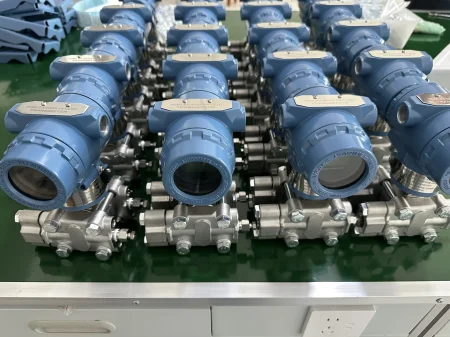
LONNMETER GROUP develops, manufactures and sells process instrumentation as one organisation, so the hygiene question reaches the same bench that builds the sensing cell. Our LONN-PT-S family of sanitary pressure transmitters is developed on the mechanical platforms already in production, including the LONN-3051 coplanar platform and the LONN-2088 gauge and absolute model, with front-flush product interfaces, 316L wetted parts, 4-20 mA with HART output, and a calibration record shipped with each unit. Front-flush assemblies are proof-pressure tested on a hydrostatic rig, weld seams are helium leak checked, and the finished output is compared against a deadweight tester and a comparator on an ISO/IEC 17025 traceable line so the as-found and as-left certificates mean something at an audit.
What we will not put in writing is a certificate number, a surface designation or an accuracy figure for a configuration we have not built. The exact connection standard, roughness value, elastomer qualification, temperature rating and performance of any specific model are those stated on its datasheet and in the documents delivered with it. The numbers in this article describe the selection method and the failure modes, not a promise about an unstated application. Compare an industrial pressure transmitter against a hygienic one and the accuracy column may look identical; the difference is in the wetted geometry, the materials record and the behaviour after the third steam cycle.
Tell us the medium, the cleaning recipe, the SIP hold, the connection standard your line uses, and the range including any vacuum or pressure spike. The contact page is where that specification conversation starts, and it is a shorter conversation when the cleaning recipe is in the first message.
Post time: Nov-09-2026


