

Every month we get an inquiry that goes something like this: “We need a density meter. Can you send a quote?” Our first response is always the same: “What are you measuring, what is the fluid, and what do you need the data for?” Nine times out of ten, the buyer has not thought through those three questions. And those three questions are what determine whether they get the right meter.
This guide walks through the decision tree from first principles. Answer these questions in order. By the end, you will know what type of density meter fits your application — and what questions to ask any vendor before you buy.
Question 1: What is your fluid?
The fluid type is the first filter. It determines whether a contact sensor can be used and what material of construction is required.
Clean liquids (water, solvents, acids, oils): Any contact density meter works. Choose based on accuracy, temperature, and pressure requirements.
Liquids with suspended solids (slurries, pulp, slurry): Contact sensors are at risk of coating and entrapment. Consider nuclear gauges for high-solids applications (>40% solids).
Corrosive fluids (strong acids, halogens): Material compatibility becomes the primary constraint. PTFE-lined or Hastelloy sensors are required.
Opaque or non-transparent fluids: Optical methods (refractometry) do not work. Use density-based or nuclear methods.
If you have a multi-component mixture and you are measuring density to infer concentration: confirm that density uniquely maps to concentration for your mixture. If two different compositions can give the same density, density alone will not give you the answer.
Question 2: What is your density range?
Density meters are designed for specific ranges. Using a meter outside its calibrated range degrades accuracy significantly. Typical ranges and the instruments that cover them:
| Density Range | Typical Fluids | Suitable Meter Types |
| 0.60 – 1.00 g/cm³ | Light hydrocarbons, solvents, ammonia | Tuning fork, vibrating U-tube |
| 0.80 – 2.00 g/cm³ | Oils, acids, alkalis, aqueous solutions | Tuning fork, Coriolis |
| 1.00 – 2.50 g/cm³ | Brines, concentrated acids, slurries | Tuning fork, nuclear gauge |
| >2.50 g/cm³ | Molten metals, heavy brines, specialty slags | Nuclear gauge (primary choice) |
If your density range spans more than one row in this table, check whether one instrument covers the full range or whether you need different instruments for different process conditions.
Question 3: What are the temperature and pressure conditions?
Temperature and pressure narrow the options significantly. Every density meter has a rated temperature and pressure range. Exceed it and the instrument either fails or gives unreliable readings.
Below 150°C, below 20 bar: Tuning fork density meters cover this range easily. Most industrial applications fall here.
150°C – 300°C, up to 40 bar: High-temperature tuning fork configurations are available. Check the seal material temperature rating — the O-ring or gasket is often the limiting component.
Above 300°C, above 40 bar: Nuclear gauges are preferred for high-temperature, high-pressure applications because the source and detector are on the outside of the pipe and are not exposed to the process fluid.
High-pressure applications also require pressure certification of the process connection. A meter rated for 10 bar will physically fit in a 40 bar line, but it is not rated for that pressure. Always check the pressure rating, not just the physical size.
Question 4: Tuning fork, Coriolis, nuclear, or ultrasonic?
Once the fluid, range, temperature, and pressure are defined, the technology choice becomes clearer. Here is a practical comparison:
| Technology | Accuracy | Slurry / Solids | High Temp / Press | Cost | Best For | Watch Out For |
| Tuning fork | ±0.001 g/cm³ | Limited (<30% solids) | Up to 300°C / 40 bar | Low–medium | Most industrial liquids | Coating, entrapment at high solids |
| Coriolis | ±0.0001 g/cm³ | Moderate (up to 20%) | Up to 350°C / 400 bar | High | Custody transfer, custody metering | Pressure drop, installation straight run |
| Nuclear (gamma) | ±0.001 g/cm³ | Any solids fraction | Any temperature / pressure | Medium–high | High-solids slurries, mining, grinding | Regulatory, licensing, source handling |
| Ultrasonic | ±0.002 g/cm³ | Low–moderate (<40%) | Up to 200°C / 25 bar | Low–medium | Clean liquids, hygienic applications | Non-linear at high solids |
Question 5: Do you need certifications?
Hazardous area certification is required if the density meter is installed in a classified location (explosive atmosphere). The certification standard depends on your geography and your plant site requirements.
ATEX / IECEx. The European and international standard. Required for EU and most international projects. Zones 0, 1, 2 for gases; Zones 20, 21, 22 for dusts.
FM / CSA. Required for North American projects. Class I (gases) and Class II (dusts) divisions.
Make sure the certification covers the specific gas group present in your application. A meter certified for Group IIA (propane) is not certified for Group IIC (hydrogen). Using an incorrectly certified meter in a hydrogen service area is a serious safety violation.
Quick reference by industry
| Oil & Gas — Refinery, upstream:
Primary choice: tuning fork (general process) or Coriolis (custody transfer) Key specs: ATEX/IECEx Zone 1, API gravity output, 15°C reference Watch: H₂S gas group (Group IIB or IIC depending on concentration)
Chemical Processing: Primary choice: tuning fork (general) or nuclear gauge (high-solids) Key specs: material compatibility (acid/alkali), PTFE or Hastelloy Watch: multi-fluid processes need correct expansion coefficient configured
Mining & Minerals: Primary choice: nuclear gauge (grinding circuit, hydrocyclone underflow) Alternative: ultrasonic for low-solids (<40%) classifier applications Watch: Am-241 vs Cs-137 source selection by ore SG and pipe diameter
Food & Beverage: Primary choice: tuning fork (sanitary config) or ultrasonic (clean fluids) Key specs: 3A/EHEDG, Ra ≤0.8 µm, CIP/SIP compatible Watch: concentration conversion table must match sweetener type (HFCS, sucrose) |
The most common mistake when requesting a quote
Sending a request for quotation that says only “density meter, please quote.” Vendors will respond with the standard product in their catalog. It may or may not be right for your application.
A minimum quote request should include: fluid name and composition (or at least the chemical family), density range, temperature range, pressure, whether the area is classified, required accuracy, and output protocol (4-20 mA, Modbus, HART, etc.). With those six pieces of information, a vendor can confirm whether their standard product fits or whether a custom configuration is needed.
LONNMETER density meter selection
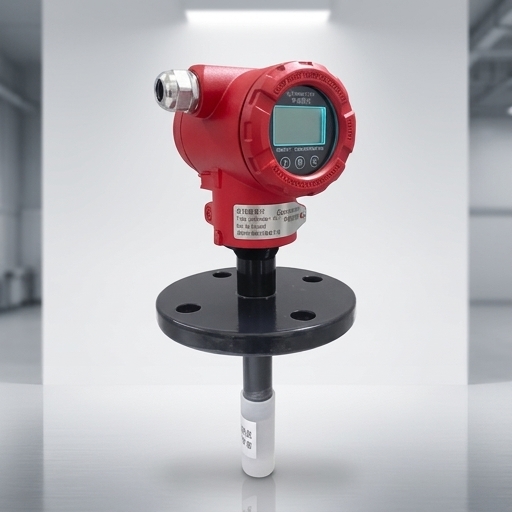
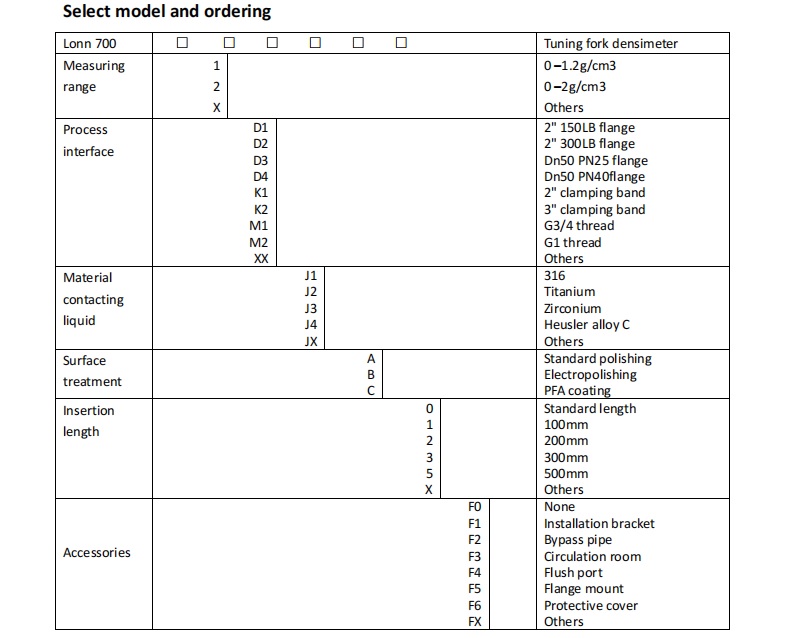
LONNMETER supplies the LONN-DN100 tuning fork density meter and the LONN700 series, covering the density range 0.60–2.50 g/cm³ in most industrial configurations. For nuclear gauge integration in mining and high-solids applications, LONNMETER offers a complete measurement system with Am-241 or Cs-137 source options.
To get a technically accurate quotation, send the six parameters listed above to the LONNMETER team. We will confirm whether a standard configuration fits or recommend the right custom specification.
Common questions on density meter selection
What accuracy do I actually need?
Match the accuracy to the application. For batch blending control, ±0.001 g/cm³ is usually sufficient. For custody transfer, ±0.0005 g/cm³ or better is required. For trend monitoring where you only care about whether the density is drifting, ±0.005 g/cm³ may be acceptable. Buying higher accuracy than you need costs money and does not improve your process.
When should I choose Coriolis over tuning fork?
Coriolis is the right choice when you need custody transfer accuracy (±0.0001 g/cm³), or when you need both mass flow and density from one instrument. The trade-off is cost, pressure drop, and installation straight-run requirements. For general process monitoring and blending control, tuning fork gives you 80% of the accuracy at 40% of the cost.
What happens if I install a standard meter in a classified area without certification?
In most jurisdictions, it is a safety and regulatory violation. The installation will fail the plant safety review and will need to be removed. More importantly, an uncertified instrument in an explosive atmosphere is a serious hazard. Always specify the certification requirement upfront. The cost difference between certified and non-certified versions is small compared to the cost of a safety incident or a re-engineering project.
Can a tuning fork meter handle abrasive slurries?
Up to a point. For solids fractions below 30% and particle sizes below 200 µm, tuning fork sensors are generally reliable. Above 30% solids or with coarse particles (>500 µm), particle entrapment between the fork tines becomes an operational problem. For grinding circuit underflow (70–80% solids), use a nuclear gauge.
How do I know if nuclear gauge licensing is a problem at my site?
Nuclear gauges require a radioactive source license from the national nuclear regulatory authority (e.g., NRC in the US, CNSC in Canada, NNSA in China). The license covers source possession, installation, leak testing, and disposal. Some sites have internal policies that prohibit open radioactive sources. Confirm the licensing situation before specifying a nuclear gauge. If licensing is a constraint, discuss ultrasonic or bypass-loop alternatives with the vendor.
Post time: Aug-10-2026


