

Concentration is not a physical property. It is a calculated value derived from a physical measurement — density, refractive index, conductivity, or acoustic velocity — combined with a conversion factor that maps the physical property to a concentration unit.
That distinction matters because the conversion factor is specific to the solute and the temperature. There is no universal “concentration meter” that works for any solution. A Brix meter configured for sucrose does not give you the correct reading for HFCS. A conductivity meter calibrated for NaCl does not give you the correct reading for H₂SO₄. The instrument must be matched to the specific solution.
This guide walks through the decision tree for selecting the right concentration meter, starting with the fundamental question: what physical property does your solution allow you to measure?
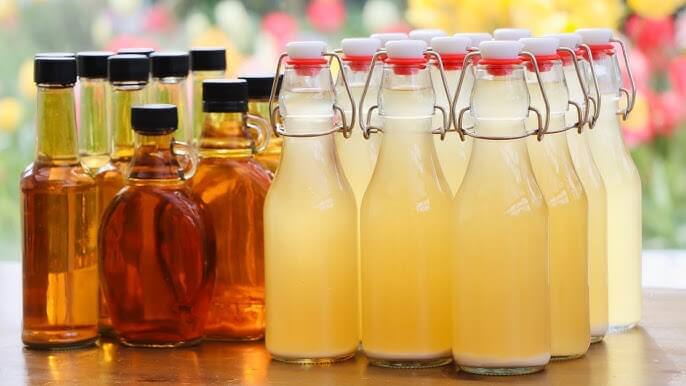
Question 1: What are you actually measuring?
Concentration can be expressed in many units, and the choice of measurement principle depends on which unit you need and which physical property it maps to:
| Concentration Type | Unit | Physical Property | Measurement Principle |
| Sugar / sweetener | °Brix, °Tw | Density or refractive index | Density meter (tuning fork) or refractometer |
| Acids and alkalis | g/L, %, mol/L | Density or conductivity | Density meter (with acid conversion table) or conductivity meter |
| Salt solutions | g/L NaCl, % | Conductivity | Conductivity meter (temperature-compensated) |
| Alcohol | % ABV, proof | Density or sound velocity | Density meter (with alcohol table, e.g., OIML) |
| Glycol / antifreeze | % ethylene glycol, % propylene glycol | Sound velocity or density | Ultrasonic (sound velocity) or density meter |
| Urea (AdBlue) | % DEF (ISO 22241) | Sound velocity | Ultrasonic (urea-specific calibration) |
Question 2: Which measurement principle fits your application?
Once you know which physical property to measure, the next question is which principle gives you the best combination of accuracy, reliability, and maintenance for your process conditions.
| Principle | Accuracy | Inline | CIP/SIP | Maintenance | Key Watch-Out |
| Density (tuning fork / vibrating U-tube) | ±0.001 g/cm³ (±0.1–0.3% conc.) | Yes | Yes (sanitary version) | Low | Conversion table must match specific solution. Two-component mixtures may not resolve uniquely. |
| Refractometry (inline Brix) | ±0.1–0.2 °Brix | Yes (prism-based) | Limited (cleaning prism critical) | Medium–high (prism cleaning) | Prism coating, bubbles, opaque fluids. Requires window cleaning. Not for slurries. |
| Conductivity | ±1–5% of reading | Yes | Yes (if sensor rated) | Medium (electrode cleaning) | Affected by all ionic species. Cross-sensitivity if multiple electrolytes present. |
| Ultrasonic (sound velocity) | ±0.1–0.5% conc. | Yes | Yes | Low | Requires specific calibration for each solution. Gas bubbles cause errors. |
The conversion table is the instrument
This point is important enough to state clearly: a density-based concentration meter is not a universal instrument. The sensor measures density. The conversion table tells the instrument how to translate that density reading into a concentration value for a specific solution.
If you change the solution, you need a different conversion table. If the solution is a mixture of two or more solutes, you need to confirm that density uniquely maps to the concentration of the target component. If two different compositions can produce the same density, the density reading will be ambiguous.
Before specifying a concentration meter, confirm three things:
1. The conversion table exists and covers the concentration range you need. For common solutions (sucrose, NaCl, H₂SO₄), tables are widely available. For specialty chemicals, confirm with the vendor.
2. The temperature reference is correct. Most tables are referenced to 20°C or 15°C. The instrument must apply the same reference.
3. For multi-component solutions, the conversion table has been validated for your specific composition. The table for sucrose does not work for HFCS. The table for NaCl does not work for KCl.
| Conversion table quick reference (density-to-concentration at 20°C):
Sucrose (Brix): 0.99713 g/cm³ → 0 °Bx | 1.10152 g/cm³ → 25 °Bx Sodium chloride: 1.005 g/cm³ → 1% NaCl | 1.150 g/cm³ → 20% NaCl Sulfuric acid: 1.005 g/cm³ → 1 g/L | 1.080 g/cm³ → 13 g/L H₂SO₄ Ethylene glycol: 1.000 g/cm³ → 0% | 1.120 g/cm³ → 40% EG
Source: OIML, ICUMSA, CRC Handbook of Chemistry and Physics |
Quick reference by industry
| Food & beverage (Brix):
Pure sucrose solutions: refractometer or density meter, ICUMSA table HFCS / invert sugar: density meter with HFCS-specific table Juice: refractometer (standard), density for opaque juices Honey: refractometer only (legal standard is refractometric Brix)
Chemical processing (acid, alkali, salt): Sulfuric acid: density meter (Hastelloy, with H₂SO₄ table) NaOH solutions: density meter (with NaOH table) Brine (NaCl): conductivity meter (cost-effective, widely used) Mixed acid systems: conductivity + density (two-parameter correlation)
Fuel / energy (glycol, alcohol): Ethylene glycol (antifreeze): ultrasonic (sound velocity, % EG) Ethanol/water: density meter (OIML alcohol table) AdBlue (urea): ultrasonic (ISO 22241 specific calibration)
Mining / hydrometallurgy: Copper leaching (H₂SO₄): density meter (Hastelloy, acid table) Gold (cyanide): density inference (no direct inline meter, lab titration standard) AMD treatment: conductivity for TDS, pH for acid neutralization |
The multi-component problem
When a solution contains more than one solute, density alone may not uniquely identify the concentration of any single component. Example: a solution containing both NaCl and sucrose has a density that depends on the sum of both contributions. Without a second measurement (e.g., conductivity), you cannot separate them.
The practical implication: if your process solution contains multiple solutes, ask whether density alone gives you the information you need, or whether you need a second measurement to resolve the ambiguity.
If density alone is ambiguous, you have two options:
Add a second inline sensor (e.g., conductivity + density) and use a two-parameter correlation to resolve the concentrations.
If the secondary component concentration is relatively constant (e.g., it does not change much during the process), you can use a single-parameter density measurement with a correction factor for the known secondary component range.
Temperature compensation is non-negotiable
Both density and refractive index are temperature-dependent. For aqueous solutions, the density temperature coefficient is approximately 0.0002–0.0003 g/cm³ per °C near 20°C. A temperature error of 3°C produces a density error of 0.001 g/cm³ — which translates to a concentration error of 0.3–0.5% for typical acid solutions.
Any inline concentration meter must include real-time temperature measurement and automatic temperature compensation to the reference temperature of the conversion table. If the instrument does not have a built-in temperature sensor, the DCS must supply a temperature signal and apply the compensation.
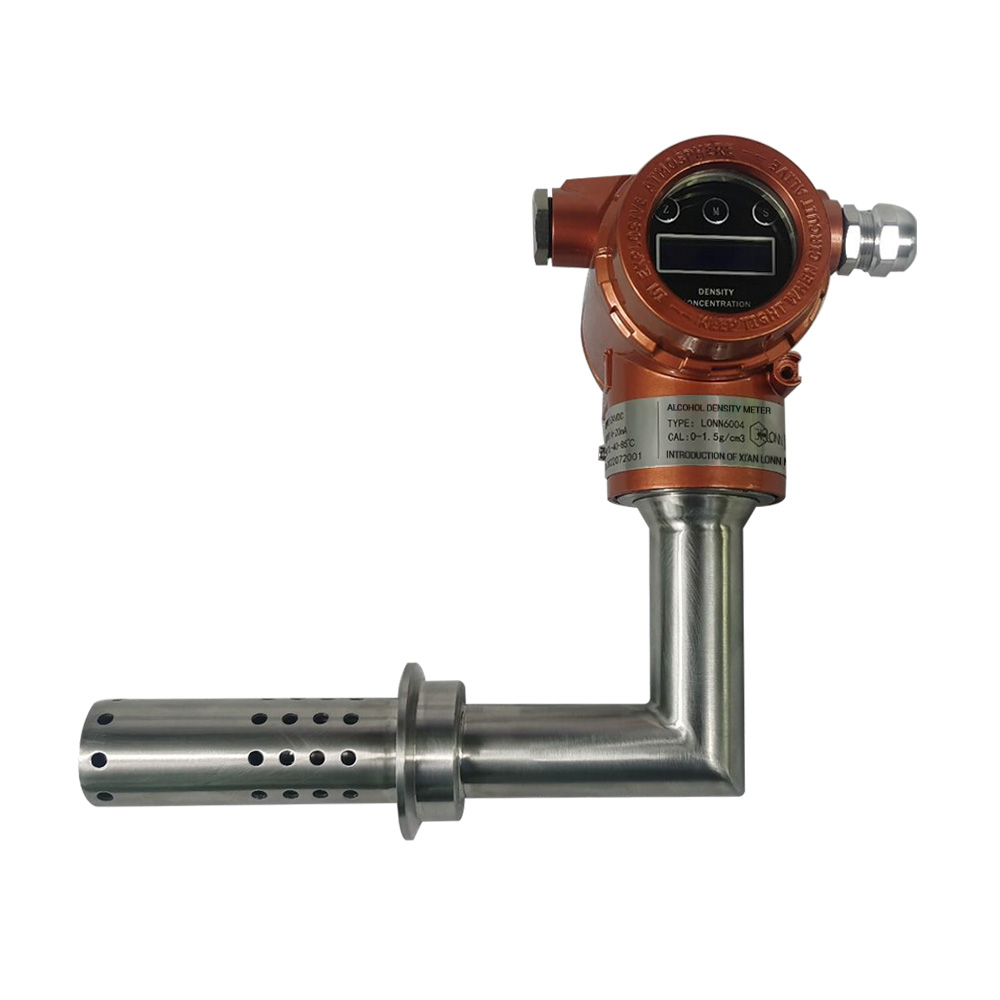
LONNMETER concentration measurement solutions
The LONNMETER LONN-DN100 and LONN700 series can be configured for concentration measurement using density-based conversion tables for sucrose (Brix), HFCS, sulfuric acid, sodium hydroxide, ethylene glycol, propylene glycol, and custom solutions. Temperature compensation is built-in. For conductivity-based concentration measurement (NaCl brine, for example), LONNMETER offers compatible conductivity sensor integration.
To specify the right concentration meter, tell us: the solution name and concentration range, the temperature range, whether one or two solutes are present, and the required output unit. We will confirm the correct conversion table and the appropriate sensor configuration.
Common questions on concentration meter selection
Can I use a Brix meter for any sweetener?
No. Brix is defined for sucrose solutions. For non-sucrose sweeteners, the conversion from density or refractive index to Brix is approximate and sweetener-specific. HFCS, invert sugar, honey, and high-intensity sweeteners all have different density-concentration relationships. Use the specific conversion table for your sweetener. Using the sucrose table for HFCS will overstate the Brix by 0.2–0.6°Bx.
Which is better for acid concentration: density or conductivity?
Density is more specific for sulfuric acid and other strong acids because the conductivity of acid solutions is not monotonic with concentration (conductivity goes through a maximum at intermediate concentrations). For H₂SO₄ between 0.5 and 10 g/L (typical heap leaching range), conductivity is monotonic, but density is the more reliable choice because it is unaffected by dissolved ions from the ore. For mixed acid systems or when the acid contains significant ionic contamination, use density.
What is the accuracy of inline concentration measurement?
It depends on the physical property and the conversion table accuracy. For density-based concentration meters: ±0.001 g/cm³ density accuracy translates to approximately ±0.1–0.5% concentration accuracy for typical acid and sweetener solutions, depending on the steepness of the density-concentration curve. For refractometry: ±0.0005 nD translates to approximately ±0.1–0.2°Brix. Validate the overall accuracy by comparing the inline meter against lab measurements across the operating range.
How do I handle multi-component solutions?
If density alone is ambiguous (two solutes both contributing to density), you need a second independent measurement. The practical combination is density + conductivity. From the density and conductivity readings, a two-parameter correlation can resolve both component concentrations. If one component concentration is relatively constant, a single density measurement with a correction factor may be sufficient. Identify the variation range of the secondary component and confirm the correction covers it.
Why does the instrument require a specific conversion table?
Because density is not concentration. Density is a physical property. Concentration is a calculated value. The calculation requires knowing the specific relationship between density and concentration for the specific solute. That relationship is defined by the conversion table. Without the correct table, the instrument will output the wrong number. The table is not optional — it is part of the specification.
Post time: Aug-14-2026


