

It’s Not About the “Best” Meter
When engineers start looking for an online density meter, the first question is often: Which one is the best?
In practice, that’s not the right question.
There isn’t a single “best” density meter — only the one that fits your process.
We’ve seen projects where a high-spec instrument performed poorly simply because it didn’t match the application. And we’ve also seen standard solutions work extremely well when the basics were done right.
At LONNMETER, most selection discussions start with the process, not the product.
Start with Your Process, Not the Datasheet
Before comparing models, it helps to get a clear picture of what you’re measuring.
A few practical questions:
- Is the liquid single-phase or does it contain gas?
- How stable is the flow?
- What is the temperature range?
- Is the fluid clean, or does it contain particles or residue?
These details matter more than most specification tables.
For example, a system that works perfectly in a clean chemical process may struggle in a pipeline with air entrainment or heavy vibration.
Accuracy vs Repeatability: What Actually Matters
It’s easy to focus on accuracy numbers.
But in many industrial processes, repeatability is just as important.
If the reading is stable and consistent, operators can make reliable decisions — even if the absolute value is slightly offset.
Typical expectations for an online density meter:
- accuracy around ±0.002 g/cm³
- strong repeatability over time
In blending or control applications, consistency is often what keeps the process under control.
Installation Conditions Will Make or Break Performance
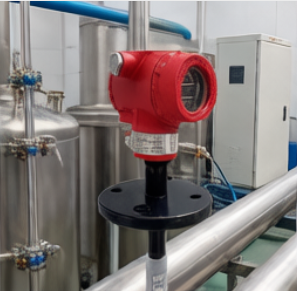
Installation is one of the most underestimated factors in density measurement.
A well-chosen instrument can still produce poor results if installed in the wrong place.
Common issues include:
- installing too close to pumps
- placing the sensor in turbulent flow
- mounting where air can collect
A better approach:
- choose a section with stable, continuous flow
- keep some distance from vibration sources
- ensure the sensor is always fully in contact with liquid
In real projects, improving installation often has more impact than upgrading the device.
Think About Integration Early
An online density meter doesn’t work in isolation.
It needs to fit into your existing system.
Things to consider:
- output signals (4–20 mA, digital communication)
- compatibility with PLC or DCS
- response time for control loops
If integration is complicated, it usually leads to delays or underused data.
A simple, reliable connection is often the better choice.
Match the Technology to the Application
Different measurement technologies are available, but they don’t perform equally in every situation.
In most industrial liquid applications, vibrating fork density meters are widely used because they are:
- relatively simple
- stable under flow conditions
- cost-effective
Other technologies, such as Coriolis-based systems, can offer additional parameters but may not always be necessary.
The key is to avoid over-specifying or under-specifying.
Maintenance Is Part of the Decision
It’s easy to focus on performance and forget about long-term use.
But maintenance affects reliability just as much as initial selection.
Things worth checking:
- how easy it is to clean the sensor
- how often calibration is needed
- whether adjustments can be done on-site
A system that is easy to maintain tends to stay accurate longer.
When Portable Measurement Still Makes Sense
Even with an online system, portable density meters still have a role.
They are often used for:
- spot checks
- verification
- troubleshooting
In many setups, both inline and portable tools are used together.
Common Mistakes When Choosing a Density Meter
Some patterns come up repeatedly:
Choosing based only on price
This often leads to higher long-term costs due to instability or maintenance.
Focusing only on specifications
Numbers on paper don’t always reflect real operating conditions.
Ignoring installation constraints
A good instrument in a bad location will not perform well.
Overcomplicating the solution
More features don’t always mean better results.
A Simple Way to Make the Right Choice
If you had to simplify the selection process, it comes down to three steps:
- Understand your process conditions
- Choose a technology that fits those conditions
- Plan installation and maintenance from the beginning
Getting these three right usually leads to a reliable result.
How LONNMETER Supports Your Selection
At LONNMETER, the focus is on practical solutions rather than just product specifications.
Typical support includes:
- reviewing application conditions
- recommending suitable configurations
- providing installation guidance
The goal is to ensure the measurement works in real operation, not just in theory.
Conclusion: Fit Matters More Than Features
Choosing an online density meter is less about finding the most advanced option and more about finding the right fit.
When the instrument matches the process, installation is done properly, and maintenance is manageable, the result is stable and reliable measurement.
That’s what actually supports production decisions.
Need Help Choosing the Right Density Meter?
If you’re evaluating options or unsure what fits your process, it’s usually worth discussing the application in detail.
You can find more information at:
https://www.lonnmeter.com/
Or contact LONNMETER for practical guidance based on real industrial use cases.
Post time: Apr-30-2026


