

In emulsion manufacturing, quality control directly determines product performance, shelf life, and customer satisfaction. One of the most critical parameters in this process is emulsion viscosity; even small fluctuations in viscosity can lead to issues like phase separation, inconsistent texture, or failed end-use requirements.
This solution focuses on how inline emulsion viscometers address challenges throughout process control, ensuring consistent emulsion viscosity in continuous production and turning reactive quality control into proactive process management.
What Are Emulsions?
An emulsion is a heterogeneous mixture of two immiscible liquids (e.g., oil and water), where one liquid (the dispersed phase) is broken into tiny droplets and suspended in the other (the continuous phase). This stability of this mixture relies on emulsifiers—substances that reduce surface tension between the two phases and prevent droplet coalescence.
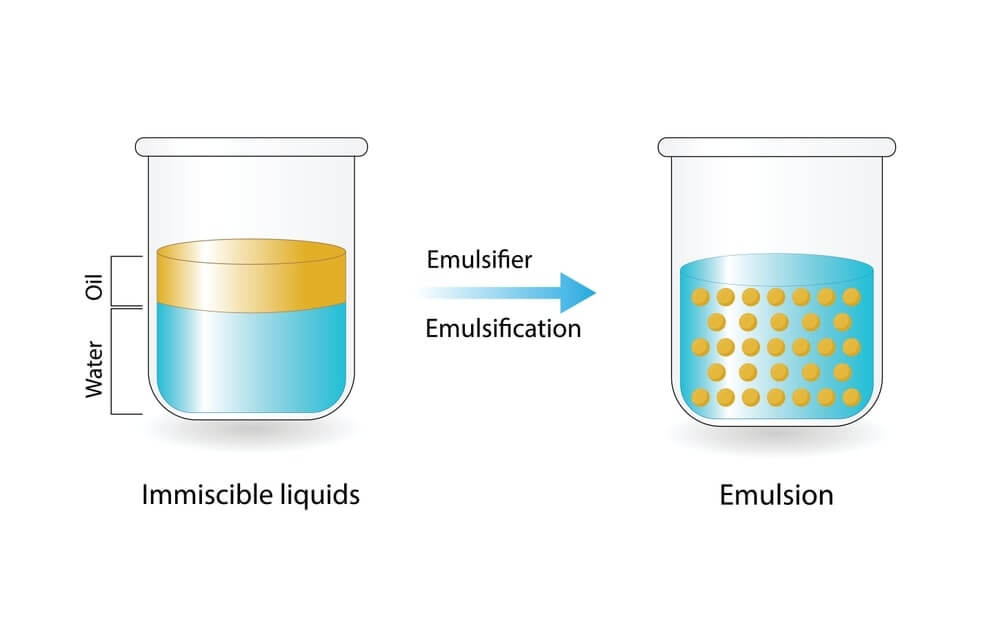
Key characteristics of emulsions that tie directly to emulsion viscosity include:
- Phase composition: The ratio of dispersed to continuous phase directly impacts viscosity (e.g., a higher oil content in an oil-water emulsion increases oil water emulsion viscosity).
- Droplet size: Smaller droplets create more friction between phases, leading to higher viscosity; larger, aggregated droplets lower viscosity and signal instability.
- Emulsifier type and concentration: Different emulsifiers (e.g., surfactants, polymers) alter the interfacial layer around droplets, which in turn changes the emulsion’s flow properties (and thus its viscosity).
Types of Emulsions
Understanding types of emulsion is critical for selecting the right emulsion viscometer, as each type has unique viscosity behaviors and production requirements. The most common classifications include:
By Phase Composition
- Oil-in-Water (O/W) Emulsions: The continuous phase is water, and the dispersed phase is oil (e.g., milk, facial moisturizers). These emulsions typically have lower oil water emulsion viscosity compared to W/O types, as water is less viscous than most oils.
- Water-in-Oil (W/O) Emulsions: The continuous phase is oil, and the dispersed phase is water (e.g., butter, motor oil). Their emulsion viscosity is often higher due to the thicker continuous oil phase.
- Multiple Emulsions: Complex mixtures like oil-in-water-in-oil (O/W/O) or water-in-oil-in-water (W/O/W) (e.g., controlled-release pharmaceuticals). These have layered viscosity profiles that require precise, real-time monitoring to avoid phase breakdown.
- Macroemulsions: Droplet sizes range from 0.1–10 μm; they are opaque and have relatively stable viscosity if properly formulated.
- Microemulsions: Droplet sizes < 0.1 μm; they are transparent and have lower viscosity emulsion due to minimal droplet interaction.
- Nanoemulsions: Droplet sizes 10–100 nm; they balance stability and viscosity, making them common in high-performance cosmetics and pharmaceuticals.
By Droplet Size
Emulsion Processing Methods – How Are Emulsions Made?
Emulsion production is a multi-step process where each stage influences final emulsion viscosity; consistent processing is only possible with real-time viscosity feedback. The typical workflow includes:
Preprocessing
- Raw Material Preparation: Measure and heat oil, water, and emulsifiers to a target temperature (usually 50–80°C) to reduce viscosity and improve miscibility. Temperature variations here can cause early viscosity shifts, so pairing a viscosity emulsion monitor with a temperature sensor is critical.
- Deaeration: Remove air bubbles from raw materials, as trapped air lowers measured viscosity and leads to inaccurate readings (and thus poor quality control).
Emulsification (Core Stage)
This step breaks the dispersed phase into tiny droplets and mixes it with the continuous phase— the primary driver of final oil water emulsion viscosity:
- High-Speed Shear Mixing: Uses rotor-stator mixers to generate intense shear; higher shear rates reduce droplet size and increase viscosity (up to a point, after which further shear has minimal effect).
- Homogenization: Uses high-pressure homogenizers (10–100 MPa) to create uniform droplets; this step is common in dairy and pharmaceuticals, where consistent emulsion viscosity is non-negotiable.
- Ultrasonic Emulsification: Uses sound waves to break droplets; ideal for nanoemulsions, where precise viscosity control prevents droplet aggregation.
- Cooling: Lower the emulsion temperature to room or storage temperature; viscosity often increases as the emulsion cools, so inline monitoring ensures it stays within spec.
- Additive Incorporation: Add preservatives, fragrances, or active ingredients; these can alter viscosity (e.g., thickeners increase viscosity emulsion), requiring immediate adjustments.
- Filtration: Remove large particles or unemulsified droplets; a sudden viscosity drop here may indicate filter clogging or phase separation.
Post-Processing

Emulsion stability basics
*
Challenges in Continuous Emulsions Viscosity Determination
For process engineers and technical experts, continuous emulsion viscosity monitoring faces unique hurdles that traditional tools (e.g., offline viscometers, glass capillary tubes) cannot overcome. These challenges include:
- Lag Time with Offline Testing: Offline methods require sampling, transporting, and analyzing samples— a process that takes 15–60 minutes. In continuous production, this lag means viscosity issues are detected too late to save entire batches, leading to costly waste.
- Sample Distortion: When sampling from the production line, oil water emulsion viscosity changes due to temperature loss, shear rate reduction, or droplet coalescence. The lab reading thus does not reflect the actual in-line viscosity, leading to incorrect process adjustments.
- Harsh Production Conditions: Emulsion manufacturing often involves high temperatures (< 450°C, per common industry specs), high pressures (> 10 MPa in some cases), and corrosive ingredients (e.g., acidic water phases). Traditional sensors fail quickly here, as they lack robust protection or material compatibility.
- Non-Newtonian Fluid Behavior: Most emulsions are non-Newtonian— their viscosity emulsion changes with shear rate (e.g., shear-thinning emulsions get thinner as shear increases). Offline viscometers test at fixed shear rates, so they cannot capture the dynamic viscosity changes that occur in pumps, mixers, or pipelines.
- Sensor Maintenance and Fouling: Emulsions can leave residue on sensor surfaces, especially if they contain solids (e.g., particulate-filled cosmetics). This fouling skews readings over time, and sensors that require frequent disassembly for cleaning disrupt production.
Lonnmeter Vibrational Viscometer – The Inline Solution for Emulsion Viscosity
To address the above challenges, the Lonnmeter in-line process viscometer is designed specifically for continuous emulsion viscosity monitoring. It is the leading choice for emulsion manufacturers because it combines robust performance, emulsion-specific adaptability, and real-time control capabilities— critical for production management teams focused on quantifiable improvements.
Key Parameters (Tailored for Emulsion Manufacturing)
The Lonnmeter’s specs directly solve the challenges of emulsion viscosity monitoring, ensuring accuracy and reliability in harsh or dynamic conditions:
|
Parameter |
Specification |
Why It Matters for Emulsions |
|
Viscosity Range |
1 – 1,000,000 cP |
Covers all types of emulsion (from low-viscosity microemulsions to high-viscosity W/O creams). |
|
Accuracy |
±3.0% |
Ensures emulsion viscosity stays within tight quality specs (e.g., ±5% for pharmaceutical emulsions). |
|
Repeatability |
±1% |
Eliminates inconsistent readings caused by emulsion droplet fluctuations. |
|
Temperature Resistance |
< 450°C |
Withstands high-temperature emulsification steps (e.g., industrial lubricant production). |
|
Sensor Pressure Range |
< 6.4 MPa (customized for >10 MPa) |
Adapts to high-pressure homogenization lines, where oil water emulsion viscosity is critical. |
|
Material |
316 Stainless Steel (standard) |
Resists corrosion from acidic or alkaline emulsion phases, preventing sensor degradation. |
|
Protection Level |
IP68 (sensor) / IP67 (electronics) |
Shields against water, dust, and emulsion splashes in messy production environments. |
|
Explosion-Proof Standard |
ExdIIBT4 |
Safe for use in petrochemical or solvent-based emulsion lines (e.g., oilfield emulsifiers). |
|
Signal Response Time |
5s |
Captures rapid viscosity shifts (e.g., during emulsifier addition) and triggers instant adjustments. |
|
Output |
4 – 20 mADC (viscosity/temperature) + Modbus |
Integrates with PLCs or SCADA systems for automated process control and data logging. |
Working Principle – Designed for Emulsion Flow Behavior
The Lonnmeter’s operating principle addresses the non-Newtonian and dynamic nature of emulsions, ensuring accurate viscosity emulsion readings without disrupting production:
- The viscometer’s conical sensor oscillates axially at a fixed frequency. As emulsion flows over the sensor, the fluid is sheared— mimicking the shear rates found in real production lines (e.g., pumps, mixers).
- Changes in emulsion viscosity alter the energy lost during oscillation: higher viscosity creates more resistance, increasing energy loss; lower viscosity reduces resistance.
- The sensor’s electronic circuit detects this energy loss, converts it to a viscosity value, and transmits the data in real time (via 4–20 mADC or Modbus).
- Unlike traditional viscometers, it has no moving parts, seals, or bearings. This design eliminates fouling from emulsion residues (no crevices for buildup) and reduces maintenance— critical for continuous 24/7 production.
Learn About More Density Meters


More Online Process Meters


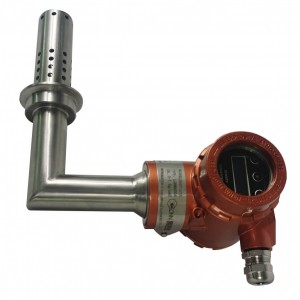
Benefits of Inline Emulsion Viscometer (Lonnmeter) for Emulsion Manufacturers
For process optimization departments and engineers, the Lonnmeter delivers tangible, quantifiable benefits that directly improve quality, efficiency, and cost-effectiveness— all centered on precise emulsion viscosity control:
Emulsion-Specific Adaptability
- Handles Non-Newtonian Fluids: By shearing the emulsion at in-line shear rates, it provides accurate oil water emulsion viscosity readings that match real production conditions— not just lab settings.
- Resists Harsh Conditions: 316 stainless steel, IP68 protection, and high-temperature/pressure tolerance mean it works reliably in all emulsion manufacturing environments, from food processing (clean-in-place requirements) to petrochemicals (explosive atmospheres).
- Eliminates Batch Waste: Immediate viscosity readings let operators adjust parameters (e.g., emulsifier dosage, shear rate) in seconds— before non-conforming emulsion is produced.
- Ensures Consistency: ±1% repeatability means every batch has the same viscosity emulsion, reducing customer complaints and rework.
- Reduces Manual Labor: No more manual sampling or lab analysis— freeing up technicians for higher-value tasks.
- Automates Process Adjustments: Integrates with PLCs to automatically tweak parameters (e.g., increase homogenizer pressure if viscosity drops)— minimizing human error and ensuring 24/7 consistency.
- Logs Viscosity Data: Modbus output stores emulsion viscosity and temperature data, which is critical for regulatory compliance (e.g., FDA requirements for pharmaceutical emulsions) or root-cause analysis (e.g., tracking why viscosity spiked last shift).
- Triggers Alarms: Immediate alarms alert operators to out-of-spec viscosity, preventing costly downtime or batch failures.
Real-Time Quality Control
Operational Efficiency
Data Traceability and Compliance
If your emulsion manufacturing team is ready to move from reactive to proactive emulsion viscosity control— and reduce waste, improve quality, and boost efficiency— it’s time to request a quote for the Lonnmeter in-line emulsion viscometer. Request your quote today to start optimizing your emulsion formulation quality control— and get the consistent oil water emulsion viscosity your customers expect.


