

Accurate zinc solution density measurement is essential to galvanizing bath quality control. It anchors real-time zinc bath monitoring and ongoing process optimization. In situ measurement techniques—including ultrasonic density meters for zinc bath, like the Lonnmeter—allow operators to monitor density as plating occurs, adjusting inputs and preventing faults before they impair coating outcomes. This approach supports both galvanized bath process optimization and regulatory compliance, reducing waste and minimizing rejected parts.
Importance of Zinc Solution Density in Electrolytic Bath Galvanizing
Solution density in a galvanizing zinc bath directly shapes key outcomes of the zinc plating process, affecting plating uniformity, adhesion, and corrosion resistance. Electrolytic bath galvanizing relies on a liquid electrolyte rich with zinc ions. The concentration—or density—of these ions determines how zinc is deposited onto metal surfaces and, ultimately, the quality of protection achieved.
Research shows that optimal bath density enables consistent coating thickness and surface uniformity. For example, increasing zinc ion concentration may produce thicker layers if plating time and current density are managed carefully. However, excessive solution density raises viscosity, reducing ion mobility and mass transport. This can slow down zinc deposition and foster porous, irregular coatings—outcomes that undermine both adhesion and corrosion resistance. Studies with acidified zinc sulfate baths found that extremely high densities, especially combined with high current, cause side reactions such as hydrogen evolution and poor leveling. The result: diminished mechanical integrity and a reduction in protective properties of the coating.

Galvanizing Zinc Bath
*
Maintaining correct zinc bath density is pivotal for process efficiency and plating quality. Precisely controlled electrolyte composition ensures maximum current efficiency—a measurement of how much electrical energy actually converts into useful zinc deposition versus energy lost to side reactions. High density may seem beneficial in theory, since it supplants more zinc ions for plating. In practice, though, excessive density often introduces viscosity-mediated inefficiencies and process instability. As current density increases, the plating efficiency may at first improve but will eventually plateau or decline if solution density is too high.
In summary, zinc solution density measurement is at the heart of electrolytic galvanizing bath management. It drives uniformity, adhesion, and corrosion resistance, impacting nearly every aspect of zinc plating bath quality and efficiency. Only through careful, accurate monitoring and control of bath density can the desired protective and mechanical properties of galvanized coatings be reliably achieved.
Core Concepts of In Situ Measurement in Zinc Bath Galvanizing
In situ measurement in the context of zinc bath galvanizing refers to the direct, continuous determination of bath conditions—such as zinc solution density—without the need for sample withdrawal or laboratory analysis. This technique operates at the heart of the zinc plating process, providing live, precise insights into the zinc bath galvanizing environment, even amidst demanding operational parameters typical of an electrolytic bath galvanizing line.
Distinction from Conventional Sampling and Laboratory Analysis
Traditional approaches to zinc plating bath quality control involve periodically extracting bath samples and analyzing them in off-line laboratories. This method suffers from key limitations:
- Sampling can disrupt bath conditions and introduce contamination risk.
- Lab analysis is slow, often requiring hours for results, which delays process adjustments.
- Infrequent measurement intervals may allow quality drift between samples.
- Temperature corrections and human error are persistently problematic.
By contrast, in situ zinc solution density measurement techniques—such as ultrasonic density meter for zinc bath and ultrasonic measurement of plating baths—eliminate sampling delays and the need for temperature adjustments. Data is collected continuously, directly in the galvanizing zinc bath, ensuring measurement accuracy aligns with real-time bath conditions. This distinction translates to a step-change in responsiveness and bath representativity, avoiding pitfalls of lab-based methods.
Benefits of In Situ Measurement
Real-time zinc bath monitoring enhances bath process optimization by delivering actionable data without delay. Operators can instantly track zinc concentration, dross levels, or contamination throughout the zinc plating process. The galvanizing bath’s stability dramatically improves due to the following factors:
- Immediate identification of out-of-spec conditions enables instant process corrections—preventing defective coatings and excessive dross.
- Automated feedback mechanisms maintain chemical control; for example, indicating exactly when a cleaning cycle completes based on dross transformation signals.
- Constant monitoring ensures the zinc solution density is kept within optimal parameters, limiting reagent and energy waste and promoting sustainable operations.
Integrated analyzers and in situ density measurement techniques reduce the need for operator intervention. This automation supports continuous productivity, higher safety, and tighter quality control in the galvanizing zinc bath environment.
The move toward real-time, automated in situ measurements—the core of modern galvanizing bath quality control—makes it possible to sustain high coating quality, minimize production losses, and streamline bath chemistry management—benefits not achievable through standard laboratory sampling and analysis procedures.
The use of tools such as Lonnmeter exemplifies this shift, allowing for direct, reliable ultrasonic density measurement of plating baths while delivering data essential for round-the-clock zinc bath process optimization.

Zinc Plating Bath Composition and Process Variables
Zinc plating baths are built on three primary chemistries: acidic (such as zinc sulfate or chloride), alkaline (typically cyanide-free zincate systems), and cyanide-based solutions. Each chemistry presents distinct advantages and operational challenges.
Acidic Zinc Baths
Acid baths, mostly sulfate or chloride-based, deliver high current efficiency and fine-grained, bright deposits. They excel in automated, high-throughput environments, producing uniform coatings on steel substrates. Yet, tight control over zinc and acid concentration is crucial; insufficient zinc leads to a rough, porous coating, while excessive levels slow deposition, degrade grain shape, and harm corrosion resistance. Additives—including brighteners and levelers—are central here for maintaining gloss and surface leveling. Rapid hydrogen evolution is a downside, demanding careful agitation and temperature management.
Alkaline Zinc Baths (Cyanide-Free)
Alkaline zincate solutions provide more ductile and adherent deposits. These baths are valued for their forgiving nature regarding substrate impurities and their superior throwing power—key when plating complex geometries. Brightness and grain refinement depend on carefully tuned organic additives: carriers, boosters, brighteners, and levelers work in synergy for mirror-like finishes. Lower booster concentrations yield more reflective deposits, while improper balance can result in dull, uneven layers. Environmental and regulatory shifts are making cyanide-free alkaline baths the standard, but they require vigilant control of additive concentration and pH.
Cyanide-Based Zinc Baths
Despite historic popularity and effectiveness on difficult substrates, cyanide baths are swiftly being replaced due to extremetoxicity and regulatory concerns. These baths yield highly uniform, adherent coatings and excel at covering complex shapes, but severe health and compliance risks limit their use. Contemporary research and industrial practice increasingly favor acid or alkaline systems with advanced additive engineering.
Critical Process Variables
Achieving optimal results in the zinc plating process depends on tight control of several critical process variables:
- Concentration: Zinc ion concentration directly impacts coating thickness, morphology, and adhesion. In acid baths, improper concentration can introduce roughness or lower deposition rates. In alkaline systems, concentration affects both uniformity and reflectivity. Real-time zinc solution density measurement using ultrasonic density meters—such as Lonnmeter—offers in situ bath monitoring for maintaining target concentrations and bath quality. This enables rapid detection of deviations and enhances process reproducibility.
- Temperature: Operating within 40–50 °C ranges delivers smooth, even coatings; higher temperatures speed grain growth but risk coarse, brittle deposits and diminished corrosion resistance. Electroplating efficiency stays above 95% in the common range, but surface quality shifts markedly with temperature changes.
- Agitation: Bath agitation ensures homogeneity and consistent ion distribution. Effective agitation prevents gradients that can cause defects or uneven deposits.
- Additives: The mixture and proportion of organic additives—carriers, boosters, brighteners, levelers—are decisive in achieving desired grain structure, adhesion, and shiny surfaces. Techniques such as voltammetric analysis allow accurate in situ measurement of additive levels, supporting galvanizing bath quality control and optimized outcomes.
Influence of Electrolyte Composition on Coating Features
Electrolyte composition fundamentally dictates coating thickness, surface leveling, adhesion, and quality in the zinc plating process. Acidic baths yield fine-grained, glossy layers when concentration and additives are balanced. Alkaline baths give tougher, more ductile coatings, with superior thickness distribution on nonstandard shapes. Cyanide baths—while now rare—offered top-tier adherence and coverage, especially in challenging geometries.
Additive systems tailored to bath chemistry control grain size and deposit brightness. For example, in alkaline baths, adjusting carrier-booster synergy steers grain structure and surface reflectivity. Overly concentrated baths or poorly managed additives can lead to dense but brittle or uneven coatings, which decreases corrosion resistance and compromises mechanical properties.
Density Correlation to Bath Composition and Plating Results
Zinc plating bath density reflects both the electrolyte concentration and additive content. Bath density plays a pivotal role in determining the physical and functional characteristics of deposited zinc coatings. Thicker, more adherent coatings arise as bath density increases, but excessive density can reduce surface leveling and induce defects over time. Real-time zinc bath monitoring—particularly using ultrasonic measurement of plating baths—supports rapid process adjustments, keeping bath density within optimal ranges for target coating thickness and adhesion.
Experimental studies show measured coating thicknesses often exceed theoretical models, indicating complex bath-plating interactions not fully captured by traditional equations. Factorial design experiments affirm that both density and alloying (e.g., nickel content) significantly elevate coating performance, durability, and aesthetic qualities. Adapting in situ measurement techniques, such as those provided by Lonnmeter, ensures continuous improvement and process optimization in galvanizing zinc bath management.
In Situ Density Measurement Methods
Direct measurement of zinc solution density within a galvanizing zinc bath is crucial for real-time process control, enabling optimal bath chemistry and galvanizing bath quality control. In situ measurement techniques are favored for continuous monitoring and rapid response to bath condition changes during the zinc plating process.
Lonnmeter Ultrasonic Density Meter: Principles, Operation, and Accuracy
The Lonnmeter ultrasonic density meter measures zinc bath density by transmitting ultrasonic waves across the solution. The time-of-flight and attenuation of these pulses are correlated to the liquid’s density. Ultrasonic measurement of plating baths relies on the relationship between sound velocity and medium density, allowing for precise, non-invasive readings.
Operation involves a transducer assembly mounted directly on the bath, continuously sampling the zinc solution. The meter’s advanced algorithms translate ultrasonic pulse measurements into density values. In situ measurements definition requires on-site, real-time data collection without removing samples. Lonnmeter devices offer:
- Real-time zinc bath monitoring, providing constant feedback for process optimization.
- Rapid response capabilities; density readings update within seconds.
- Accuracy generally within ±0.001 g/cm³ for zinc solutions, though final precision depends on calibration and bath conditions.
Compared to manual methods, the ultrasonic density meter for zinc bath minimizes labor and risk of contamination or sample error, supporting consistent electrolytic bath galvanizing outcomes.
Comparison to Indirect Methods: Hydrometer, Sample Withdrawal, Titration
Traditional indirect zinc solution density measurement involves physical sampling and subsequent lab analysis. Common practices include:
- Hydrometer: Uses buoyancy principles to estimate density. Sensitivity limited by temperature fluctuations and bath contaminants. Readings are not continuous and may lag behind actual bath changes.
- Sample Withdrawal: Involves extracting bath fluid, typically followed by weighing or volumetric analysis. Risks sample contamination and may be affected by stratification in the zinc bath galvanizing tank.
- Titration: Estimates zinc ion concentration but does not directly yield solution density. Requires chemical reagents, skilled operators, and periodic sampling. Time lag can impact process control.
Indirect approaches require manual intervention, increasing downtime and reducing responsiveness to bath composition changes. Real-time, in situ density measurement techniques such as Lonnmeter ultrasonic meters overcome these limitations, offering continuous and direct feedback for bath process optimization.
Installation and Integration for Continuous Bath Analysis
Proper installation is critical for reliable ultrasonic measurement of plating baths. Key steps and considerations include:
- Place Lonnmeter sensors away from air bubbles and turbulence. Avoid high points or immediate post-inlet/outlet installation, as these interfere with accurate readings.
- Ensure sufficient straight lengths of piping both upstream and downstream for stable flow profiles where the meter is mounted.
- Clean and smooth pipe or bath surfaces minimize signal loss. Avoid regions with scaling or corrosion.
- Align transducers using “V” or “Z” configurations for optimal wave propagation. Position sensors on the side of horizontal pipes to reduce errors from bubbles or sediment.
- Implement robust grounding and shielding for the transducer and electronics, especially in metallic installations, to prevent electrical noise from affecting ultrasonic pulse measurement.
- Configure sensor settings with correct bath and vessel parameters, including diameter, wall thickness, and material properties.
- Use built-in diagnostics to verify installation quality, identifying signal loss, error codes, or abnormal readings.
Continuous integration of Lonnmeter ultrasonic density meters enables uninterrupted zinc bath process optimization and galvanizing bath quality control, exploiting in situ measurement techniques for best results.
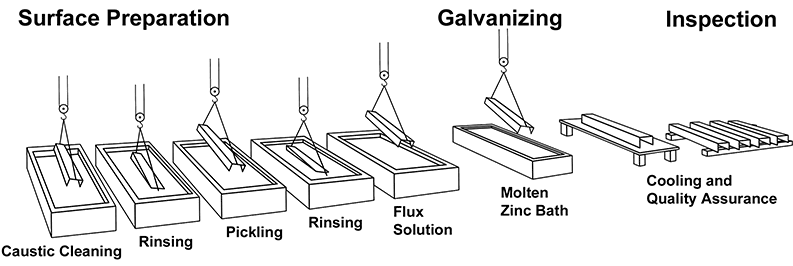
Galvanizing Process
*
Practical Applications of In Situ Measurements in Process Control
Real-time, in situ measurement techniques—especially ultrasonic density meters—are revolutionizing the zinc plating process. Monitoring zinc bath galvanizing density continuously allows for dynamic process adjustments, which are critical for high-quality results and efficiency.
Real-time Bath Adjustment for Maintaining Optimal Density
Using in situ measurement in galvanizing, operators can track density fluctuations in a galvanizing zinc bath with direct, ongoing feedback. Ultrasonic density meter for zinc bath installations, such as those from Lonnmeter, enable operators to correct bath composition immediately, maintaining the ideal density for uniform coating. For example, live density readings can trigger automated additions of zinc or aluminum into the bath, ensuring the solution remains within target specifications and preventing off-spec product runs.
Early Detection and Prevention of Process Deviations
Continuous in situ measurements definition includes catching deviations like dross formation and solution stratification before they impact product quality. Dross, or intermetallic buildup (notably η-Fe2Al5), manifests as density anomalies within the bath. In situ density measurement techniques pinpoint local dross accumulation early, particularly around equipment surfaces and roll grooves, which are linked to strip defects in finished steel products. Similarly, solution stratification—layering caused by temperature or compositional gradients—alters bath density profiles detectably, signaling need for mixing or bath adjustment to restore homogeneity. Integration with process monitoring supports real-time alerts and mitigation, dramatically lowering defect rates and downtime.
Enhancing Quality Control Through Fast Response
Speed in recognizing and responding to density changes underpins effective zinc bath process optimization. As soon as real-time zinc bath monitoring detects density drift, operators or automated systems can intervene, maintaining coating thickness and surface quality. For high-volume production lines—especially in automotive applications—these fast corrections ensure consistency and reduce rejected output. Continuous ultrasonic measurement of plating baths improves traceability and enables quick validation of the zinc plating bath’s condition, which is crucial for meeting tight quality standards.
Optimizing Electrolyte Replenishment and Energy Consumption
In situ density measurement provides vital input for optimal electrolyte replenishment strategies, essential for stable zinc plating bath operation. Density data direct the precise addition of electrolytes and control of additives, minimizing risks of dendrite formation and hydrogen evolution, which degrade interface stability. For example, continual monitoring allows for accurate dosing of substances such as Gly-Gly, which reinforce bath stability and extend operational cycles. Moreover, by keeping density consistently at target levels, energy consumption is reduced, as the electrochemical interface remains efficient and uniform. This translates into lower operational costs and improved sustainability of industrial galvanizing line.
Integration: Lonnmeter Ultrasonic Density Meters
Advanced ultrasonic ceramic sensors from Lonnmeter represent the benchmark for in situ measurement in galvanizing. Their real-time density readings empower automated control systems to make dynamic process adjustments. These sensors operate with high resistance to abrasion and chemical drift, ensuring consistent performance even in harsh industrial environments. Mounted directly in the zinc solution, Lonnmeter instruments feed density data to plant control systems, which automatically manipulate chemical dosing, temperature, or mixing rates. Such integration reliably upholds galvanizing bath quality control and sharply reduces the risk of manual errors, contributing to leaner, more resilient zinc plating process management.
Troubleshooting Bath Issues with Accurate Density Measurement
Bath instability, non-uniform zinc coatings, and excessive dross are persistent challenges in zinc plating processes. Accurate zinc solution density measurement—especially with in situ density measurement techniques—enables real-time diagnosis and correction.
Bath instability in galvanizing zinc baths often manifests as fluctuating coating quality, increased additive consumption, or abnormal bath growth. Causes include uncontrolled zinc concentration, uneven anode dissolution, poor rinsing, and contamination by iron or other impurities. Excessive reliance on anode surface area, rather than direct zinc solution density measurement, frequently leads to zinc metal build-up, requiring costly corrective actions and risking fogging or deposit defects. Using ultrasonic density meter technology, such as Lonnmeter, operators gain precise, in situ measurement in galvanizing, allowing for immediate feedback and corrective intervention.
Non-uniform zinc coatings are closely linked to variations in zinc bath galvanizing composition. When density drops below optimal, electric field and ion concentration gradients may develop, resulting in patchy or rough layers. Real-time zinc bath monitoring quantifies local bath density, helping correlate uniformity problems to solution variations. For instance, integrating in situ measurements definition with electrochemical bath analysis reveals whether a drop in density arises from additive depletion, drag-in from rinses, or structural changes. By tightening process controls with ultrasonic measurement of plating baths, improvements in coating smoothness and thickness can be achieved, especially when combined with additives like quaternary ammonium salts or nano-SiO2 for grain refinement.
Excessive dross formation, a key concern in galvanizing bath quality control, commonly results from density-driven precipitation of zinc-iron-aluminum intermetallic compounds. When bath density is not sufficiently controlled—especially in hot-dip techniques—localized density gradients can form near critical equipment, accelerating dross build-up and causing operational disruptions. Ultrasonic density meter for zinc bath readings highlight areas of density alteration, often correlating with regions of fluid stagnation or inadequate temperature management. By monitoring zinc solution density alongside temperature and concentration, it is possible to optimize the bath to reduce dross production. Recent process models using coupled density and fluid dynamics data confirm that raising aluminum concentration can further minimize dross—crucial for bath process optimization.
Integrating bath density data with other process controls transforms traditional troubleshooting. By synchronizing zinc bath density, temperature, and electrolytic bath galvanizing composition, systems detect instability triggers early. For example, combining ultrasonic readings from a Lonnmeter with direct chemical analysis and temperature profiles creates a comprehensive monitoring dashboard. This integration supports prompt adjustment of wetting agents, evaporators, and electrical parameters, resulting in stable, high-quality coatings without excessive additive use. In chemical bath deposition processes, this synergy ensures optimal thin film growth and corrosion resistance, as supported by industrial trials of model-driven integration.
In summary, the zinc plating process benefits from dense, real-time monitoring of bath parameters. Tools like in situ density measurement, ultrasonic sensors, and integrated process data deliver actionable insights for troubleshooting non-uniform deposits, minimizing dross, and maintaining stable, efficient zinc baths.
Quality Assurance in Zinc Plating Process
Ensuring high quality in the zinc plating process hinges on precise control and verification of the zinc bath density. This parameter directly affects coating thickness, adhesion, and ultimately, the long-term corrosion protection delivered by the galvanized layer.
Techniques for Verifying Process Outcomes Related to Bath Density
Accurate measurement of bath density using in situ density measurement techniques is integral for process quality. Real-time zinc bath monitoring—often accomplished by ultrasonic density meter for zinc bath or inline X-ray fluorescence (XRF)—offers critical data on solution consistency throughout plating operations. These technologies allow operators to correlate bath composition with critical product parameters:
- Coating Thickness: Measurement methods such as microscopy and XRF quantify the zinc layer applied to substrates. An optimized zinc solution density ensures the desired coating thickness is achieved, minimizing defects linked to under- or over-coating. For instance, increased zinc ion concentration in the bath has been shown to consistently produce thicker, more uniform protective layers when temperature and plating time are tightly controlled.
- Adhesion: Verifying coating adhesion draws on standardized bend, tape (ASTM D3359), and scratch tests, which probe the bond between zinc coating and underlying steel. Dense, homogenous deposits—typical of an optimally controlled zinc plating bath—exhibit strong adhesion and meet strict industrial benchmarks. Poor bath density control can lead to rough, brittle coatings with compromised adherence, detected reliably using these methods.
Use of Density Data in Quality Documentation and Process Audits
Zinc solution density measurement forms the backbone of process records required for galvanizing bath quality control. Data collected from in situ measurement in galvanizing enables thorough documentation of every production batch. This includes:
- Routine Logging: Systematic recording of bath density values alongside process parameters (temperature, current density, alloying additions).
- Traceability: These records support traceability—key for customer specifications, regulatory compliance, and internal audits. Reliable instruments such as Lonnmeter ensure data accuracy and integrity.
- Audit Readiness: Quality audits leverage bath density documentation to verify process consistency, validate coating properties, and confirm adherence to established standards. Inconsistencies can be traced to specific density deviations, facilitating corrective action.
Linking Solution Density to Long-Term Corrosion Resistance and Coating Performance
The zinc bath galvanizing process relies on carefully tailored bath density to guarantee corrosion resistance and overall coating performance. Empirical studies link increased bath density—managed through controlled zinc ion concentration and additives—to:
- Enhanced Corrosion Protection: Thicker, denser zinc layers demonstrate superior resistance in accelerated exposure tests. However, excessive density may cause rough surfaces, so optimal control is essential.
- Mechanical Reliability: Uniform coatings, produced via real-time bath optimization, resist cracking and peeling, maintaining protection in demanding environments.
- Process Optimization: Adjustments in electrolytic bath galvanizing density, captured through in situ measurements definition, are directly related to improvements in coating longevity and resistance to chemical attack. Alloyed systems (e.g., zinc-nickel) further refine durability when bath composition is precisely managed.
In summary, comprehensive zinc solution density measurement, coupled with robust verification and documentation practices, secures coating performance for galvanized steel and ensures success in quality control and process audits.
Tools and Technologies for Zinc Solution Density Measurement
Modern zinc bath galvanizing calls for precise zinc solution density measurement to maintain optimal process parameters and ensure coating quality. Several instruments and sensor techniques are employed, each with distinct operational principles, strengths, and limitations.
Advanced Instruments for Zinc Solution Density Measurement
Lonnmeter Ultrasonic Density Meter
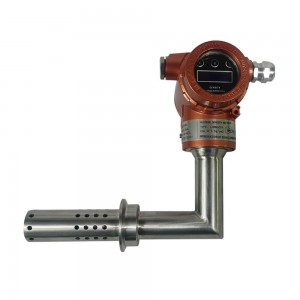
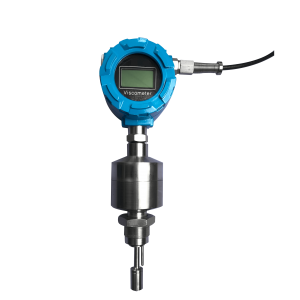
The Lonnmeter ultrasonic density meter is engineered for in situ measurement in galvanizing. It utilizes ultrasonic waves, measuring their speed and attenuation as they pass through the zinc bath. The instrument provides continuous, real-time zinc bath monitoring, making it suitable for automated process environments. It is non-invasive, meaning no direct contact with the solution is needed, reducing risk of contamination or wear. The device is designed to operate reliably under the high temperatures and corrosive conditions found in electrolytic bath galvanizing.
Other Available Sensor Technologies
- Capacitive Sensors: Measure changes in capacitance in response to solution density and ionic concentration. These sensors are compact, can be installed inline, and provide rapid feedback. Often used in hybrid density measurement systems for greater accuracy.
- Hydrometers: Manual devices that exploit buoyancy for density measurement. Hydrometers require sample extraction and manual reading, making them less suited for real-time or automated applications.
- Titration Methods: Laboratory-based analysis of zinc plating bath density through chemical reaction quantification. High accuracy, but labor-intensive and not suitable for process optimization or real-time adjustments.
Pros and Cons of Density Measurement Approaches
Ultrasonic Measurement (e.g., Lonnmeter):
- Pros:
- Enables real-time, in situ density measurement techniques.
- Compatible with SCADA systems for automated galvanizing bath quality control.
- Handles extreme temperature and corrosive environments.
- No radiation hazards; non-contact operation minimizes risk of fouling or damage.
- Precision can reach uncertainties down to 1% or better, with hybrid models offering up to 0.1% accuracy in zinc bath process optimization scenarios.
- Cons:
- Initial installation cost is higher than traditional sensors.
- Sensitive to changes in bath phase (e.g., heavy turbulence or gas bubbles may affect readings).
- Requires periodic calibration and thorough cleaning.
Capacitive Sensors:
- Pros:
- Good for rapid measurement of ionic solutions.
- Small-format, scalable for distributed sensor networks.
- Effective for high-speed concentration monitoring.
- Cons:
- Can be prone to electrode fouling, especially in heavily contaminated or variable chemistry baths.
- Requires frequent baseline recalibration to maintain accuracy.
Hydrometers and Titration Methods:
- Pros (Hydrometers):
- Simple construction, easily available for laboratory checks.
- Cons (Hydrometers):
- Manual operation only; not suitable for zinc bath process optimization.
- Susceptible to human error and environmental variation.
- Pros (Titration):
- High chemical specificity and accuracy for lab validation.
- Cons (Titration):
- Sample extraction required.
- Slow, labor-intensive—unsuited for real-time zinc bath galvanizing control.
Selecting the Right Density Measurement Technology
Choosing a density measurement technique for the zinc plating process should account for several factors:
Bath Chemistry:
Highly acidic or alkaline electrolytic bath galvanizing environments demand sensors built from corrosion-resistant alloys or engineered polymers. For example, ultrasonic probes with plasma-functionalized coatings survive longer in aggressive solutions.
Operational Environment:
In situ measurements definition hinges on sensors’ ability to remain functional within the process stream. Non-invasive ultrasonic meters like Lonnmeter minimize downtime and contamination. For multi-bath setups, capacitive sensors offer installation flexibility but may need protective housings.
Required Precision:
For automated, real-time galvanizing bath quality control, ultrasonic density meter for zinc bath outperforms hydrometers and titration methods. Hybrid systems using both ultrasonic and capacitive sensors provide the highest accuracy and resilience to drift. Manual measurement approaches remain useful for laboratory validation, troubleshooting, or periodic benchmarking.
Example Scenario:
In a continuous zinc bath galvanizing line that utilizes SCADA-based real-time zinc bath monitoring, an integrated Lonnmeter ultrasonic density meter is preferred due to its accuracy, automation compatibility, and corrosion-resistant construction. Conversely, a batch-based plating process with frequent solution changes might employ hydrometers for periodic checks, supporting but not replacing the automation enabled by advanced sensors.
Summary Table of Sensor Selection Criteria:
| Technology | Bath Compatibility | Precision | Automation Suitability | Maintenance Needs |
| Ultrasonic (Lonnmeter) | Excellent | High | Yes | Moderate |
| Capacitive | Good | Medium-High | Yes | High |
| Hydrometer | Fair | Low | No | Low |
| Titration | Variable | High | No | High |
Robust sensor selection and deployment underpin reliable zinc solution density measurement and support consistent process performance for the zinc plating bath and galvanizing zinc bath operations.






Frequently Asked Questions
What is in situ measurement in the context of zinc plating baths?
In situ measurement means monitoring the zinc plating bath’s properties, like solution density, directly during production—no sample removal needed. Operators track and control bath characteristics in real time, maintaining precision without interrupting the zinc plating process. This direct approach allows for rapid adjustments, supporting zinc bath process optimization and improving galvanizing bath quality control. In situ measurement techniques—including ultrasonic testing and online XRF analysis—are increasingly preferred for higher speed and reliability compared to traditional, off-site laboratory methods. For example, ultrasonic immersion sensors have demonstrated continuous, sub-micron resolution measurements, capturing dynamic changes in bath properties and plating kinetics during operation.
Why is solution density critical for galvanizing zinc bath quality?
Correct solution density in the galvanizing zinc bath is essential for successful zinc plating process results. Density controls the electrolyte’s composition and, in turn, influences how the zinc coating forms on the steel substrate. When solution density is managed precisely:
- Coating thickness remains uniform across products.
- Adhesion quality is consistent, avoiding common plating issues.
- Corrosion resistance meets standard requirements for industrial applications.
If solution density drifts from optimal values, defects such as dross formation, poor adhesion, and irregular coating thickness can occur. Maintaining the right bath density also makes chemical dosing and alloying (with additives like aluminum) efficient, optimizing zinc consumption and reducing waste through electrolytic bath galvanizing. Continuous monitoring and quick correction of density help ensure product quality and bath stability.
How does the Lonnmeter ultrasonic density meter work in zinc solution density measurement?
The Lonnmeter ultrasonic density meter accurately measures zinc solution density using the principle of sound wave propagation. The device emits ultrasonic pulses through the galvanizing zinc bath; the velocity and attenuation of these waves depend on the medium’s density. By analyzing changes in sound wave behavior, the instrument calculates the exact solution density in real time. This real-time zinc bath monitoring facilitates automated quality control and immediate process adjustments. Such ultrasonic measurement of plating baths delivers high repeatability, and is tailored for both continuous and batch zinc bath galvanizing operations.
Can in situ measurements prevent common plating issues?
Yes—incorporating in situ density measurement techniques allows swift identification and correction of bath parameter deviations that cause plating defects. Operators respond in real time to density fluctuations, preventing problems such as:
- Dross formation caused by excessive dissolved impurities.
- Uneven coatings from inconsistent solution composition.
- Instability in the bath due to temperature or chemical changes.
Process analyzers like ultrasonic density meters and online XRF devices enable this level of control, improving the reliability of the zinc bath and safeguarding coating quality. Case studies in automotive and marine sectors confirm that real-time monitoring slashes the occurrence of plating defects, boosts corrosion resistance, and minimizes costly rework.
How often should zinc plating bath density be monitored?
For high-volume or critical production, continuous in situ density monitoring using devices such as the Lonnmeter ultrasonic density meter is ideal. This ensures that all fluctuations are detected and corrected instantly. Where continuous monitoring isn’t feasible, regular measurement intervals—either manual or automated—are recommended. Frequency should match the intensity of production, bath size, and required product quality. Automated measurement systems integrated with plant controls can handle frequent checks, while periodic manual checks may suffice for smaller operations, provided controls remain tight to maintain bath and product stability.
Post time: Dec-03-2025


