

Level Measurement: Contact vs Non-Contact
Level measurement instruments divide roughly into two groups. Contact instruments touch the liquid. Float switches and conductivity probes are in this group. Non-contact instruments measure the level from above the liquid without touching it. Ultrasonic sensors and radar instruments are in this group.
This distinction matters more than it sounds. Contact instruments are simpler and cheaper, but they can fail in dirty liquids, get coated by sticky products, or be damaged by corrosive fluids. Non-contact instruments avoid those problems but cost more and can have issues with foam, vapors, or turbulence.
Between float switches and ultrasonic sensors, the choice comes down to what you are measuring, how accurate you need to be, and how much you want to spend.
Float Level Switches: Simple and Reliable
A float switch works exactly the way it sounds. A buoyant object floats on the liquid surface. As the level rises and falls, the float moves. Inside the float, a switch (usually a reed switch) opens or closes when the float tilts past a certain angle.
The simplicity is the main advantage. There are no electronics in contact with the liquid. The switch signal is a simple on/off dry contact. It works with any controller, any PLC, any relay. And it costs a fraction of an ultrasonic sensor.
Float switches work best in clean, low-viscosity liquids. Water, diesel, hydraulic oil — liquids that do not coat or corrode the float. If the liquid is viscous enough to stick to the float, the switch sticks. If the liquid is acidic or caustic enough to corrode the 316SS or Hastelloy float, it fails.
They are also sensitive to turbulence. In a tank with a high-fill inlet or an agitator, the float bobs around. It may trigger false alarms or chatter between on and off states. For those applications, a stilling well — a vertical pipe around the float — dampens the turbulence.
Ultrasonic Level Sensors: Continuous and Non-Contact
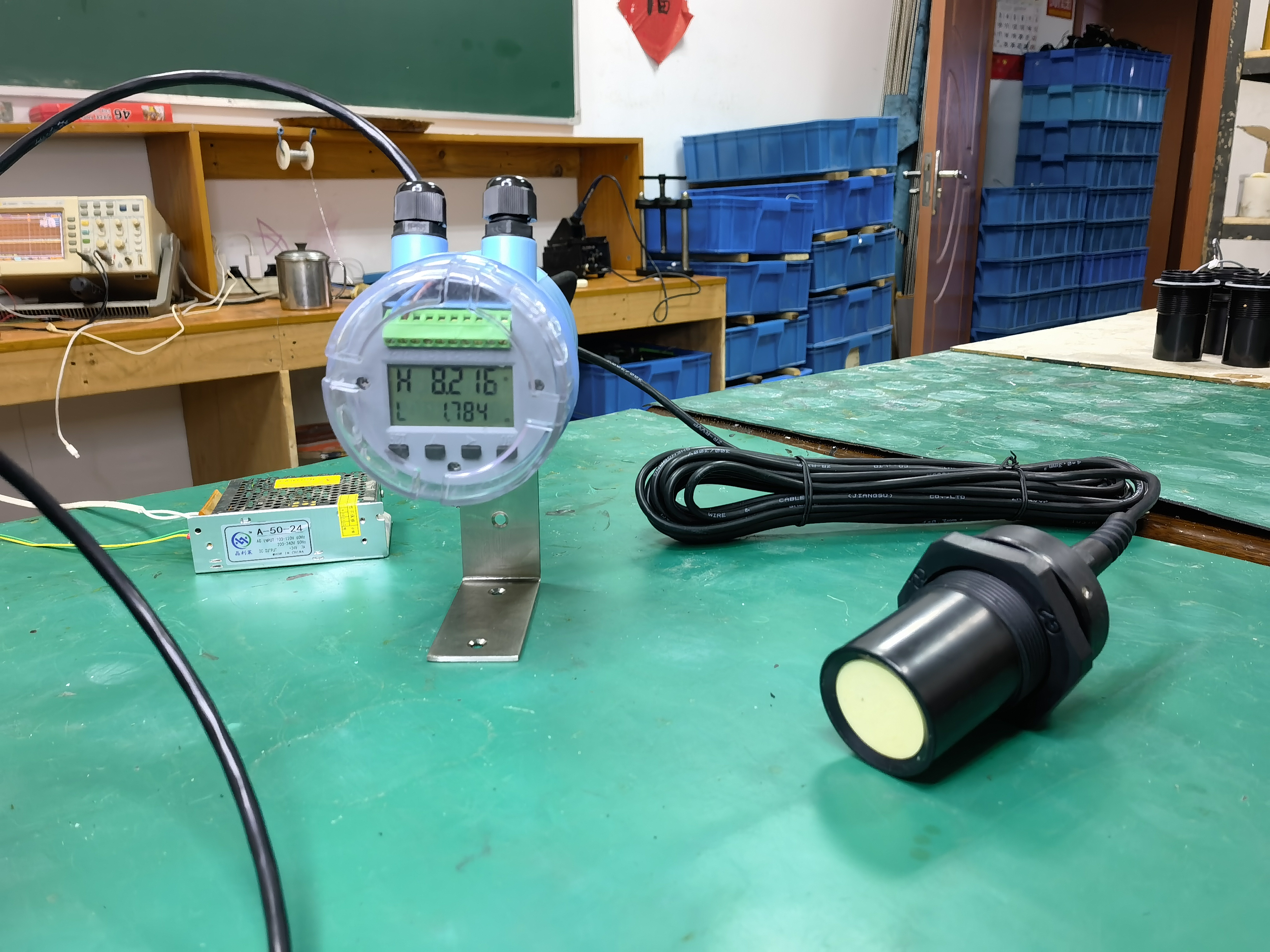
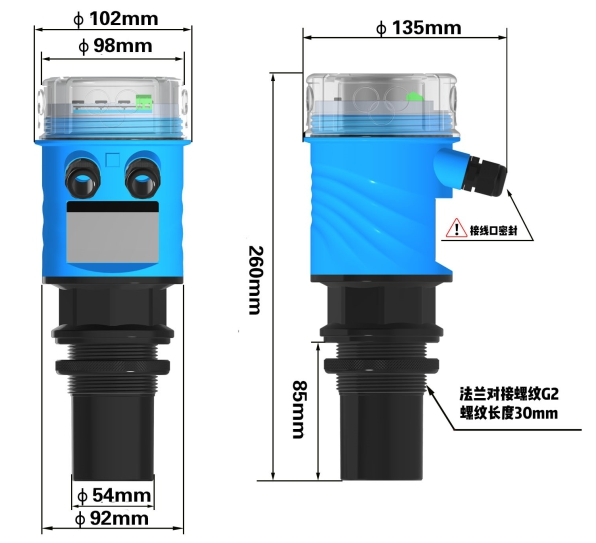
An ultrasonic sensor mounted above the tank emits a pulse of sound. The pulse travels down to the liquid surface, reflects, and returns to the sensor. The instrument measures the travel time and converts it to distance, then to level.
The main advantage is that it gives you a continuous reading, not just a switch point. You know the actual level at all times, not just whether it is above or below one height. That is useful for inventory monitoring, overfill prevention, and any process where level drives a proportional control action.
The sensor never touches the liquid, so there is nothing to corrode, coat, or get stuck. It works in tanks that are hard to access, in aggressive chemicals where no float material would survive, and in food products where hygiene standards rule out internal instruments.
The accuracy is typically ±0.25% to ±0.5% of the measuring range. For a 3-meter tank, that is ±7.5 to ±15 mm. Most tank gauging applications do not need better than that.
Quick Comparison
|
Factor |
Float Level Switch |
Ultrasonic Level Sensor |
Pick This When |
|
Output |
On/off switch point |
Continuous level (4-20mA / Modbus) |
Continuous monitoring needed |
|
Accuracy |
N/A (binary) |
±0.25 – 0.5% of range |
Accuracy matters |
|
Liquid type |
Clean, low viscosity |
Most liquids, check for foam/vapor |
Dirty or corrosive liquid |
|
Cost |
Lower ($50 – $300) |
Higher ($400 – $2,000+) |
Budget constrained, simple alarm |
|
Maintenance |
Simple but can foul |
Low (no wetted parts) |
Low maintenance priority |
|
Tank access |
Requires tank penetration |
Top-mount only, no tank intrusion |
No tank modification wanted |
Where Each One Wins in Practice
Use a float switch for high and low level alarms in clean water tanks, diesel day tanks, hydraulic oil reservoirs, and sumps. If you need two alarm points (high-high and low-low), two float switches at different heights solve that cheaply.
Use an ultrasonic sensor for continuous inventory measurement, overfill prevention at loading racks, tank farm gauging, and anywhere the liquid is too aggressive for a float or the tank cannot be easily penetrated.
In many plants, the answer is both: float switches for critical high-high and low-low alarms (as a backup safety layer) and an ultrasonic sensor for continuous monitoring. The float switch is the last line of defense. The ultrasonic gives you the operational data.
Frequently Asked Questions About Level Measurement
Q: Can ultrasonic sensors work in tanks with foam on the surface?
A: Foam attenuates the ultrasonic signal and can cause false readings or no readings at all. For tanks with significant foam, consider guided wave radar instead of ultrasonic. Guided wave radar sends the signal along a probe that extends into the liquid, and it handles foam much better.
Q: What happens to an ultrasonic sensor in a tank with heavy vapor?
A: Heavy vapor, especially steam, refracts the ultrasonic pulse and causes errors. In steam-raising tanks or vessels with significant vapor space, ultrasonic is not the right choice. Guided wave radar or a differential pressure transmitter handles vapor better.
Q: My tank has an agitator. Will turbulence interfere with a float switch?
A: Probably. An agitator creates surface turbulence that makes the float bob and chatter. The standard fix is a stilling well — a vertical pipe around the float that dampens the wave action. Alternatively, switch to an ultrasonic sensor or a guided wave radar which are unaffected by surface conditions.
Q: Do float switches need calibration?
A: Float switches are not calibrated in the traditional sense. The switch point is set by the physical position of the float in the tank. Once installed, you verify that it actuates at the correct level by checking the on/off signal against a reference measurement (a dip tape or a sight glass). After that, periodic functional testing is all that is needed.
Post time: Jul-08-2026


