

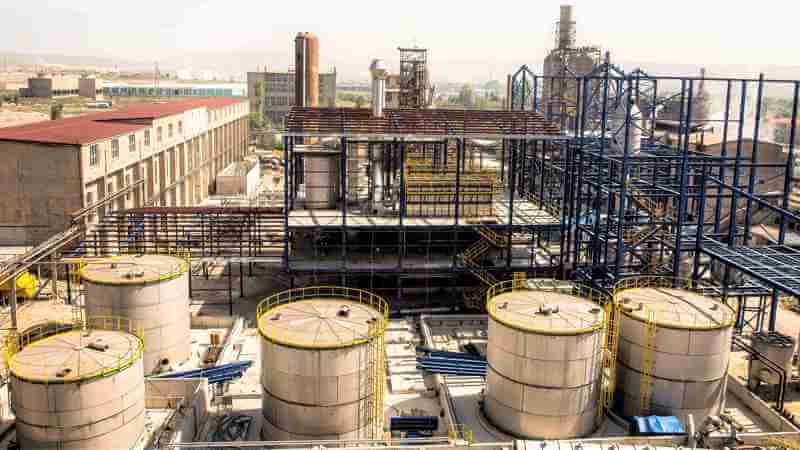
A storage tank is a quiet liability. It sits there full of diesel, caustic, or finished water, and the moment nobody can tell how full it is, a transfer pump runs dry, a bund overflows, or a batch gets blended against the wrong inventory. We put ultrasonic level meters on tanks because the sensor never touches the product. That single fact — non-contact — decides where the technology wins and where it quietly fails.
I have commissioned ultrasonic level meters on API 650 crude tanks, on bunded diesel day tanks in generator rooms, on brewery hot liquor tanks, and on outdoor chemical bunds where the only access is a manhole and a wrench. The principle is the same every time. The traps are the same every time too. This note is the version I wish every plant engineer had before the first procurement call.
1. Why a tank calls for non-contact sensing
Contact probes — float, magnetostrictive, hydrostatic, guided radar — all sit inside the liquid or against the wall under it. That is fine until the liquid is sulfuric acid at sixty percent, or heated edible oil that cooks the seal, or a tank that gets steam-cleaned and floods the gauge head. Every contact method trades the sensor body against the medium. On a wine tank, an IBC tote of AdBlue or urea solution, a kerosene or bitumen tank, or a powder silo, the medium itself is the reason we reach for the roof-mounted head.
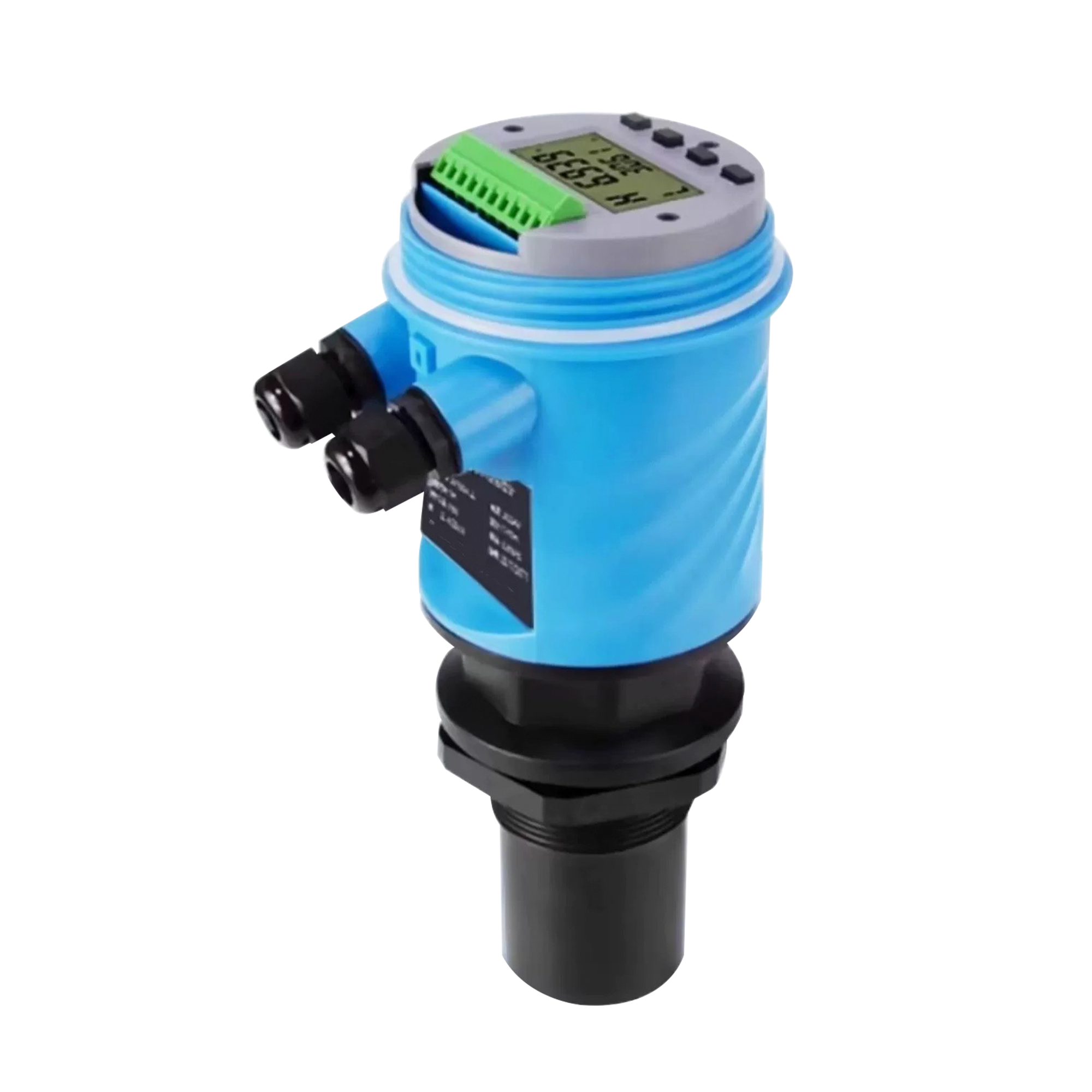
Ultrasonic avoids that trade. The transducer mounts on the tank roof and fires sound down through the vapor space. Nothing wets. Nothing corrodes. For a storage tank holding a hostile or food-grade product, that is often the only reason ultrasonic gets specified over a cheaper immersed sensor.
The cost is paid in the air gap. Sound has to travel through vapor, and vapor is not a stable medium. Temperature, steam, foam, and dust all live in that gap, and they are the real subject of this entire note.
2. The measurement, without the hand-waving
The meter measures time of flight. It sends a burst, the sound reflects off the liquid surface, and the echo returns. Distance to surface is half the round-trip time multiplied by the speed of sound in the gap:
where d is the path length from the transducer face to the surface, t is the round-trip time, and c is the speed of sound in the vapor. Level is then tank height minus d minus the transducer offset.
Here is the part that surprises buyers. c is not a constant. In air it is roughly:
At twenty degrees it is about 343 m/s. At zero it is about 331 m/s. A ten-degree swing moves the speed by six meters per second. On a six-meter tank, ignore that and you can be off by a quarter of a meter before the liquid moves at all. Every serious ultrasonic level meter carries a temperature sensor at the transducer and compensates c in firmware. A unit without temperature compensation is a toy, and we tell customers that plainly.
3. Reading the datasheet like a commissioning engineer
Spec sheets for ultrasonic level meters list a pile of numbers. These are the ones that decide whether the meter survives the tank:
| Parameter | What it really means | Typical value (LONN-ULM class) |
| Measuring range | Distance from face to far surface, before blind zone | 0.3 – 8 m (standard), up to 15 m on low-angle units |
| Blind zone | Nearest distance the sensor can see; surface inside it is invisible | 0.2 – 0.4 m depending on range |
| Accuracy | Usually % of full span, not % of reading | ±0.2 % to ±0.5 % F.S. |
| Resolution | Smallest detectable change | 1 mm |
| Beam angle | Half-angle of the cone; drives wall clearance | 4° – 12° |
| Process temperature | Ambient at the transducer, not the liquid | -20 to +60 °C (electronics limited) |
| Ingress protection | Head enclosure rating | IP67 or IP68 |
| Output | Signal and protocol | 4–20 mA + HART, or Modbus RTU |
The accuracy line is the one people misread. A ±0.5 % F.S. unit on an eight-meter span is ±40 mm at any level. On a small day tank that is a wide band. Buyers fixate on the percentage and forget it is of full span. We always ask for the actual span before quoting a number, because the same meter reads tighter on a two-meter tank than on an eight-meter one.
4. Temperature, vapor, and the speed-of-sound problem
We covered the formula. The field consequence is that the vapor gap must be characterized. On an outdoor diesel tank through a Gulf summer, the gap temperature swings thirty degrees between dawn and noon. Without compensation the reading walks. With compensation it holds.
Steam is worse than temperature. Above a hot liquor or cleaning tank, a fermentation vessel, or an asphalt tank, a layer of vapor sits under the roof. Sound slows and scatters in saturated vapor, and the echo can dissolve into noise. That is the classic failure we are called to fix: a brewery hot liquor tank or a caustic scrubber reads fine in the morning and drifts by lunch. The fix is rarely the meter. It is recognizing the gap is no longer air. Radar, which ignores vapor, is the right call there, and we say so rather than oversell ultrasonic.
Vacuum is the opposite wall. In a vacuum the speed of sound collapses toward zero and ultrasonic simply stops working. Any tank pulled under vacuum — distillation receivers, some pharmaceutical vessels — is a radar or hydrostatic job, never ultrasonic.
5. The blind zone and why it eats your low-level alarm
The transducer cannot hear a surface that is too close; the transmit pulse is still ringing when the near echo returns. That dead band is the blind zone, typically a few hundred millimeters.
Two mistakes repeat. One: the low-level alarm is set inside the blind zone, so the tank runs dry before the alarm can ever trip. Two: the meter is mounted on a shallow tank where the entire working range is inside the blind zone. A 0.3 m blind zone on a 1 m tank leaves 0.7 m of usable span and a useless low alarm.
We size the blind zone in first. If the low-level trip must sit at 0.4 m, the blind zone must be under 0.3 m and the tank must be tall enough that 0.4 m is genuinely reachable. On short tanks we move to a guided radar or a hydrostatic transmitter, because fighting the blind zone is fighting physics.
6. Beam angle, wall clearance, and the echo off the side
The sound leaves the transducer as a cone, not a pencil. The half-angle — beam angle — might be eight degrees on a tight unit or twelve on a wide one. At the liquid surface the cone has a diameter, and if the tank wall is inside that cone the sound bounces off the wall and returns a false echo.
The clearance math is simple and we run it on every quote:
On an eight-meter tank with a six-degree half-angle, clearance is tan(6°) × 8 ≈ 0.84 m. The meter must sit at least that far from any wall, ladder, or internal pipe. On a narrow vertical tank this rules ultrasonic out entirely, and the answer is a side-mounted hydrostatic or a smaller beam unit. We have lost jobs to this calculation. It is the honest way to lose them.
7. What the medium does to the echo
The liquid surface is the mirror. A calm, flat surface returns a clean echo. A boiling, agitated, or foaming surface scatters it.
- Still water, diesel, methanol, toluene, latex, solvents — clean reflection, ultrasonic’s home turf.
- Light foam — partial loss; many transmitters ride through with echo processing, but the reading gets soft near the surface.
- Dense stable foam — the sound reflects off the foam top, not the liquid, and the level reads high and lies; slurry and heavy sludge behave the same way. This is the single most common “defective meter” call we get, and the meter is usually fine.
- Aggressive chemicals — non-contact is the win; nothing touches the acid. But the vapor above sulfuric or caustic can attack the transducer face, so we spec a PTFE-faced head and warn against condensation pooling on it.
- LPG and light hydrocarbons — the surface is cold, the vapor is heavy, and acoustic coupling is poor. We treat these as radar or servo jobs unless the customer accepts limited accuracy.
- Acids, ammonia, molasses, wine, brine — hydrochloric and ammonia vapors attack almost any wetted part, so non-contact wins by default; wine and brine read clean when still, but molasses skins over and a false surface forms at the crust, which we handle by slowing the sample rate.
We tell customers the surface condition up front. A meter that reads foam is not broken; it is measuring the wrong interface.
8. Sizing math, worked
A plant asks for level on a vertical solvent tank. Given: tank height 6 m, lowest acceptable level 0.5 m above bottom, blind zone 0.3 m, beam half-angle 5°, surface can foam during transfer.
Usable span runs from the blind zone up to the tank top: 0.3 m to 6.0 m, so 5.7 m of measurable range. The low-level alarm at 0.5 m is inside the 0.3 m blind zone plus a thin margin — too close. We recommend raising the alarm to 0.6 m or dropping the blind zone with a closer-range model. Wall clearance is tan(5°) × 6 ≈ 0.53 m, so the nozzle must sit at least half a meter from any wall.
Because the surface foams during transfer, we set the transmitter to ignore near-surface echoes for the first two seconds after a transfer pump starts, then trust the settled reading. That is a configuration choice, not a hardware change, and it is in the commissioning report.
The point of the math is not the numbers. It is that range, blind zone, and beam angle are decided by the tank, not by the catalog. A meter sized to the catalog peak always fails at the low end.
9. Mounting that does not come back to bite you
Mount the transducer firing straight down. Any tilt throws the beam onto the wall. Use a stilling pipe only when the surface is violent — and note a stilling pipe narrows the beam and can trap vapor, so it is a trade, not a cure.
Keep the nozzle away from inlet streams. A fill line dumping into the cone creates a local splash that the meter reads as surface. We ask for offset from the inlet equal to the beam radius at that depth, which is usually half a meter or more on a tall tank.
Outdoor heads need sun and rain protection. Direct sun heats the transducer, shifts the local temperature reading, and ages the seal. A simple cover or a north-facing bracket fixes it. We have seen a meter read a steady two-centimeter drift on a sunny wall that vanished the day a cover went on.
10. Outputs, alarms, and the pump it controls
The 4–20 mA loop is still the workhorse: 4 mA at empty, 20 mA at full, HART on top for config. For a storage tank the loop usually drives a local indicator and a SCADA point. On a day tank it often runs a fill pump through a relay at the low and high set points.
We set the alarm points in the transmitter, not in the PLC, when the customer wants the pump to fail safe during a comms loss. A high-high trip that lives only in the controller is worthless when the network drops. Put the safety interlock in the field device. That is a lesson from a generator room where the SCADA link went down during a fuel transfer and the only thing that stopped the overflow was the relay wired to the meter.
Modbus RTU over RS485 is the alternative for plants that already speak it. We wire it when the customer’s historian expects registers, not a loop. Either way the device owns the alarm, not the network.
11. Calibration, proof, and the certificates
An ultrasonic level meter is calibrated against a known gap in the factory, not against a liquid. We verify the time-of-flight against a traceable distance on a test rig and confirm the temperature compensation across a temperature sweep. That is the whole calibration; there is no liquid to weigh.
For inventory and custody, the relevant marks are different. A tank gauge used for stock reconciliation may need OIML certification depending on the jurisdiction and the duty. A meter used in a hazardous area needs ATEX or IECEx for the head. Outdoor heads get IP68 and a CE mark. We list exactly which certificate applies to which configuration, because a customer who orders an ATEX head for a non-hazardous water tank paid for nothing, and a customer who skips it for a solvent bund failed the audit.
Our own bench does the distance and temperature proof. We do not buy a calibrated loop and trust the label. The bench is the reason we can promise the span accuracy we quote, and it is the part a trading company cannot show you.
12. Ultrasonic versus its brothers
A storage tank often suits more than one technology. The boundaries we draw with customers:
- Ultrasonic vs radar — radar ignores vapor, foam, and dust, and reaches farther, at a higher price. Ultrasonic wins on cost for clean-air tanks up to about fifteen meters. Above that, or under steam and foam, radar.
- Ultrasonic vs hydrostatic — hydrostatic reads true head pressure and is immune to surface conditions, but it wets the process and needs a stable density, which glycerol and silicone lines rarely give. Ultrasonic reads the surface and touches nothing. Food and aggressive chemical tanks favor ultrasonic; invoicing by weight favors hydrostatic.
- Ultrasonic vs float or magnetostrictive — those are cheap and simple but sit in the liquid and fail on coatings and corrosion. Non-contact is the argument.
We do not push ultrasonic into a radar tank. The honest boundary is the product.
13. What we actually build, and why it matters
The transducer is the meter. We mold our own piezoelectric element and match it to the front face, because a bought transducer sets the beam angle and the temperature drift we then have to live with. The temperature-compensation algorithm runs on our own firmware, tuned against our own test-rig sweep, not a generic curve.
The heads are assembled and proof-tested in-house, then burned in across a temperature cycle before release. A unit that drifts on the bench never reaches your tank. That is the vertical integration we lead with, and it is also why we can take an OEM private-label order with custom span and alarm defaults: the calibration and the firmware are ours to set.
For a storage-tank program we have supplied private-label ultrasonic level meters with customer branding, custom blind-zone tuning for short tanks, and Modbus maps matching the customer’s register list. The product is standard; the configuration is not.
14. Mistakes we keep finding in the field
- Setting the low alarm inside the blind zone, then wondering why the pump ran dry.
- Mounting the nozzle beside the fill pipe, so every transfer reads a false surface.
- Specifying ultrasonic over a hot liquor or cleaning tank where steam owns the gap, then blaming the meter for drift.
- Ignoring wall clearance and getting a permanent false echo off the shell.
- Letting sun cook the transducer on an unprotected outdoor head.
- Buying ATEX for a water tank, or skipping it for a solvent bund.
Every one of these is a five-minute conversation before the order. Most of the service calls we make are the same five minutes delivered late.
15. The short version for procurement
If the tank holds a still or lightly foaming liquid under normal pressure, in air, with a tall enough span and a clear cone, a non-contact ultrasonic level meter is the cheapest reliable answer. Size the blind zone first, check the wall clearance, compensate the temperature, and put the alarm in the device. If the gap is steam, foam, dust, or vacuum, stop and call radar or hydrostatic. That is the whole decision.
We build the meter, we proof it on our own rig, and we tell you when our own product is the wrong one for your tank.
Post time: Oct-14-2026


