

Every industry has its own vocabulary, and process instrumentation has one of the densest. The same word can mean different things to a chemist, an instrument engineer, and a procurement manager — which is precisely where specification errors begin.
This glossary collects the 50 terms we use most often when specifying density, viscosity, concentration, and flow instrumentation. The definitions are written for practical use — what the term means, why it matters in a specification, and the unit it is usually expressed in. Keep it next to your RFQ template.
Terms are grouped by category. Within each group, terms are ordered by how frequently they cause specification confusion.

1. Density terms (10)
| Term | Definition |
| Density | Mass per unit volume of a fluid. SI unit kg/m³; process instruments commonly express it in g/cm³ or g/mL. Water at 20°C = 0.9982 g/cm³. |
| Specific gravity (SG) | Ratio of the fluid density to the density of a reference substance (water at 4°C or 20°C for liquids). Dimensionless. SG 1.00 = water. |
| Reference temperature | The temperature at which density is reported or normalized, e.g., 15°C (API standard) or 20°C (ISO standard). Always state it — density without a reference temperature is meaningless. |
| Temperature compensation | Automatic correction of the measured density to a reference temperature using the fluid’s thermal expansion coefficient (α). |
| Thermal expansion coefficient (α) | Rate at which density changes with temperature, expressed in g/cm³ per °C. Water: ~0.0002. Hydrocarbons: 0.0007–0.0012. |
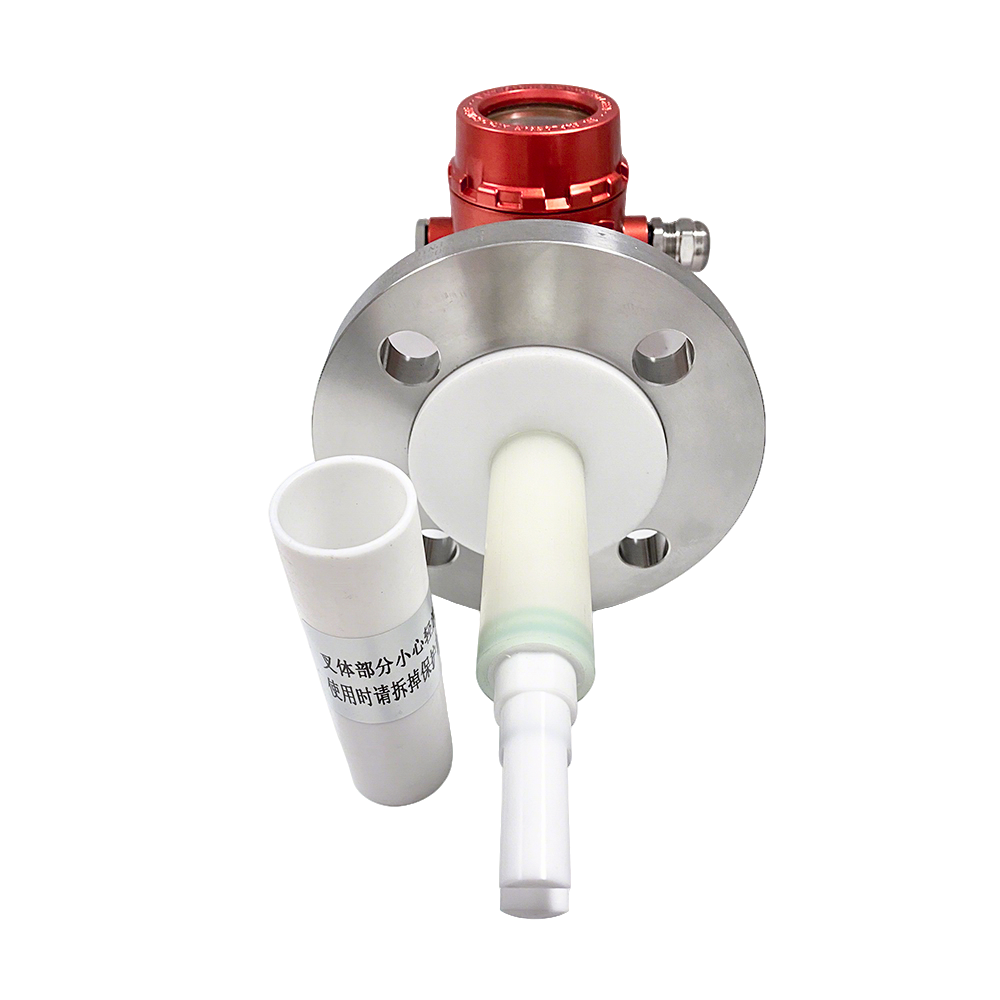
| Tuning fork sensor | A vibrating fork immersed in the fluid. Resonance frequency changes with fluid density. The core sensing element of LONNMETER LONN-DN100. |
| Resonance frequency | The natural frequency at which the fork vibrates. Density is derived from the frequency shift relative to a reference (air or vacuum). |
| Drift | Gradual change in the meter output over time without a change in the true process value. Causes: sensor coating, material aging, electronics drift. |
| Span | The difference between the upper and lower range limits of the instrument, e.g., density span 0.60–2.50 g/cm³. |
| Zero calibration | Calibration against a known reference at the low end of the range, commonly demineralized water (0.9982 g/cm³ at 20°C). |
2. Viscosity and rheology terms (12)
| Term | Definition |
| Viscosity | A fluid’s internal resistance to flow. Dynamic viscosity is shear stress divided by shear rate; SI unit Pa·s, process unit mPa·s (equal to cP). |
| Kinematic viscosity | Dynamic viscosity divided by density. SI unit m²/s; process unit mm²/s (equal to cSt). Basis of ISO VG lubricant grades. |
| Newtonian fluid | A fluid whose viscosity is constant regardless of shear rate. Water, mineral oils, most low-viscosity syrups. |
| Non-Newtonian fluid | A fluid whose viscosity changes with shear rate or shear history. Paints, polymer solutions, drilling muds, most slurries. |
| Shear rate | Velocity gradient in a flowing fluid, in reciprocal seconds (s⁻¹). Describes how fast adjacent fluid layers slide past each other. |
| Shear stress | Force per unit area required to maintain a shear rate, in pascals (Pa). |
| Shear-thinning (pseudoplastic) | Viscosity decreases as shear rate increases. The most common non-Newtonian behavior (paints, ketchup, polymer melts). |
| Shear-thickening (dilatant) | Viscosity increases as shear rate increases. Less common; e.g., some starch suspensions, wet sand. |
| Bingham plastic | A fluid that behaves as a solid below a threshold stress (yield stress) and flows linearly above it. Drilling muds, sewage sludge. |
| Yield stress | The minimum shear stress required to make a Bingham plastic or viscoplastic fluid start flowing, in Pa. Cannot be measured by vibrational sensors. |
| mPa·s / cP | Millipascal-second and centipoise. Equal units for dynamic viscosity. Water at 20°C = 1.0 mPa·s. |
| Viscosity index (VI) | Empirical measure of how much a lubricant’s viscosity changes with temperature. High VI = less change. Standard test ASTM D2270. |
3. Concentration terms (10)
| Term | Definition |
| Concentration | Amount of a solute in a solution, expressed in many units: %, g/L, mol/L, ppm. A calculated value, not a directly measured physical property. |
| Conversion table | The function or lookup table mapping a physical property (density, refractive index, conductivity) to concentration for a specific solute. The heart of any concentration meter. |
| °Brix (°Bx) | Percent sucrose by mass in a solution, defined by ICUMSA. 25 °Bx = 25 g sucrose per 100 g solution. Refractometric Brix is the legal basis for many food standards. |
| Refractive index (nD) | Ratio of the speed of light in vacuum to its speed in the fluid. Water nD = 1.3330 at 20°C. Basis of refractometric concentration measurement. |
| Conductivity | Measure of a solution’s ability to conduct electricity, in µS/cm or mS/cm. Basis of conductivity-based concentration measurement. |
| Brix vs. actual solids | Refractometric Brix approximates total dissolved solids for pure sucrose but is not identical to true solids content for other sweeteners or mixtures. |
| g/L | Grams of solute per liter of solution. Common for acid concentration in hydrometallurgy, e.g., 1–10 g/L H₂SO₄ in heap leaching. |
| % (w/w) vs % (v/v) | Weight percent (mass solute / mass solution) versus volume percent (volume solute / volume solution). Always state which — they differ whenever solute and solvent densities differ. |
| Temperature-corrected concentration | Concentration value corrected to a standard reference temperature (usually 20°C). Required for meaningful comparison across plant locations and seasons. |
| Multi-component ambiguity | Situation where two or more different compositions give the same density (or conductivity), so a single physical measurement cannot uniquely determine concentration. Solved with a second measurement parameter. |
4. Process and instrumentation terms (12)
| Term | Definition |
| Inline measurement | Measurement taken directly in the process line without diverting the sample. Real-time, continuous, no manual sampling. |
| Bypass loop | A small-diameter loop diverting a portion of the process flow through the instrument. Allows installation without cutting the main line. |
| 4–20 mA loop | The standard analog process signal. 4 mA = range minimum, 20 mA = range maximum. Loop-powered instruments operate on the same two wires. |
| HART | Highway Addressable Remote Transducer. Digital communication superimposed on the 4–20 mA signal. Allows remote configuration and diagnostics. |
| Modbus RTU | Serial digital communication protocol widely used with RS-485. Read-only registers or read/write registers depending on instrument. |
| RS-485 | Serial communication standard supporting multi-drop networks of up to 32 devices over distances to 1,200 m. |
| DCS | Distributed Control System. The plant-wide control platform where process instruments report and control loops execute. |
| PLC | Programmable Logic Controller. Used for discrete and small continuous control tasks. |
| Dead leg | A section of pipe with no flow where fluid stagnates. Causes sample lag and contamination in bypass loops. |
| SIP / CIP | Steam-in-Place and Clean-in-Place. Sanitary cleaning methods for food, beverage, and pharmaceutical process instruments. |
| Repeatability | The closeness of agreement between successive measurements of the same value under the same conditions. Often better than accuracy — and sometimes more important for control. |
| Accuracy vs. precision | Accuracy is closeness to the true value. Precision (repeatability) is consistency between readings. An instrument can be precise but inaccurate (calibration offset) or accurate but imprecise (noisy). |
Hazardous area and certification terms (6)
| Term | Definition |
| Hazardous area | A location where an explosive atmosphere may occur. Requires certified instruments to prevent ignition. |
| Zone 0 / 1 / 2 | European (IEC) classification of gas hazardous areas. Zone 0: explosive atmosphere present continuously or for long periods. Zone 1: likely in normal operation. Zone 2: unlikely and only briefly if it occurs. |
| Gas group IIA / IIB / IIC | Classification of gases by ignition energy. IIC (hydrogen, acetylene) is the most easily ignited and requires the highest protection level. A meter certified for IIB is not certified for IIC. |
| ATEX | European Union directive for equipment in explosive atmospheres (2014/34/EU). Required for EU projects. |
| IECEx | International Electrotechnical Commission certification scheme for explosive atmospheres. Internationally recognized. |
| FM / CSA | North American certification schemes for hazardous area equipment. FM = Factory Mutual, CSA = Canadian Standards Association. Different scheme from ATEX. |
| How to use this glossary in practice
When writing an RFQ, define every critical term explicitly instead of assuming the supplier shares your definition. Three specifications that cause the most misunderstanding between buyers and sellers:
1. “Density” — always state reference temperature (15°C or 20°C) and unit (g/cm³ or kg/m³) 2. “Viscosity” — always state dynamic (mPa·s) or kinematic (mm²/s), and temperature 3. “Concentration” — always state the solute, the unit (%, g/L), and w/w vs v/v
A specification that defines its terms is a specification that gets quoted correctly. |
Common questions about process measurement terms
What is the difference between density and specific gravity?
Density is mass per unit volume (g/cm³). Specific gravity is the ratio of the fluid density to a reference density — water at a stated temperature. Because it is a ratio, specific gravity is dimensionless and has no unit. The reference temperature matters: SG vs water at 4°C differs slightly from SG vs water at 20°C because water density changes with temperature (0.99997 vs 0.9982 g/cm³).
Why do viscosity and kinematic viscosity numbers differ for the same oil?
Because kinematic viscosity = dynamic viscosity ÷ density. For an oil with density 0.9 g/cm³, dynamic 90 mPa·s equals kinematic 100 mm²/s. The ISO VG system for lubricants uses kinematic viscosity at 40°C — ISO VG 100 means approximately 100 mm²/s at 40°C. Always confirm which viscosity your specification requires; mixing the two is a common and costly error.
What does “accuracy ±0.001 g/cm³” actually mean for my concentration reading?
It depends on the slope of the density-concentration curve for your specific solute. For sulfuric acid in the heap leaching range (roughly 1–10 g/L), 0.001 g/cm³ of density error translates to roughly 1 g/L of concentration error. For sucrose near 20 °Bx, the same density error is about 0.2–0.3 °Bx. The conversion table converts physical accuracy into concentration accuracy — the two are not the same number.
Is repeatability more important than accuracy for my application?
For closed-loop process control, repeatability usually matters more than absolute accuracy. If the meter consistently reads 0.005 g/cm³ above the true value, the controller compensates by holding a slightly different setpoint — the process stays in control. If the meter is noisy (poor repeatability), the controller cannot hold any setpoint reliably. For custody transfer, billing, or regulatory compliance, absolute accuracy matters most. State your priority in the specification.
Where can I find authoritative definitions of these terms?
The most useful references: ISO 5725 (accuracy and precision), ISA-51.1 (process instrumentation terminology), API Manual of Petroleum Measurement Standards (density and SG for hydrocarbons), ICUMSA (sugar), and the International Vocabulary of Metrology (VIM, JCGM 200). Instrument manufacturer technical manuals also provide terminology context specific to their products — but the standards bodies define the terms.
Post time: Sep-09-2026


