

Twenty thousand psi is a design rating on a Christmas tree, not a range you order from a catalogue. Between that wellhead and a fiscal metering skid sit three quite different measurement problems, and the instrument that solves one is usually wrong for the other two. The phrase oil and gas pressure transmitter describes a family rather than a part number. What changes across the value chain is the range, the wetted metallurgy, the process interface and the safety function, while the underlying sensing principle stays much the same. Our pressure transmitter range covers gauge, absolute and differential platforms for general industry; hydrocarbon service adds constraints that a water-treatment specification never mentions.
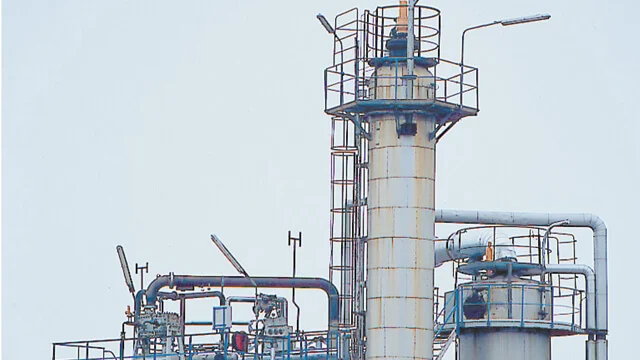
Most enquiries name a pressure and a line size, then stop. That is enough to quote something and not enough to keep it alive through a sour season, a pigging run or a shutdown. Selection starts with the point in the process, not with the accuracy column.
Three different measurement problems, one product name
| Value chain | Typical measuring points | Dominant constraint | Instrument shape |
| Upstream | Tubing and casing head, choke, separator, injection well | Very high static pressure, H2S, sand, remote location | High-range head with sour-qualified wetted parts |
| Midstream | Gathering lines, compressor discharge, metering skid, tank farm | Distance, custody accuracy, unattended monitoring | DP or gauge unit with HART or wireless telemetry |
| Downstream | Fractionator, hydrotreater, reactor, flare, utility header | High temperature, hydrogen, corrosive process | Remote seal with capillary or direct-mount high-temperature cell |
On an upstream well you are watching tubing pressure and casing pressure, often on separate channels so the operator sees both at once. Shut-in pressure can sit far above the flowing value, and a workover or a pressure test can drive the line beyond anything in normal production. Midstream moves the difficulty from raw range to distance and arithmetic: a gathering site may be visited once a quarter, while a custody-transfer point is a commercial instrument whose error has a monetary value. Downstream hands the problem to temperature and chemistry, where a fractionator or a hydrotreater runs hotter than a directly mounted sensing cell tolerates.
Calling all three an oil and gas pressure transmitter is convenient and slightly misleading. The specification has to say which of the three it is, because the range, the seal and the certificate follow from that answer.
Range, turndown and the overpressure case
API Spec 6A rates surface wellhead equipment in working-pressure classes reaching 20,000 psi, so an oil and gas pressure transmitter on a Christmas tree has to sit inside that envelope with margin rather than at the edge of its span. A modern smart cell may offer 100:1 turndown, which makes it tempting to range a 0 psi to 3,000 psi sensor down to a 30 psi operating span. The trick costs more than it saves. Zero stability and temperature-effect performance degrade at extreme turndown, and a wellhead that sees both shut-in and flowing pressures within a narrow band is better served by a sensor whose upper range limit sits within roughly ten times the calibrated span, with a separate high-pressure switch handling the upset case.
Overpressure is a mechanical question, not a measurement one. A blocked impulse line, a pump starting against a closed valve, or a pig arriving at a slug catcher produces a spike that a thin low-range diaphragm remembers permanently. Proof pressure and burst pressure are specified against the credible upset, and the rating has to be checked at the maximum ambient the site will see, since flange and housing ratings derate with temperature under ASME B16.5. Class 600 on a cool day is not Class 600 at the top of its temperature range.
On the low side, near-vacuum appears in vapour recovery, flare headers and the suction of a compressor. A gauge-referenced unit with no documented negative-pressure capability will read badly or deform when the line is pulled down during a shutdown. Where the process can cross atmospheric pressure, an absolute pressure transmitter or a gauge device with a stated vacuum rating is the honest choice. Range selection is where most hydrocarbon specifications are won or lost, and it is decided by the upset case, not the operating point.
Sour service is a materials question first
Hydrogen sulphide changes the failure mode from drift to sudden cracking. NACE MR0175 and its ISO counterpart ISO 15156 govern the wetted materials for sour service, and the classification depends on H2S partial pressure together with chloride concentration, pH, temperature and the stress state of the metal. Published thresholds are not consistent across revisions and secondary sources, so the sensible move is to take the sour designation from the process or reservoir engineer and request material compliance from the manufacturer against the current standard revision, rather than copying a number from a blog into a purchase order.
Wetted hardness is the detail that gets missed. The standard places a limit on the hardness of the exposed metal, commonly quoted around HRC 22 for many carbon and low-alloy steels, because a hard microstructure is far more susceptible to sulphide stress cracking. A diaphragm that has been cold-worked, a welded collar that was not properly heat-treated, or a spring inside the process path can all fall outside the qualified condition even when the alloy name on the certificate looks right. Ask for compliance on the whole wetted assembly, including welds and any elastomer backing, not only on the flat membrane.
Alloy selection then follows the produced fluid. 316L handles many sweet services but is a poor answer to high chlorides at temperature, where duplex and super duplex stainless, Inconel 625 or Hastelloy C-276 are the usual steps up. Formation water can be far more aggressive than the hydrocarbon itself. Offshore adds salt spray to the outside of the housing, so the enclosure material and the cable gland are part of the same corrosion decision. An oil and gas pressure transmitter specified for a sour well is a materials package with a sensor attached, and treating it as an accuracy purchase is how a cracked diaphragm ends up venting hydrocarbons into a classified area.
Where the process meets the instrument
Crude is rarely clean. Sand, wax, asphaltene, scale and produced water all attack a small pressure port, which is why diaphragm seals are standard on heavy crude, slop oil and many produced-water streams. A remote seal puts a flush membrane at the pipe wall and transmits pressure through a fill fluid and a capillary to the sensing cell, keeping the electronics away from both the solids and the heat. The arrangement solves plugging and buys temperature isolation, and it introduces two new error sources: the thermal expansion of the fill fluid and the temperature difference between paired capillaries on a differential measurement.
Capillaries should be the same length, routed together and shielded from direct sun or a nearby heater. A differential pair whose legs sit at different temperatures reports a false pressure difference that no amount of calibration removes. Fill fluid has to be chosen for the process temperature and for incidental-contact requirements, and on hot refinery duty the high-vacuum behaviour of that fluid matters, since a column that cavitates under a hot membrane loses its hydraulic link. In hydrocracking and catalytic reforming, atomic hydrogen can permeate a standard stainless diaphragm and shift the zero over time. Gold-plated barrier membranes and ceramic or sapphire sensing elements exist for exactly this, and they are worth specifying when the line list shows a hydrogen-rich hot service.
Pulsation is the other interface problem. Reciprocating pumps and compressor discharge produce pressure ripple that fatigues a membrane and makes a control loop hunt. Snubbers, restrictors and electronic damping tame the ripple, but they also slow the response, which matters if the transmitter is part of a shutdown function. Protection has to be matched to the dynamic duty rather than added as an afterthought. Our note on inline pressure monitoring for high-sand-content crude oil describes the erosion and plugging side of this in more detail.

The classified area and the safety function
Almost every hydrocarbon measuring point sits in a classified zone. IEC 60079 and ATEX 2014/34/EU govern the equipment protection, and the choice between flameproof and intrinsically safe construction is driven by the area classification rather than by preference. We covered that decision separately in our article on how pressure transmitters improve safety in hazardous environments; on an oil and gas project it interacts with the loop design, because an intrinsically safe barrier, the cable and the transmitter are certified as one system.
A second, distinct question is whether the transmitter belongs to a safety instrumented function. IEC 61508 and IEC 61511 define how a sensor in an emergency shutdown loop is qualified, how diagnostic coverage is assessed, and how often a proof test must be performed to hold the claimed integrity level. A SIL claim is not a marketing adjective. It is a property of a specified device, in a specified architecture, with a documented test interval and failure-rate data. An oil and gas pressure transmitter bought for a shutdown loop needs the certificate and the proof-test procedure to travel with it, and the loop response time has to accommodate whatever damping was added for pulsation protection.
Redundancy is the third layer. Two out of three voting on a compressor trip, or a separate high-pressure switch guarding a wellhead, exists because a single instrument can fail in a way that looks like a valid reading. Deciding where redundancy belongs is a hazard study output, not a procurement choice, but the instrument datasheet has to state which role each unit plays. A control transmitter and a shutdown transmitter on the same tap may need different certificates, different test regimes and different tap arrangements.
Impulse lines, manifolds and the plumbing that fails first
Instrument tubing causes more field problems than the sensor. On liquid service the transmitter is mounted below the tap so the impulse lines stay liquid-full and slope continuously back to the process. On gas service it sits above the tap so condensate drains back into the line. Steam and hot hydrocarbon vapour need condensate pots or pigtails at equal elevation, because an unequal liquid column on the two legs of a differential measurement is indistinguishable from a real pressure difference. Those conventions are old and still routinely ignored on skids where the tubing was routed for drawing convenience.
Wax and hydrate formation are the cold-climate version. A line that freezes or gels gives a perfectly stable, completely wrong reading, and the operator sees a flat trend rather than a fault. Heat tracing, insulation and winterisation are part of the instrument specification on an Arctic pad, as are the fill-fluid choice and the housing ambient rating. Conversely, a desert site with +65 °C ambient and solar gain pushes the electronics and the fill fluid towards their upper limits, and a transmitter rated only to +40 °C ambient will drift or shut down.
Isolation hardware matters for maintenance and for safety. A double block and bleed manifold lets a technician positively isolate and vent the instrument before breaking containment on a high-pressure hydrocarbon line, which is standard practice on shutdown taps, fiscal metering and critical process points. A single block valve may be adequate on a low-consequence utility header. Manifold material, seat material and packing have to follow the same sour-service metallurgy as the diaphragm, since a soft seat that swells in H2S or hydrocarbon defeats a carefully specified sensor. Our industrial pressure transmitter line covers the less demanding utility ends of the same skid, and the boundary between the two specifications should be explicit on the line list.
Output, SCADA and unattended sites
For an oil and gas pressure transmitter on a packaged skid, the wired 4-20 mA loop with HART remains the default because it is easy to document, simple to trouble-shoot and understood by every maintenance crew. Our 4-20 mA pressure transmitter family covers that interface, and on a hydrocarbon project the diagnostics carried on the HART layer often matter more than the extra resolution: a plugged impulse line, a failing sensor or a drifting zero can be flagged before the reading is wrong enough to trip a process.
Remote well pads and gathering stations change the economics. Trenching cable to a point visited once a quarter is expensive, so a battery or solar-powered wireless unit reporting into SCADA under IEC 62591 is often the better answer, provided the update rate, battery life and network redundancy suit the function. A wireless transmitter is a poor choice for a fast shutdown loop and a good one for a slowly varying casing pressure trend. The protocol decision belongs with the control system designer, but the datasheet has to state it, because a wireless head and a wired head are different products with different certification and power budgets.
Modbus and FOUNDATION Fieldbus appear on packaged skids and refinery units, and the choice is usually dictated by the host DCS. What is worth checking on every project is the loop budget under intrinsic safety, the surge protection on long cable runs, and the earthing arrangement at a site where lightning and stray currents are common. A perfect sensor on an unprotected loop is a spare part waiting to happen.
Metering and the arithmetic of custody transfer
Fiscal measurement turns instrument error into money. A differential-pressure flow measurement across an orifice plate follows ISO 5167, and the gas volume has to be corrected to a reference condition using a compressibility calculation such as AGA Report No. 8 or ISO 12213. Static pressure and temperature are inputs to that correction, so a pressure transmitter on a custody transfer skid is a commercial instrument whose bias multiplies across every cubic metre billed. The error budget is assembled as a root-sum-square of reference accuracy, temperature effect over the site’s actual swing, long-term drift, and the static-pressure effect on the DP cell, not quoted as a single best-case accuracy figure.
Static-pressure effect is the trap specific to high-pressure DP work. A differential transmitter reading a small pressure drop while sitting at a high line pressure sees a zero shift from that static load, and the effect grows with the ratio of line pressure to the calibrated differential span. On a gas transmission line the differential across a primary element may be a few tens of millibar while the line sits at 70 bar. Specifying the cell without a stated static-pressure performance is an invitation to a systematic billing error that a bench calibration will not reveal.
Level and interface in a separator use the same DP family, with the added complication that density changes with composition, temperature and pressure. Hydrostatic pressure is p = ρgh, so a shift in the density of the liquid column reads as a level change. Our differential pressure transmitter families cover these duties, and the related note on inline liquid level measurement for crude oil storage tanks explains why a level loop on a hydrocarbon tank is rarely just a pressure loop. Where the density varies across batches, a density input or a compensating measurement is part of the design, not an optional refinement.
Reading a datasheet against a real line list
| Line list item | Upstream wellhead | Midstream metering | Downstream fractionator |
| Calibrated span | 0 psi to 10,000 psi | 0 bar to 100 bar | 0 bar to 40 bar |
| Upset case | Shut-in and pressure test above flowing value | Pig arrival and pump start | Thermal cycle and vacuum on cooldown |
| Wetted material | Sour-qualified alloy with documented hardness | 316L or duplex to chloride level | High-temperature diaphragm with hydrogen barrier |
| Process interface | Direct mount with flushing ring and DBB manifold | Paired impulse lines with condensate control | Remote seal with matched capillaries |
| Function | Indication plus separate high-pressure trip | Fiscal measurement with static-pressure compensation | Control with SIL assessment where required |
Numbers expose the looseness of adjectives. On the wellhead the range is set by the test case, the wetted parts by the sour classification, and the manifold by the isolation philosophy. On the metering skid the accuracy specification is meaningless without static-pressure performance and a compressibility model. On the fractionator the dominant number is process temperature, and a direct-mounted cell that reads beautifully at ambient will drift as soon as the unit reaches operating conditions. Three line items on a spreadsheet, three different instruments.
This is also where turndown and range interact with the commercial case. For an oil and gas pressure transmitter on a fiscal point, the operating pressure belongs in the upper part of the calibrated span, with the absolute error budget computed at the actual operating pressure rather than at full scale. A 0.1 % of span figure sounds reassuring until the span is ten times the operating value. The pressure transmitters process solutions overview groups the platforms by duty, which is a more useful starting point than a model number copied from a previous project.
Failures we are asked to diagnose
Certain patterns repeat. A separator level that slowly walks away from the gauge glass is usually an impulse line that has partially plugged with wax or sand, not a sensor that has lost calibration. A wellhead pressure that reads high after a workover often turns out to be trapped pressure behind a closed manifold valve. A zero that drifts on a hot hydrotreater line points to fill-fluid thermal effects or hydrogen permeation, and a reading that is stable and wrong on a cold morning points to a frozen leg. None of these show up as a transmitter fault code, because the electronics are doing exactly what they were told to do with a bad input.
Material failures are less frequent and more consequential. A diaphragm that was not qualified for the actual H2S and chloride conditions can crack without warning, and the first symptom is hydrocarbons where they should not be. This is why we ask for the sour classification and the material certificate before discussing accuracy on an upstream point. Our notes on pressure monitoring in diesel hydrotreating and inline pressure measurement in gasoline refinery distillation cover the downstream versions of the same diagnostic conversation.
Installation, commissioning and the handover file
Installing an oil and gas pressure transmitter on a live hydrocarbon site adds permits and isolation to the ordinary loop check. The instrument is installed after the manifold and the impulse lines have been pressure-tested and flushed, with the tap orientation confirmed against the phase of the process. At commissioning a loop calibrator or a HART communicator drives the current, a deadweight tester or a pneumatic standard provides the reference, and the as-found reading is recorded before anything is trimmed. Adjusting a unit whose as-found was already within tolerance destroys the evidence that it arrived in good order. The as-left certificate closes the loop, and on a site with an ISO/IEC 17025 traceable calibration line the certificate names the standards used.
The handover file should carry material traceability such as EN 10204 3.1 certificates, sour-service compliance documents where applicable, the hazardous-area certificate with its exact marking, any SIL documentation and the proof-test procedure, plus the calibration records. A shutdown transmitter that cannot produce its proof-test interval at an audit is functionally undocumented, however good its reading. On a live plant the first few thermal cycles deserve an extra zero check, because they establish what this particular installation does to drift and what the calibration interval should actually be.
What the enquiry needs before a quote means anything
Give the supplier the point in the value chain, the medium and its H2S, chloride, sand and water content, the operating and upset pressures including any vacuum, the full temperature range on both the process side and the ambient side, the area classification and gas group, whether the loop is control, fiscal or shutdown, the required output and protocol, the connection and manifold standard, and the document package expected at delivery. Our article on density meters for oil and gas pipelines makes the same point from the compositional side of a pipeline measurement system.
Leaving out the sour classification is the costliest omission. An oil and gas pressure transmitter quoted for a sweet line and installed on a sour one is not a slightly wrong purchase; it is a component that may fail by cracking. The same information determines the diaphragm alloy, the manifold trim, the elastomer, the enclosure and the certificate. An in-line mounting platform that is right for a clean utility header can be the wrong mechanical basis for a sand-laden wellhead tap, and the difference is visible on the line list long before it is visible in the field.
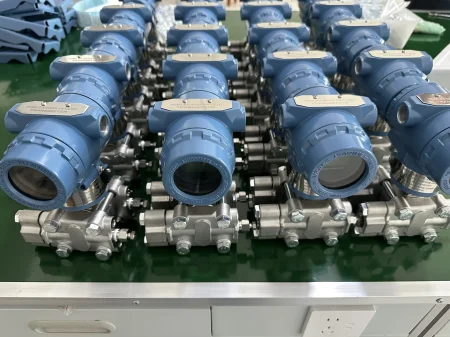
The LONNMETER platform for hydrocarbon duty
LONNMETER GROUP develops, manufactures and sells process instrumentation within one organisation, so a materials question reaches the same bench that builds the sensing cell. Our LONN-PT-O family for hydrocarbon service is developed on the mechanical platforms already in production, including the LONN-3051 coplanar platform and the LONN-2088 gauge and absolute model, with 316L wetted parts as the starting point, 4-20 mA with HART output, and a calibration record shipped with each unit. Assemblies are proof-pressure tested on a hydrostatic rig, weld seams are helium leak checked, and the finished output is compared against a deadweight tester and a comparator on an ISO/IEC 17025 traceable line, so the as-found and as-left certificates trace to national standards.
We will not write a sour-service qualification, a protection marking, a SIL claim or an accuracy figure for an oil and gas pressure transmitter configuration we have not built. The exact alloy, hardness documentation, certificate scope, pressure rating and performance of any specific model are those stated on its datasheet and in the documents delivered with it. This article describes the selection method and the failure modes, not a promise for an unstated well or an unstated process.
Tell us the point in the value chain, the sour classification, the operating and upset pressures, the temperature swing, the area classification and the loop function. The contact page is where that conversation starts, and it moves faster when the line list arrives with the first message.
Post time: Nov-11-2026


