

A buyer searching for a level transmitter manufacturer is rarely buying one box. They are choosing who builds the instrument that sits on a tank for the next decade, who answers when the calibration drifts in year three, and who can still supply the same probe when the plant expands in year six. That is a supply-chain decision dressed as a product decision, and the two should not be separated. We are a manufacturer that designs, calibrates and ships level transmitters from our own line — ultrasonic, radar and guided wave — and we run an OEM program for integrators and distributors who need the same hardware under their own label. This page is written for the engineer or purchaser who has been burned by a trading company that vanished after the first shipment, and wants to know what to actually check before signing.
What “manufacturer” should mean on a level transmitter
The word gets stretched. A trading company that re-sells a branded sensor bought on the open market will call itself a manufacturer in a catalogue, and the difference only shows up when you need a firmware change, a spare probe, or a certificate that traces to the calibration bench. A real manufacturer controls three things: the design of the measurement head, the calibration that sets the stated accuracy, and the supply of spare parts years later. If a vendor cannot show you the calibration bench, the firmware source, and a parts list that extends past the warranty, you are buying from a reseller with better stationery.
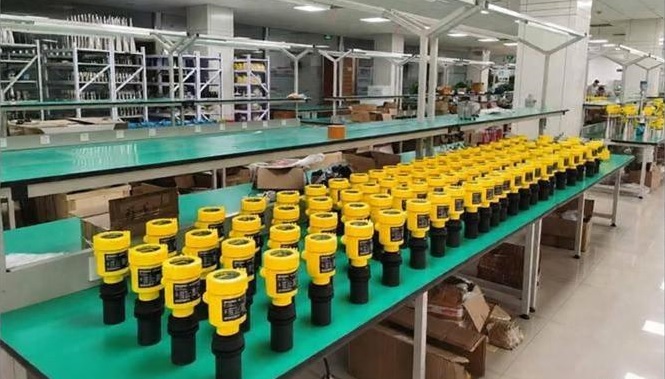
On our side, the ultrasonic liquid level meter heads are assembled and calibrated in-house, the radar level transmitter front-ends are built on our own RF boards, and the guided wave radar probes are cut, welded and pressure-tested on our floor. None of those statements help you unless you can verify them, so the rest of this page lists the questions we expect a serious buyer to ask — and the answers that separate a build shop from a box mover.
The R&D group is the first thing to inspect
A level transmitter is a measurement instrument, not a commodity. The accuracy you pay for is set by the transducer, the signal-processing firmware, and the temperature-compensation curve — and all three live in the design office. When a client reports a 6 mm error on a tank, the fix is a firmware compensation constant, not a new sales order. A trading company cannot change that constant; a manufacturer with an R&D group can, and that is the single most valuable capability to confirm before you commit.
In our group the transducer selection, the echo-processing algorithm, and the dead-zone table are all owned internally. That means a request like “read reliably through a 200 mm condensate layer on a hydrochloric acid tank” is a firmware-and-probe task we scope in engineering, not a catalogue lookup. It also means we can document the measurement principle for your safety case instead of pointing you to a competitor’s white paper. If your vendor’s technical answers always route back to “please refer to the manual,” you are not talking to the people who wrote the manual.
Production: what the line should actually look like
Walk the floor, or have your inspection agent walk it, and look for four things. First, a surface-mount line with controlled soldering, because the 80 GHz radar front-end and the 120 kHz ultrasonic driver are both dense boards that fail quietly when soldered by hand. Second, a calibration bench with traceable standards — a tank simulator or a calibrated distance reference for ultrasonic, and a dielectric-reference target for radar — because the stated ±3 mm means nothing if it was never checked against a known distance. Third, a pressure and leak test for any wetted housing rated for the process. Fourth, an aging burn-in, because the transmitters that fail at month two almost always fail in the first forty-eight hours if you make them run hot first.
We run all four as in-line stations, not as a final inspection after the fact. A transmitter that leaves the bench has been powered, driven with a simulated echo, and checked against the span it will defend in the field. The cost of that discipline is a slower line; the benefit is a return rate you can put in a contract. When a buyer compares two quotes and one is suspiciously cheaper, the missing line item is usually this bench time, and it shows up later as a freight bill for returned units.
Calibration and the traceability that buyers forget to ask for
Calibration is where accuracy is born, and traceability is where it is proven. A transmitter calibrated against an in-house ruler is accurate only by accident; one calibrated against a standard that itself traces to a national metrology institute is accurate by discipline. For a level transmitter used in custody transfer or in a safety-instrumented function, the calibration certificate is part of the plant’s compliance file, and the buyer should ask where the bench standard came from and when it was last verified.
We calibrate each unit against a reference that is re-certified on a schedule, and we keep the record. That record is what lets a client’s auditor close a finding instead of opening one. The honest caveat: the certificate covers the instrument as shipped, not the installation. A transmitter calibrated to ±3 mm can still read wrong if it was mounted where the beam clips a ladder, and no manufacturer’s certificate covers a bad install. We say that plainly, because the alternative is a vendor who blames your tank for their meter.
Materials and the wetted parts that decide survival
Most level transmitter failures are not electronic; they are chemical. The wetted parts — the antenna, the probe, the seal, the process connection — meet the medium, and the medium wins if the material is wrong. A 316L stainless antenna in chlorinated brine pits within months. A PTFE-faced probe in concentrated sulfuric acid outlasts the tank. The material choice is a manufacturing decision made before the order is cut, and a manufacturer should be able to name the exact alloy and polymer on the wetted path and defend it against your medium.
We stock antennas and probes in 316L, in PVDF for aggressive acids, and in PTFE-lined constructions for the worst cases, and we keep the compatibility table current against the media our clients actually run — hydrochloric acid, sodium hypochlorite, caustic soda, solvent blends, liquid nitrogen, and the slurries and food-grade liquids that sit between. The buyer’s job is to name the medium on the quote, because the price delta between a 316L probe and a PTFE probe is small next to the cost of pulling a dissolved probe out of a live line. A manufacturer who asks “what is in the tank?” before quoting is protecting you; one who quotes from a picture of the tank is not.
Output, protocol and the integration that integrators care about
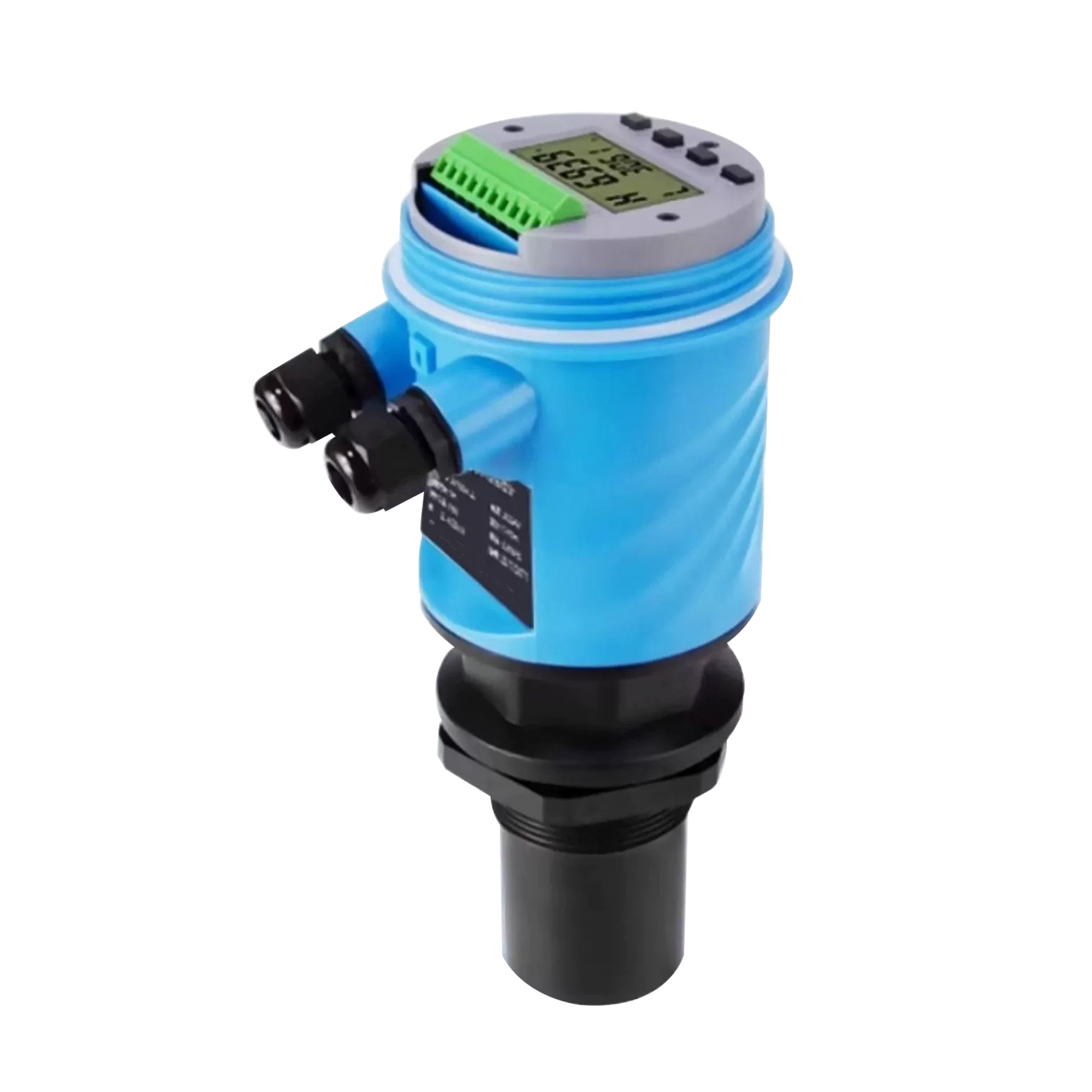
A level transmitter is useless until it talks to the system. The workhorse output is the 4-20 mA analog loop with HART on top, because every DCS and PLC in an existing plant speaks it. Newer builds often want RS485 with Modbus for multi-drop wiring, and some want a relay or a digital display built into the head. The manufacturer’s job is to ship the protocol your panel expects without a field converter bolted on afterward, and to document the register map so your integrator is not reverse-engineering it at commissioning.
We build the head to carry 4-20 mA/HART as standard, with RS485/Modbus and relay options on the same platform, and we release the Modbus register list with the datasheet rather than on request after the site is live. For OEM clients the protocol and the default span are part of the private-label configuration, so a distributor’s sku arrives already set to their panel’s expectation. The difference between a manufacturer and a reseller shows here too: when the register map has a bug, one of them can fix the firmware and the other can only escalate a ticket to someone they do not employ.
The OEM and ODM program, stated without the usual fog
OEM means you sell our hardware under your brand; ODM means we also design or modify the hardware to your specification. Both are common requests from system integrators, distributors and branded-equipment houses, and both are worth doing only if the manufacturer can carry the load past the first container. A private-label program that cannot hold a consistent firmware version, a stable probe supply, or a coherent certificate package is a liability wearing your logo.
Our OEM program covers label, firmware default, packaging and documentation under the client’s brand, with the same instrument that ships under our own name. The ODM side handles probe length, process connection, material grade and output configuration to a client’s drawing, within the envelope our platform supports. We set a minimum order quantity that reflects the label and firmware setup rather than a punitive hurdle, and we quote lead time against actual production load, not against a sales target. The thing an OEM buyer should verify is continuity: ask for the firmware version history and the spare-parts horizon, because a logo means nothing if the probe you branded is unavailable in two years.
MOQ, lead time and the incoterms that protect both sides
Commercial terms are where OEM relationships live or die, and they are worth stating plainly instead of hiding behind “contact us for pricing.” Minimum order quantity for a private-label run is set by the setup — label printing, firmware load, packaging — not by a wish. Lead time is quoted against the production schedule at order entry, and it moves with the component market, so a firm number means a firm component commitment, which is why we confirm it in writing at the pro-forma stage rather than the handshake stage.
Shipment terms follow standard incoterms: EXW from the factory, FOB from the port, or CIF to the destination, chosen by the buyer. None of those terms change the instrument, but they change who carries the risk between our dock and yours, and a buyer who does not pick one is letting the freight forwarder pick it. We state the incoterm on every pro-forma and we do not bury it, because a surprise at customs is the most expensive surprise in this business. The manufacturer who handles these terms as routine is the one who has shipped containers before; the one who fumbles them is learning on your order.
Certifications: claim only what the model carries
Buyers in classified areas need Ex certification, and buyers in regulated supply chains need a quality system behind the product. The honest position is that certification is model-specific: a transmitter rated Ex d for a Zone 1 gas area is a different approval file from one rated Ex ia for an intrinsically safe loop, and neither should be assumed from a generic “we are certified” line on a homepage. The same is true of CE marking and of an ISO 9001 quality system that governs how the bench is run.
We specify the relevant Ex rating and the quality-system scope per model on the datasheet, and we tell buyers to confirm the exact approval number for their zone before mounting, because mounting an uncertified head in a classified area is a safety violation, not a paperwork slip. We do not print a certificate number on a webpage and call it compliance; we put it on the model’s documentation where an auditor can read it against the unit in the field. A manufacturer who cannot show you the approval file for the exact model you are buying is asking you to bet your safety case on a sentence.
The factory audit: what your inspector should photograph
A supplier audit is only as good as what the inspector is told to look for, and most checklists are written to be passed. The photographs that matter on a level transmitter maker are not the reception or the showroom; they are the calibration bench with its standard and its last re-certification date, the soldering line with its temperature profile, the pressure test rig with its gauge, and the aging rack with units running under load. If the inspector comes back with a lobby and a catalogue but no bench photo, the audit verified a website, not a factory.
We host audits and we hand the inspector the bench, because a clean bench is the easiest honest thing we own. The harder honest thing is the failure bin — the returned units, the root-cause tags, the corrective action. A manufacturer with a real failure bin is learning; one with a spotless record and no bin is editing. Buyers should ask to see both the calibration log and the returns log, because the gap between the two tells you more about the product than any brochure spec. An auditor who photographs the returns bin is doing the job; one who only photographs the lobby is not.
Spare parts and the ten-year horizon that OEM buyers forget
The transmitter is cheap; the decade of spares is the contract. A logo on a probe means nothing if the probe is unavailable in year four and the client’s branded sku now points at a discontinued part. The supply commitment is the quiet half of an OEM relationship, and it is the half most resellers cannot make, because they never held the inventory in the first place — they brokered it.
We commit to a spare-parts horizon tied to the platform life rather than to a single model’s sales curve, and we keep probes, antennas and head boards for the families we ship, including the guided wave radar line. For OEM clients the commitment is written into the agreement as a minimum availability window, not offered as a hope. A buyer should put that window in the contract before signing, because a verbal “we’ll keep making it” is worth the paper it is not written on. The manufacturer who can name the horizon in writing is the one who controls the bill of materials; the one who hesitates does not.
Reading a manufacturer’s quote line by line
A level transmitter quote is a small document that hides large risks, and the line items worth reading are the ones vendors omit. Check whether calibration is a line item or folded into the unit price — if it is folded in and unmentioned, ask what standard backs it. Check whether the Ex rating is named with an approval number or left as a generic “explosion-proof” adjective. Check whether the probe material is specified per medium or quoted as a single default. Check whether lead time is a firm commitment against production load or a seasonal guess. And check whether the incoterm is stated, because the line “FOB Shenzhen” versus “EXW factory” changes who pays the freight and who owns the risk the moment the unit leaves the dock.
We itemize those lines rather than burying them, because a quote that hides the certification and the calibration is a quote that shifts the risk onto you. The cheapest-looking number is usually the one with the most blanks, and every blank is a question you will answer under pressure at commissioning. A manufacturer’s quote should read like an engineering document, not like a teaser, and the buyer who treats the blanks as negotiation points instead of warning signs pays for them later.
Why a direct manufacturer beats a trading layer on total cost
The trading layer earns its margin by standing between you and the builder, and it earns it twice — once on the unit price and once on every support call it has to forward. On a straightforward repeat order the layer is merely expensive; on a non-standard medium, a firmware question, or a spare needed in a hurry, the layer is a bottleneck with no bench behind it. The manufacturer absorbs none of that friction because the bench, the firmware and the parts are in the same building as the person answering the phone.
We price as a manufacturer, which means the quote reflects the instrument and the setup, not a reseller’s markup stacked on a reseller’s markup. It also means that when a client in a solvent plant needs a probe length changed after the tank was rebuilt, the change is a production task, not a procurement quest. The total cost of a level transmitter is measured in the second and third year, not on the pro-forma, and the direct line to the builder is the cheapest insurance on that math.
A short checklist for vetting any level transmitter manufacturer
Bring this to the conversation and watch which questions get a number and which get a brochure. Can they show the calibration bench and the traceability of its standard? Can they name the wetted material against your specific medium? Do they release the Modbus register map with the datasheet? Will they state the firmware version and the spare-parts horizon for an OEM run? Do they put the Ex approval number on the model’s documentation rather than the homepage? Can they describe the failure mode of their own product honestly, including the installs where it is the wrong call? A manufacturer answers those from memory; a reseller promises to check and never calls back.
What we build and where to start
Our level transmitter lines cover the three technologies a process plant actually needs: ultrasonic for calm, low-vapour, atmospheric tanks; radar for the vapor, the agitation and the low-dielectric liquids; and guided wave radar for interfaces and cryogenic duties where free-space beams fail. They share a head platform, a calibration discipline and a spare-parts commitment, which is what lets an OEM client brand one family instead of three. If your need is a standard instrument, start from the level transmitter range and tell us the medium, the temperature and the tank height. If your need is a private-label or modified build, tell us the volume and the drawing, and we will scope the OEM or ODM path against real production load rather than against a hope. The fastest way to a firm number is a specific application, and the contact page is where that conversation starts.
Post time: Oct-30-2026


