

Modern Challenges in Carbonated Beverage Production
Addressing Critical Process Needs
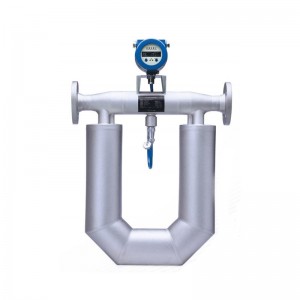
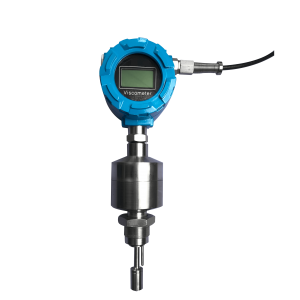
Carbonated beverage production demands exceptional consistency and precision at every stage. Variations in concentrate ratio, carbonation level, or fill volume lead to unacceptable batch inconsistencies, compromising taste and product stability. Fill errors and poor control can increase plant downtime as products must be reprocessed or discarded. Reliable online continuous level measurement tools are vital. These transmitters ensure automated, repeatable mixing and filling, and protect against overflow or unsafe tank empties. Hygiene is critical. All equipment, including Lonnmeter’s inline density and viscosity meters, must withstand frequent cleaning cycles with caustic, acidic, or high-temperature agents. Design must minimize product contact surfaces and risk of contamination, supporting rapid changeover and compliance with strict beverage safety standards.Continuous real-time data from level, flow, and pressure measurement enhances process optimization. Immediate feedback enables tight control over mixing ratios, carbonation reactions, and fill volumes—directly optimizing carbonated beverage production process yield and reducing waste. Integration of explosion-proof safety equipment is essential in CO2 carbonation process areas, reducing risks from pressurized gas environments and ensuring operator safety.
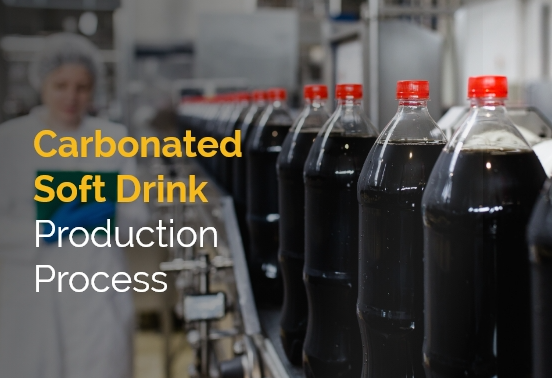
Carbonated Beverage Production Process
*
Industry Overview: Process Flow and Control Points
The carbonated beverage process starts with syrup blending, moves through dilution and carbonation reaction, then finishes with filling and capping. Each stage has unique control points requiring precise and robust measurement:
- During syrup blending, continuous level measurement transmitters track concentrate volumes for consistent ratio control. Improper sensing causes concentrate inconsistencies, affecting taste and carbonation stability.
- Inline flowmeters for carbonated beverages maintain correct water and syrup flow rates, with advanced flow measurement detecting real-time deviations.
- At the carbonation stage, pressure transmitter for carbonated beverage process monitors and regulates CO2 injection. Pressure, temperature, and liquid level have direct influence on CO2 solubility in carbonated beverages and bubble retention.
- During filling, radar level transmitter for beverage production offers non-contact, bubble-interference-resistant sensing in pressurized tanks. This supports high-speed, accurate product delivery to containers, even under challenging foaming or turbulent conditions.Lonnmeter’s inline density and viscosity meters, installed at key process points, provide data for real-time control of both mixing and carbonation. These meters are engineered to resist CO2 bubble interference, ensuring stable readings despite fluctuating gas release. Their robust hygienic design allows integration into maintenance-friendly beverage production equipment, supporting rapid cleaning and minimizing downtime.Process integrity depends on automation and monitoring at every stage. Sophisticated transmitters, flow, and pressure sensors—combined with reliable continuous level measurement products for liquid production—enable beverage manufacturing process automation, quality control, and carbonated drink process optimization. Each instrument plays a crucial role in producing a consistently high-quality beverage, protecting safety, and ensuring operational efficiency.
The Core of Carbonation: Ensuring Quality and Consistency
Understanding the Carbonation Reaction
The carbonation reaction—the dissolution of carbon dioxide gas (CO₂) into liquid under pressure—is central to the carbonated beverage production process. CO₂ solubility depends on both temperature and pressure; precise monitoring is essential for ensuring consistent beverage quality across production batches. Maintaining the ideal level and pressure of CO₂ prevents under-carbonation (leading to flat taste) or over-carbonation (resulting in excessive foam or packaging stress).
Continuous level measurement transmitters and pressure transmitters are indispensable in the carbonated beverages manufacturing process. These devices ensure exact dosing of CO₂ and help stabilize pressure throughout the carbonation process. When pressure fluctuates, product quality and shelf life can be compromised. Lonnmeter’s inline density meters provide real-time feedback for adjusting CO₂ levels and maintaining the correct saturation.CO₂ bubble interference resistance is vital in automated carbonation systems. Erratic bubble formation may skew sensor readings, causing errors in level measurement and challenging the accuracy of inline flowmeters for carbonated beverages. Advanced measurement tools are engineered to minimize disruption from gas bubbles, improving consistency during beverage manufacturing process automation.
Explosion-proof safety is mandatory in production environments handling pressurized gases. Equipment such as continuous level measurement transmitters for beverage industry is designed to withstand sudden pressure surges, protecting workers and maintaining process integrity. All devices used must conform to the strict safety standards demanded by beverage plant environments. Lonnmeter’s instruments leverage robust construction to deliver uninterrupted performance under demanding operating conditions.
The Importance of Concentrate Consistency
Achieving precise concentrate consistency control in beverage manufacturing is equally important for product quality. Variations in syrup mixing ratio directly affect taste, mouthfeel, and color. Automated systems featuring liquid level sensing technology in beverage industry monitor the flow and proportion of each liquid ingredient, providing immediate feedback for adjustment.Precision mixing ratio control in beverage production relies on accurate dosing and blending. Lonnmeter inline density meters enable processors to measure syrup concentrations in real time, adjusting pumps and valves to maintain recipe parameters. This eliminates batch-to-batch variability and supports strict flavor profiles for carbonated drink process optimization.Real-time monitoring of ingredient flow, temperature, and levels underpins beverage production quality control. Online continuous level measurement tools allow operators to track syrup and water inputs minute by minute, reducing human error and streamlining operations. This data-driven approach is crucial to advanced flow measurement in beverage production, ensuring each bottle’s contents are identical in taste and carbonation. A strict focus on hygiene compatibility for all continuous level measurement products supports sanitary practices in food and beverage plants. Measurement transmitters and inline density meters are engineered for easy cleaning, often featuring smooth surfaces and materials compatible with wash-down routines. Such hygienic and maintenance-friendly beverage production equipment minimizes contamination risks and ensures compliance with industry health regulations. Maintenance is simplified, downtime is reduced, and product integrity is preserved with cleanable, robust sensors designed for continuous liquid production.
Advanced Inline Measurement: Technologies and Solutions
Inline measurement is essential to modern carbonated beverage production processes. Real-time data on fluid level, flow, and pressure underpins precise quality control, supporting the carbonation reaction and ingredient consistency at every stage. During the carbonation reaction in beverage production, maintaining the correct CO₂ concentration requires continuous monitoring of several variables—chief among them, product level, precise mixture ratios, and pressure stability.Level, flow, and pressure must be measured with high repeatability and minimal drift. Inline flowmeters for carbonated beverages track product flow rates to ensure blending and carbonation steps meet recipe standards with reliable accuracy.
In the carbonation process, pressure transmitters for the carbonated beverage process monitor tank and pipeline pressures, protecting both the process and equipment from unsafe excursions and supporting explosion-proof safety in beverage plants. Precision mixing ratio control in beverage production critically depends on having these measurements perfectly synchronized and integrated within broader automation systems.Continuous level measurement products for liquid production must withstand the high CO₂, rapid flow, and variable density encountered in carbonated beverage production.
Guided wave radar level transmitter for beverage production, such as those manufactured by Lonnmeter, employ nano-second microwave pulse reflection. They detect changes in dielectric properties to determine exact product and interface levels, functioning without compromise even when CO₂ bubbles, foam, turbulence, or vapor are present in the tank. This CO₂ bubble interference resistance technology is crucial, as traditional level sensors can give false readings due to rapid gas release or foaming during beverage carbonation process monitoring.One of the core benefits of this technology is the ability to deliver direct level readings, free from compensation for density, temperature, or pressure changes—a necessity when CO₂ solubility in carbonated beverages directly affects apparent density and bubbles shift product stratification.

Lonnmeter’s guided wave radar design does not rely on moving parts, which minimizes wear and supports maintenance-friendly beverage production equipment, critical for continuous operations. Installation is top-down, reducing the risk of leaks and improving safety, and re-calibration after initial setup is not required—addressing both cost and hygienic risk in automated SIP/CIP environments.These advanced online continuous level measurement tools enhance reliability, especially in stainless tanks with difficult geometries or aggressive cleaning regimens. In hygienic and maintenance-friendly beverage production equipment, compatibility with high-temperature, high-pressure SIP (Sterilize-in-Place) and CIP (Clean-in-Place) cycles is integral.Integration with the production infrastructure is designed to reduce both physical and digital complexity. Multivariable transmitters, capable of reading level, interface, and even temperature from a single entry point, lower the total instrument count and reduce tank penetrations. This not only helps maintain vessel integrity but also reduces cleaning points that could harbor contamination.Modern continuous level measurement transmitters for beverage industry are optimized for straightforward online data transfer. Output signals, standardized (for example, 4–20 mA with HART protocols), integrate easily with distributed control systems or SCADA platforms.
This connectivity underpins beverage manufacturing process automation, supporting predictive maintenance and troubleshooting routines that maximize plant uptime. Operators can act on real-time data to optimize beverage mixing ratios, respond immediately to deviations within the carbonated beverage process flow diagram, and streamline routine beverage carbonation equipment maintenance.In summary, the use of robust, maintenance-minimizing, and interference-immune level technology is foundational for effective carbonated beverage production quality control. These systems, led by guided wave radar and advanced inline sensors like those from Lonnmeter, are pivotal in ensuring process safety, repeatability, and the high throughput demanded in today’s beverage industry.
Ensuring Process Excellence: Application Highlights
Security, Safety, and Compliance in High-CO₂ Environments
In carbonated beverage production lines, high-pressure and high-CO₂ conditions demand stringent safety measures. Equipment like Lonnmeter’s inline density and viscosity meters are engineered for explosion-proof operation, meeting globally recognized safety standards such as IEC 61508 SIL2. Compliance with SIL2 signifies reduced risk and proven reliability for critical processes that involve flammable or pressurized gases.Automated, continuous measurement reduces manual intervention and human error, ensuring safe plant operation. This is vital in the carbonation reaction step, where precise CO₂ solubility control protects both product integrity and workplace safety. For example, continuous online monitoring minimizes risk of over-pressurization and helps maintain optimal mixing ratios in the beverage manufacturing process.
Process Optimization with Inline Flowmeters and Pressure Transmitters
Precision inline flowmeters for carbonated beverages and pressure transmitters form an integrated backbone for process control. By providing real-time data about flow rates and system pressure, these instruments enable seamless adjustments from the CO₂ carbonation process all the way to bottling.Continuous level measurement transmitters support advanced process automation. As online measurement tools provide immediate feedback, plant operators and automated control systems can maintain concentrate consistency, respond to fluctuations in carbonation, and uphold exacting mixing ratio control. For instance, pressure transmitter data alerts when carbonation falls outside specified ranges, allowing for instant corrective action, thus ensuring the product aligns with the quality standards of the carbonated beverage production process.
Hygiene, Compatibility, and Maintenance
Maintaining high hygiene standards is essential in the beverage industry. Inline instruments must be constructed from sanitary materials such as food-grade stainless steel, facilitating compatibility with cleaning processes and resistant to corrosion or bacterial growth. Designs feature smooth surfaces and minimal crevices, important in hygiene-critical operations.Ease of access supports regular inspection and cleaning, reducing contamination risks and equipment downtime.
Guided wave radar technology plays a significant role, providing non-contact, highly accurate continuous level measurement ideal for hygienic beverage production environments. Its reliable performance endures frequent washdowns and rapid changes in process conditions, helping sustain ongoing compliance and effective maintenance routines.Lonnmeter’s product portfolio aligns with these strict requirements by offering robust, maintenance-friendly, and hygienic solutions designed for the continuous level measurement needs within carbonated beverage production. This supports both the integrity of the carbonation process flow diagram and the long-term efficiency of beverage carbonation equipment.
Selecting the Best Level Measurement Solution for Your Carbonated Beverage Process
Matching the requirements of the carbonated beverage production process with the capabilities of continuous level measurement transmitters is essential for consistent results. In beverage manufacturing, maintaining concentrate consistency and precise mixing ratios ensures quality and taste. Continuous level measurement transmitters for the beverage industry must withstand rapid process changes, frequent washing, and challenging tank geometries. Selection should consider the carbonation reaction in beverage production, tank pressure, agitation, and potential interference from CO2 bubbles—all factors that complicate reliable level readings. The chosen solution must offer hygienic design, easy maintenance, and compatibility with explosion-proof safety standards, as demanded in beverage plants.Operational costs, ease of installation, and straightforward maintenance drive the adoption of robust technology. For carbonated beverages, instruments must endure regular cleaning cycles and resist build-up from syrups or concentrate. Solutions with advanced flow measurement, reliable pressure transmitters, and durable sensors simplify integration into the process flow diagram and long-term upkeep. These capabilities directly benefit beverage carbonation process monitoring and minimize downtime for ongoing beverage carbonation equipment maintenance and process optimization.
Lonnmeter Guided Wave Radar: The Smart Choice for Beverage Plants
Lonnmeter guided wave radar technology stands out in the carbonated beverage process. Its radar level transmitter for beverage production is formulated to combat CO2 bubble interference, delivering stable readings where traditional systems falter. It excels in controlling liquid level sensing even during vigorous carbonation reactions. The transmitter ensures consistent quality control by providing accurate, continuous level measurement in tanks, mixers, and carbonation vessels—the heart of advanced flow measurement in beverage production.Lonnmeter’s product design meets hygienic and maintenance-friendly criteria, supporting frequent washdowns and cleaning routines. Its inline flowmeters for carbonated beverages integrate seamlessly alongside pressure transmitters, allowing for real-time data on CO2 solubility and helping maintain precision mixing ratio control.
Operators benefit from explosion-proof safety equipment compatibility, vital for high-pressure CO2 environments.Examples of application include maintaining the exact concentrate consistency control in beverage manufacturing, preventing overflows or shortages during the carbonation reaction, and sustaining optimal production efficiency. Lonnmeter radar reduces false alarms associated with foam or bubbling, keeping monitoring reliable throughout batch and continuous processes. The transmitter’s performance directly supports beverage manufacturing process automation and the stringent quality standards of carbonated beverage production.






Frequently Asked Questions (FAQs)
How does the carbonated beverage production process benefit from guided wave radar level transmitters?
Guided wave radar level transmitters are engineered for continuous, non-contact measurement of liquid level, proving invaluable in the carbonation reaction in beverage production. The technology’s immunity to density fluctuations, temperature shifts, and CO₂ bubbles ensures accurate readings even in a dynamic environment like carbonated beverage process flow. This design, with no moving parts, reduces maintenance requirements and downtime. For carbonation process optimization, precision in monitoring syrup and carbonated water levels is essential. These transmitters deliver reliable data, supporting concentrate consistency control in beverage manufacturing and preventing quality variations from process disruptions.
What role do continuous level measurement products play in explosion-proof safety for beverage applications?
Continuous level measurement transmitters designed for beverage manufacturing often include explosion-proof safety equipment features, such as pressure-resistant enclosures and safety certifications. These characteristics are critical where pressurized CO₂ and volatile ingredients are handled, minimizing risks of overfill, leaks, or accidental releases. By providing real-time level sensing, these tools alert operators to abnormal process conditions, safeguarding equipment and personnel in CO₂ carbonation process environments. Integration with plant control systems enables prompt response to deviations, supporting both productivity and industrial safety.
How does inline flow measurement improve the carbonated beverages manufacturing process?
Inline flowmeters for carbonated beverages play a key role in achieving precision mixing ratio control in beverage production. They monitor real-time flow of both carbonated water and syrup, ensuring consistency in the carbonation reaction. These flowmeters work alongside radar level transmitters and pressure transmitters for beverage production, automating flow adjustments to match recipe requirements. Stable and accurate flow measurement is fundamental to product quality, as even minor deviations can affect taste, texture, and CO2 solubility in carbonated beverages. Inline flow measurement supports advanced flow measurement in beverage production, optimizing both throughput and repeatability.
What is the importance of hygiene and maintenance compatibility in level measurement for beverage plants?
Hygienic and maintenance-friendly beverage production equipment is necessary to comply with strict quality standards. Level measurement devices for beverage manufacturing must allow for cleaning-in-place (CIP) and sterilization-in-place (SIP) without routine disassembly. Guided wave radar level transmitters feature sanitary-grade materials and a top-down mounting configuration, minimizing risk of contamination and facilitating automated cleaning cycles. The absence of wetted moving parts further reduces maintenance interventions, supporting uninterrupted operations in liquid level sensing technology in beverage industry setups where product purity is paramount.
Where can I find and compare continuous level measurement tools online?
Online comparison platforms provide detailed specifications for continuous level measurement products for liquid production. Lonnmeter’s range includes guided wave radar transmitters optimized for beverage plant requirements. Comprehensive data sheets, process diagrams, and product selection guidance help users match equipment to the specific demands of carbonated drink process optimization, carbonation process monitoring, and beverage manufacturing process automation. Users can request quotes and technical advice directly from Lonnmeter, facilitating informed decisions about monitoring and quality control solutions tailored to carbonated beverage production quality control.
Post time: Jan-04-2026


