

Introduction: Why Interface Detection Matters
In multi-product pipeline systems, different liquids are often transported through the same line.
Typical examples include:
- gasoline and diesel
- diesel and jet fuel
- different grades of crude oil
At some point, one product begins replacing another inside the pipeline.
That transition area is known as the interface.
If the interface is not identified accurately, operators may end up with:
- contaminated product
- unnecessary waste
- off-spec batches
- higher reprocessing costs
In large pipeline operations, even a small amount of mixing can become expensive very quickly.
That’s why interface detection is such an important part of pipeline management.
What Happens During Product Transition
When one product follows another through a pipeline, the change is not instant.
Instead, a mixing zone develops between the two liquids.
Inside this zone:
- density changes gradually
- product composition becomes unstable
- quality specifications may no longer be met
The challenge is determining exactly when the first product ends and the second product begins.
This is where online density measurement becomes extremely useful.
Why Density Is Used for Interface Detection
Different petroleum products usually have different densities.
For example:
- gasoline is generally lighter
- diesel is denser
- heavy oils have even higher density values
As the product changes in the pipeline, the density changes as well.
An online density meter continuously tracks these changes in real time, allowing operators to identify the transition point more accurately.
Compared with manual sampling, this approach is:
- faster
- more consistent
- easier to automate
How Online Density Meters Detect Interfaces
The density meter is installed directly in the pipeline.
As fluid flows through the sensor:
- density values are measured continuously
- changes are transmitted to the control system
- operators monitor the trend during product switching
When density begins moving away from the normal range of the first product, the system recognizes that the interface zone has arrived.
Once the density stabilizes at the range of the second product, the transition is complete.
The process sounds simple, but in practice, stable measurement is essential.
Common Challenges in Interface Detection
Real pipeline conditions are rarely ideal.
Several factors can make interface detection more difficult.
Flow turbulence
Rapid flow changes can create unstable readings and make the transition harder to interpret.
Air or gas in the pipeline
Entrained gas may disturb density measurement and produce inconsistent data.
Similar product densities
Some products have density values that are very close to each other.
In these situations, detecting the interface requires stable and repeatable measurement rather than extremely high absolute accuracy.
Temperature variation
Density changes naturally with temperature.
Without proper compensation, the interface point may appear inaccurate.
Why Stability Matters More Than Extreme Precision
For interface detection, operators are usually watching trends rather than single numbers.
What matters most is:
- stable measurement
- repeatable response
- continuous real-time monitoring
A system that reacts consistently to product change is often more valuable than one focused only on laboratory-level precision.
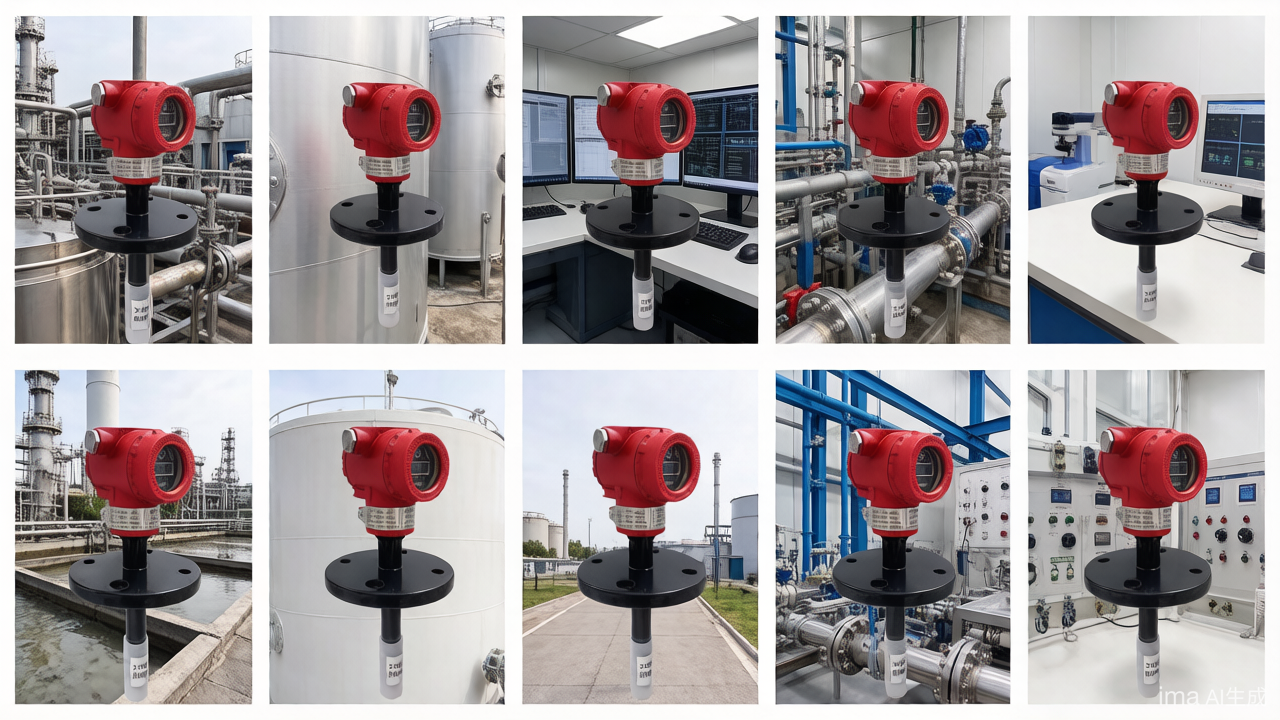
This is why many industrial pipeline systems use vibrating fork online density meters.
They provide:
- continuous operation
- stable readings under flow conditions
- relatively simple installation and maintenance
Installation Has a Direct Impact on Results
Even a good density meter can perform poorly if installation is not considered carefully.
Some common mistakes include:
- mounting near pumps
- installing in highly turbulent sections
- placing the sensor where gas can collect
A more reliable setup usually includes:
- stable flow conditions
- full liquid contact with the sensor
- distance from major vibration sources
In many cases, interface detection problems are caused more by installation issues than by the instrument itself.
Benefits of Accurate Interface Detection
When interface detection improves, pipeline efficiency improves as well.
Benefits typically include:
- reduced product contamination
- lower waste volume
- fewer off-spec batches
- improved transfer efficiency
- better operational control
Over time, even small improvements in transition management can produce significant cost savings.
How LONNMETER Supports Pipeline Interface Detection
At LONNMETER, we work with industrial customers using density measurement in real pipeline environments.
Our online density meters are designed for:
- continuous monitoring
- stable operation under flow conditions
- integration with industrial control systems
Support includes:
- application analysis
- installation recommendations
- technical guidance for interface monitoring
The focus is always on practical reliability in day-to-day operation.
Conclusion: Reliable Detection Starts with Reliable Measurement
In multi-product pipelines, interface detection is ultimately about controlling transition zones accurately.
Online density measurement provides operators with continuous insight into what is happening inside the line.
When the system is installed correctly and matched to the application, it becomes a practical tool for:
- reducing contamination
- improving efficiency
- supporting stable pipeline operation
In real industrial environments, consistency and reliability matter more than theoretical perfection.
Need Help with Pipeline Interface Detection?
If you are evaluating density measurement solutions for multi-product pipelines, it’s important to consider both process conditions and installation requirements.
You can learn more at:
Or contact LONNMETER for practical support based on real industrial pipeline applications.
Post time: May-08-2026


