

A magmeter looks simple until you have to size one for a slurry that chews through linings, or a dosing line where the electrode plates over in a fortnight. We build these instruments, calibrate them on our own water benches, and watch them fail in the field when the lining or the ground path was the wrong call. This guide is the checklist we hand our own application engineers before a quote goes out.
1. Confirm the principle fits before you size anything
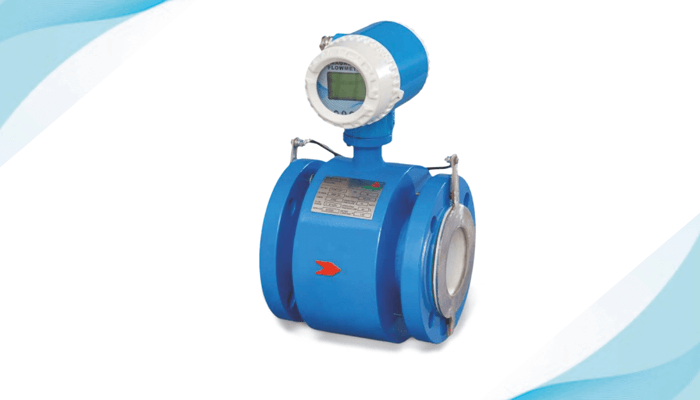
The electromagnetic flow meter works on Faraday’s law: a conductive fluid moving through a magnetic field induces a voltage proportional to average velocity. The meter measures velocity across a known bore, so it reports volume flow without a pressure-drop element in the path. That is the whole appeal — no orifice, no moving part, no turndown penalty from a restriction.
But the law has a hard gate. The fluid must be conductive. A clean, de-ionised stream below about 5 µS/cm will not register, and you should not pretend it will. Demineralised water, ultra-pure water in a pharma loop, and most hydrocarbons sit under that floor. We have seen engineers specify a magmeter on de-ionised make-up water and then wonder why the display never moved. It is not the instrument. The physics simply does not apply. For those duties, reach for an ultrasonic clamp-on or a Coriolis meter — both live outside the conductivity floor.
Gases, steam, and vapours are out entirely. So are open channels without a full pipe. A magmeter measures what fills the cross-section; a half-full sewer with a free surface is a different instrument class (a level-velocity meter, or a flume). Know this before you promise a number to the plant manager.
2. The lining decides the service life, not the body
The meter tube is steel, but the wetted surface is a liner. Pick the liner for the medium, the temperature, the abrasion, and the vacuum — in that order. Get it wrong and the body outlives the liner by a decade the liner never sees.
- PTFE (Teflon) — chemically near-universal, cleanable, good to about 180 °C. Weak on abrasion and on vacuum: it can collapse against the wall under suction. Needs a grounded, conductive version or a separate ground ring, because PTFE is an insulator and the signal return path must close elsewhere.
- PFA — like PTFE with better permeation resistance and easier moulding for small bores. The choice for aggressive chemicals and food-contact duty where you want zero porosity.
- Polyurethane (PU) — the abrasion king. Sludge, sand-laden water, mineral slurries, and tailings wear anything else smooth; PU shrugs them off. Limit it to about 60–70 °C and watch the chemical list (solvents attack it).
- Neoprene (chloroprene) — the general waterworks liner. Cheap, tough enough for potable and raw water, good to about 80 °C. The default for municipal duty unless the water is oily or hot.
- Hard rubber — good chemical resistance and abrasion, the old workhorse for mine and mill duties. Slower to machine, heavier to handle.
A water utility, a desalination pre-treatment line, a brewery wort stream, and a mining tailings pump each want a different liner. The body metal is the same; the liner is where the meter lives or dies.
3. Electrodes and the ground path
The electrode senses the induced voltage. Match the metal to the chemistry, and remember the ground path is part of the circuit.
- 316L stainless — potable water, clean process water, most neutral streams. The everyday choice.
- Hastelloy C-276 — chloride-heavy, acidic, and mixed-salt duties where 316L pits. Seawater and many chemical loops land here.
- Titanium — seawater, bromide, and chloride service with excellent resistance; lighter and often cheaper than Hastelloy for marine duty.
- Tantalum — strong oxidisers and most acids except hydrofluoric and hot caustic. Expensive; reserve it for the duty that needs it.
- Platinum-iridium — the top of the table for aggressive oxidising media, but rarely justified outside severe chemical service.
For abrasive or coating slurries, use scraping (self-cleaning) electrodes that wipe the surface on a cycle, or capacitive (non-contact) electrodes set behind the liner so the slurry never plates the metal. A wastewater return-sludge line that coats a static electrode will drift within weeks; a scraper electrode stays honest.
The ground is not optional. A magmeter needs a closed signal loop, and that loop closes through the process fluid and the pipe. With a conductive liner like rubber or PU, the steel body and pipe earth usually suffice. With PTFE or PFA — insulators — you must fit a grounding ring or ground electrodes, or the reading wanders with every pump start. We have rolled trucks to sites where the only fault was a missing ground ring on a PTFE line. Fix the ground, fix the meter.
4. Empty-pipe detection saves the audit
An empty-pipe (dry-pipe) function watches for a void at the top of the tube and freezes the output instead of reporting a wild flow when the line drains or a pump loses prime. On a chemical dosing skid this is the difference between a quiet night and a tank overfilled by a meter that thought it was still moving liquid. Specify empty-pipe detection on any line that can run dry, and wire it to hold the last good value or alarm — not to keep integrating.
5. Bore and velocity: size to the working window, not the pipe
The economic velocity window for a magmeter runs roughly 0.5 to 5 m/s, with 1 to 3 m/s the sweet spot for most water duties. Too slow and you lose resolution at low flow; too fast and you erode the liner and waste pump energy. The mistake we see most is sizing the meter to the adjacent pipe, so a line that usually runs at a trickle sits at 0.2 m/s in a DN200 body and the low-flow numbers are noise.
Work the velocity backwards from the flow:
- Case A — Raw water to a waterworks, peak 2,000 m³/h. Area for a 1.5 m/s target is Q/v = 0.556 / 1.5 = 0.37 m², which is a DN700. At low duty 400 m³/h the velocity drops to 0.30 m/s — still readable, still above the floor. Liner: neoprene. Electrode: 316L. That is a normal municipal pick.
- Case B — Return sludge at a treatment works, 300 m³/h with sand. A DN300 at 1.2 m/s. Liner: polyurethane for the abrasion. Electrode: scraping type, Hastelloy C, because the sludge is corrosive and coats. Empty-pipe detection on, because the return line drains on a cycle.
- Case C — PAC dosing, 2 m³/h, small line. A DN25 looks right at 1.1 m/s but the low-dose trickle falls to 0.2 m/s; step to DN20 for a healthier low end, liner PFA, Hastelloy electrode, and accept the higher velocity at peak. Dosing lines live at the small-bore edge where liner chemical resistance matters more than abrasion.
The point is boring but true: size the bore to the flow you actually carry, not the flange the pipefitter already welded.
6. Range, accuracy, and the number that matters
A well-specified magmeter reads about ±0.2% to ±0.5% of rate, with repeatability near ±0.1%, and a turndown around 100:1. The turndown is the quiet advantage over differential-pressure meters, which collapse at the bottom of their range. For billing or custody transfer on water, the ±0.2% class with MID approval is the bar; for internal balance and control, ±0.5% is plenty and cheaper.
Do not buy accuracy you cannot use. A control loop closed at ±0.5% gains nothing from a ±0.2% meter if the valve downstream is the real limit. Spend the budget on the liner and electrode that survive the fluid instead.
7. Straight length and upstream disturbance
A magmeter is forgiving on profile compared with an orifice, but it still wants a settled flow. Plan about 10 diameters of straight pipe upstream and 5 downstream from the nearest disturbance — a bend, a valve, a pump elbow. A close-coupled double bend throws a swirl that biases the average. Where space is tight, fit a flow straightener and document it; do not just hope the meter averages it out. We have corrected “meter reads 8% high” calls that were purely an elbow three diameters upstream.
8. Installation posture and the air trap
Mount the meter so the tube stays full. On a rising main that means a vertical run with flow upward, or a horizontal run on the bottom of a header where air migrates to the top and away. Never put the electrodes at the top of a horizontal pipe in a gassy line — gas collects there and you read bubbles. For lines that can siphon, vent the high point or the vacuum will collapse a PTFE liner. Submersible versions rated IP68 go straight into a wet well; a panel-mounted transmitter head does not.
9. Explosion protection and ingress
In a tank farm, a solvent area, or a gas plant, the transmitter needs the right Ex rating — flameproof Ex d or intrinsic safety Ex ia — matched to the zone. Ingress rating follows the location: IP67 for a weatherproof outdoor header, IP68 for submerged duty. A rating on paper means nothing if the conduit entry was never sealed; the cert lives or dies at the cable gland.
10. Output, signal, and the bus you already run
The analogue workhorse is 4–20 mA with a pulse output for totalisation. For integration, HART rides the same pair; Modbus RTU, Foundation Fieldbus, or Profibus PA sit on the fieldbus you already run. Pick the output the DCS expects, not the one the catalogue features. A pulse output to a batch controller on a chemical dosing skid closes the loop locally and saves the PAC the plant was pouring down the drain — typically 10 to 15% of dosing chemical, which pays for the meter inside a season.
11. Approvals that open the door
For drinking water, the liner and electrode face need the local potable approvals — WRAS in the UK, NSF-61 in North America, ACS in France, KTW-BWGL in Germany. For billing on water, MID (Measuring Instruments Directive) with OIML R49 pattern approval is the entry ticket across the EU. Food and pharma want FDA or EC 1935/2004 compliant liners. Hazardous areas want ATEX or IECEx. List the approvals the end user must have before you quote; a missing WRAS stamp can kill a tender you already shipped the sample for.
12. Total cost is the liner, not the sticker
The purchase price is a fraction of a magmeter’s life cost. A polyurethane liner in a gritty sludge line that lasts eight years beats a cheap neoprene that fails in two, even at triple the upfront. Calibration interval, liner replacement, and downtime at a remote pump station set the real number. We size for the duty that survives, because the second truck roll is the expensive one.
13. The pre-quote checklist we actually use
- Conductivity above 5 µS/cm? If not, stop — wrong principle.
- Fluid chemistry, temperature, and abrasion — which liner and electrode?
- Full pipe at all times, or empty-pipe detection required?
- Working flow range — what bore gives 0.5–5 m/s, not just peak?
- Straight length available, or straightener needed?
- Ground path closed (ground ring on PTFE/PFA)?
- Ex zone and ingress rating for the location?
- Approvals the tender demands (MID, WRAS, NSF-61, ATEX)?
Any blank line is a question back to the client, not a guess in the quote.
14. Mistakes we keep finding in the field
- Sizing to the adjacent pipe, then living below 0.3 m/s every night the plant idles.
- Skipping the ground ring on a PTFE line and chasing a “fault” that is a floating signal.
- Choosing neoprene for a hot solvent and watching it swell.
- Forgetting empty-pipe detection on a line that drains, and integrating air.
- Buying ±0.2% where the valve, not the meter, sets the loop accuracy.
A water utility, a desalination plant, a brewery, a dairy, a paint line, an ink blend, an adhesive mix, a mining tailings pump, and a pharmaceutical WFI loop all look like “a flow meter” until you pick the liner. The selection is the product.
15. Why the maker matters here
We machine the bodies, mould the liners, wind the coils, and calibrate on our own traceable water benches — so the bore, the field, and the zero are set by one accountable shop, not a supply chain of strangers. Our excitation drives a low-frequency three-value square wave that holds the zero against the earth loops a magmeter hates, and a dual-frequency mode that rides through slurry noise other meters turn into drift. For OEM and ODM buyers, the same instrument ships under your label with your approvals file. When a liner fails at a remote site, you call one number and reach the people who built it.
16. When this is not the meter
For conductive liquid in a full pipe, the magmeter is hard to beat on cost and turndown. For non-conductive fluids, gases, steam, or open channels, it cannot read — that is physics, not a limitation we can engineer out. For those, a Coriolis meter covers non-conductive liquids and gives mass and density, an ultrasonic clamp-on covers external and non-intrusive duty, and a level-velocity meter covers the half-full sewer. Pick the principle first; the model follows.
Post time: Oct-08-2026


