

A water utility does not buy a flow meter because it is elegant. It buys one because the number on the screen has to hold up in a billing dispute, survive a grit-laden storm overflow, and still read within tolerance after five years of chlorinated water. We build magmeters for exactly that kind of abuse. This note is written from our application engineering desk — the same desk that signs off the lining-and-electrode matrix before a unit leaves the plant — and it covers what actually decides whether an electromagnetic flow meter works in water and wastewater service, not what the brochure headline implies.
1. Why plants keep coming back to the magmeter
In water and wastewater, the magmeter won more ground than any other principle because it has no moving parts in the wetted path. There is nothing to wear against the flow, nothing to jam with rags, and the pressure drop is effectively zero. For a lift station moving screened sewage, that single fact removes the failure mode that kills most mechanical meters. We still specify turbine and positive-displacement meters for clean, viscous or custody-transfer duties elsewhere, but for conductive liquids with solids, air or chemistry, the magnetic principle is usually the least troublesome.
That said, it is not universal. The one hard rule is conductivity: the liquid must conduct. Below roughly 5 µS/cm, the signal collapses. We have watched more than one installer try to put a magmeter on deionized rinse water and wonder why the reading flatlined. It is not a fault. It is the physics.
2. The physics, stated once and plainly
Faraday’s law of induction is the whole game. A conductive fluid moving through a magnetic field induces a voltage. For a meter of fixed bore, that induced voltage is proportional to average velocity:
E = B · L · v
where B is the field flux density, L is the electrode spacing (fixed by the bore), and v is the mean velocity of the liquid. Multiply by the known cross-section and you get volume flow. No inference, no float, no turbine wheel. The meter measures the velocity of a conductor moving through a field, and converts that to volume against geometry it already knows.
Two consequences follow that people underweight. First, because the measurement is geometric and volumetric, density, viscosity, pressure and temperature of the liquid do not enter the equation — as long as it conducts and the pipe stays full. Second, the signal scales with velocity, so any condition that distorts the velocity profile (air pockets, partly full pipe, swirl from a bad elbow) distorts the reading directly. Most “magmeter is wrong” calls we get are actually “the pipe is not full” or “there is a bubble train” calls.
3. Reading the datasheet like an engineer
Buyers fixate on the accuracy number. It matters, but it is the least of what breaks a water application. Here is the order we actually check.
Accuracy class. For water, reputable magmeters sit at ±0.2% to ±0.5% of rate depending on bore and lining. Smaller bores tend to hold the tighter class. For custody transfer of potable water we treat ±0.2% as the floor and require a certified instrument.
Repeatability. Often ±0.1% or better. This is what matters for dosing control loops even when absolute accuracy is looser.
Turndown (range ratio). A good magmeter holds 100:1 or more. That is the difference between reading the night-line trickle and the storm peak on the same sensor. We have replaced meters that were “fine” but had a 10:1 turndown because the plant’s low-flow leakage accounting was useless.
Lining and electrode compatibility. This is where water and wastewater diverge most. We cover it below.
Empty-pipe detection. Non-negotiable for lift stations and any suction application. If the pipe runs dry, the meter must alarm, not freeze at a stale value.
Grounding provision. Non-conductive linings need a ground path through ground rings or ground electrodes. Miss this and the reading wanders with the plant earth.
Output and comms. 4-20 mA plus pulse is the baseline. HART or Modbus RTU/TCP earns its place the moment the signal feeds a SCADA or a dosing controller.
4. Lining selection — the matrix that decides service life
The lining is the only thing between the process and the sensor body. Pick wrong and you are pulling the meter in eighteen months. Our standard selection matrix for water duties:
| Media condition | Recommended lining | Why | Watch-outs |
| Clean potable water, ambient | PTFE or PFA | inert, smooth, certifiable | cost; needs ground ring |
| Raw water, slight abrasion | Hard rubber / Ebonite | tough, economical | temperature cap ~60 °C |
| Wastewater, grit, sludge | Polyurethane (PU) | best abrasion resistance | not for strong solvents |
| Chemically aggressive dosing | PFA | broad chemical resistance, high temp | premium |
| High-temperature effluent | PFA / FEP | stable to ~180 °C | liner adhesion at flanges |
| General sewage, mild | Neoprene (CR) | cheap, decent wear | swell with some organics |
For drinking-water service the lining has to clear the local potable-contact certification — WRAS in the UK, NSF/ANSI 61 in North America, KTW-BWGL in Germany. We keep dedicated potable-grade linings and do not mix them with industrial stock, because the certification chain is part of the product, not a sticker.
A note from the field: polyurethane beats PTFE hands down for grit, but it hates aromatic solvents and some hydrocarbons. If the wastewater stream ever sees fuel interceptors or solvent recovery, we move the lining up to PFA and accept the cost. The wrong lining choice is the most expensive cheap decision in this whole spec.
5. Electrode and grounding — the part people get wrong
Electrodes pick up the induced voltage. In clean water, 316L stainless is fine. The moment you add chlorination, hydrogen sulfide, or abrasive grit, the choice changes:
- Chlorinated / aggressive: Hastelloy C-276 or titanium.
- Sludge with scaling tendency: tantalum, or a platinum-coated pair, or — our preference for fouling service — a scraper-type (self-cleaning) electrode that the operator cycles weekly.
- High abrasion + corrosion: Hastelloy C with a hardened face, or ceramic.
Grounding is where installations go bad. A PTFE-lined meter is electrically insulated from the pipe. Without a ground ring or ground electrodes straddling the liner, the measurement reference floats and the signal rides the plant earth noise. We mandate ground rings on every non-conductive-lined meter and document the jumper in the install sheet. Half the “unstable magmeter” service calls we attend are a missing or painted-over ground strap.
Conductivity deserves a sentence of respect. Most municipal water sits well above the 5 µS/cm floor, so it is a non-issue — until you meter reverse-osmosis permeate or condensate, where it is a hard stop. We ask for the conductivity range on every enquiry for that reason.
6. Installation rules that decide whether it works
We can ship a perfect meter and still watch it fail on site. The rules:
Full pipe, always. A magmeter measures velocity across the whole bore. A partly filled sewer pipe is not a flow meter, it is a guess. On gravity lines we specify an inverted-U or a full-flow weir upstream, or a filling valve. On pumped suction we keep the meter below the source and short-coupled.
Straight run. Ten diameters upstream, five downstream, free of valves and elbows that swirl the profile. Where the pit is cramped we fit a straightening vane rather than accept a distorted profile.
No air at the top. Air collects at high points. We route the meter on a rising run, or put a de-gas point just upstream. Bubble trains read as flow spikes and then dropouts.
Ground and bond. Covered above — but it belongs in the install section too, because the electrician and the fitter are different people.
Avoid siphon. A siphon above the meter empties the bore mid-span and the reading goes mad. We set the meter below hydraulic grade or break the siphon with an air valve.
One war story: a treatment works complained of 8% over-registration on a stormwater bypass. The meter was perfect. The upstream elbow had no straight run and a persistent vortex threw the profile. Ten diameters of spool and a vane later, the dispute with the neighboring district evaporated.
7. Application notes by duty
7.1 Raw water and intake
Large bore (DN300–DN1200 and up), low and variable velocity, sand in suspension. We line with hard rubber for economy and fit 316L or Hastelloy electrodes. Velocity is kept in the 1–2 m/s band to limit abrasion but stay above the low-end turndown floor. Empty-pipe detection is mandatory because intake screens trip and the line drains.
7.2 Drinking water (potable)
Accuracy and certification lead. We use PTFE or PFA lining with potable-grade certification, ±0.2% accuracy, and — for billing — a unit cleared to MID (Measuring Instruments Directive 2014/32/EU) or OIML R49 for cold-water meters. Pulse output drives the revenue meter; the 4-20 mA feeds the SCADA trend. We dual-stamp the calibration certificate because the water authority audits it.
7.3 Wastewater and sludge
This is the harsh end. Grit abrades linings; rags and grease foul electrodes; hydrogen sulfide corrodes. We line with polyurethane for grit, step electrodes up to Hastelloy C or ceramic for abrasion, and specify scraper electrodes where fatbergs form. Turndown has to cover the dry-weather trickle and the storm surge on one sensor. We add empty-pipe detection because lift stations transiently run dry.
7.4 Chemical dosing
Chlorine (sodium hypochlorite), PAC, ferric, and polymer (PAM) are dosed in small bore (DN15–DN50) at low, steady flow. The liquid is corrosive and sometimes sticky. PFA lining, tantalum or platinum electrodes, and a pulse output into the dosing controller. We keep velocity modest to avoid shear damage to polymer chains in PAM lines — too fast and the flocculant is partly sheared before it doses.
8. Empty-pipe detection and fouling maintenance
Empty-pipe detection uses the change in capacitance between the electrodes and the (absent) liquid. When the bore drains, the meter flags it and holds or zeros the output instead of reporting a phantom flow. For a lift station this single feature stops a pump running dry from being logged as throughput.
Electrode fouling is the other routine issue. Grease and scale build an insulating film and the signal drifts. Options, in order of preference: scraper electrodes cycled on a schedule; a periodic chemical clean (citric or inhibited acid, commensurate with lining); or — for stubborn duty — a removable electrode the crew swaps without pulling the spool. We do not recommend ultrasonic cleaning on lined sensors; the liner does not like it.
9. Signal, batch control and the dosing loop
The meter is only as useful as what eats its signal. Our standard fit:
- 4-20 mA for rate, wired to the PLC or recorder.
- Pulse / frequency for totalized volume — the revenue and dosing signal.
- HART for config and diagnostics over the loop.
- Modbus RTU/TCP where the plant runs open protocol.
For dosing, the pulse output drives a batch controller: dose a fixed volume of PAC per tank turnover, closed-loop, no operator in the loop. We have seen polymer savings of 10–15% just from replacing a hand-dosed scoop with a magmetered batch because the dose became repeatable instead of hopeful. The magmeter does not save chemical by magic; it saves chemical by making the dose a measured thing.
10. How the magmeter compares
| Principle | Conductive liquids | Solids / sludge | Zero moving parts | Turndown | Notes |
| Electromagnetic | yes | excellent | yes | ~100:1 | needs conductivity >5 µS/cm |
| Ultrasonic (clamp) | yes | poor (scatter) | yes | moderate | no pipe cut, but solids scatter signal |
| Ultrasonic (inline) | yes | fair | yes | moderate | better than clamp, still grit-sensitive |
| Vortex | yes | poor | yes | ~10–20:1 | needs min velocity, bluff-body wear |
| Turbine | clean only | no | no | moderate | bearing wear, not for sewage |
| Open-channel (weir) | yes | good | yes | wide | needs free surface, civil works |
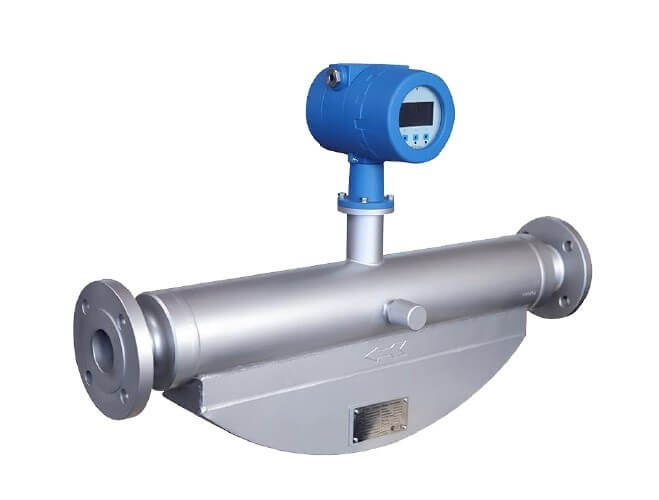
For full-pipe conductive water with grit, the magmeter wins on ruggedness and turndown. For non-conductive or ultra-pure water, it is disqualified and we move to ultrasonic or coriolis. For free-surface channels, a magmeter cannot read at all and the weir or flume takes over. Our coriolis mass flow meter covers the non-conductive and mass/custody cases; the two principles are siblings in the same flow portfolio, not rivals.
11. Sizing worked example
A regional works needs to meter raw-water intake, expected 800 m³/h peak, 120 m³/h night line. They propose DN300.
Cross-section A = π·(0.30)²/4 = 0.0707 m². Peak velocity v = 800 / (3600 · 0.0707) = 3.14 m/s. Night velocity v = 120 / (3600 · 0.0707) = 0.47 m/s.
At 3.14 m/s the peak is above our 3 m/s abrasion comfort line for gritty raw water, and at 0.47 m/s the night line is well inside the turndown but near the lower accuracy band. We recommend DN350 instead: peak drops to 2.31 m/s (lining-friendly), night rises to 0.35 m/s (still readable on a 100:1 turndown). Lining hard rubber, electrodes 316L, ground rings, empty-pipe on. The slight oversize costs little and keeps the meter in its happy range for the whole operating envelope. Sizing to the peak alone is the classic error; we size to the envelope.
12. Calibration and certifications
We calibrate every magmeter on a water rig — volumetric or weighbridge tank — before it ships, and stamp the certificate to the stated accuracy class. For potable and custody duties the unit carries the applicable approvals:
- MID (2014/32/EU) and OIML R49 for cold-water custody transfer in the EU and aligning markets.
- WRAS / NSF-61 / KTW-BWGL for potable-contact linings.
- ISO 9001 as the baseline quality system.
- ATEX / IECEx where the location is classified (gas or dust zone).
- IP67 / IP68 rating matched to the duty — IP68 for permanent submersion in wet wells.
We keep the calibration rig in-house because sending a DN600 sensor to a third party is neither fast nor cheap, and our own bench lets us re-certify returned units in days, not weeks. The certificate chain — material, lining cert, calibration, approval — is what a water authority actually audits, and we treat it as part of the product rather than paperwork.
13. What we actually build
We are not a reseller with a logo. We machine the flow tube, weld the housings, wind and pot the excitation coils, bond the linings, and calibrate on our own rig — design, manufacture, and sales under one roof. That vertical span matters when something is wrong at 2 a.m.: the person who answers the call can trace the unit to the coil batch and the calibration record, not to a distributor three companies away.
On the technology side, our excitation uses low-frequency three-value square-wave drive to suppress zero drift and quadrature interference, with dual-frequency excitation available for heavy slurry duty where electrode noise would otherwise corrupt the signal. We offer OEM and ODM builds for integrators who need the sensor under their own name, with the same calibration discipline. One accountable entity, from the lining bond to the certificate — that is the part no catalog paragraph conveys until something fails.
14. When not to use a magmeter
Honesty here protects the client. Do not specify a magmeter for:
- Non-conductive liquids (DI water, oils, most solvents) — below the conductivity floor.
- Gases or steam — no conductor, no signal.
- Free-surface / open channel — needs a weir or flume instead.
- Very low flow in a huge bore — size to the envelope, do not expect a DN600 to read the dribble honestly.
Where those constraints bite, we point to our coriolis or ultrasonic lines rather than force a square peg. The right meter is the one that reads true for the actual liquid, not the one on the shelf.
15. Spec checklist and next step
Before you issue the enquiry, lock these down: liquid and conductivity range, solids content and size, temperature and pressure, bore and expected velocity envelope, custody or control intent, lining and electrode allowance, and the approvals your authority demands. Send us that and we return a sized proposal with the lining-electrode matrix and the calibration certificate path.
If you are scoping a water or wastewater project and want the sizing checked against your actual duty, reach the application desk through the contact page and we will work the envelope with you — including which principle in our flow portfolio actually fits, not just the magmeter.
Post time: Sep-28-2026


