

What is the difference — and why it changes how you specify
By LONNMETER Technical Team · Process density & concentration instrumentation
A customer called us last month. They were specifying instruments for a sulfuric acid dilution skid. “I need a density meter and a concentration meter,” they said. “Two separate boxes.” We stopped them there. In most cases what they needed was one density meter with concentration output configured — not two instruments.
|
The short version: a density meter measures density. A concentration meter reports concentration. Under the hood, nine times out of ten, they are the same instrument. The concentration number is computed from the density using a conversion table for your specific fluid. You are not buying two technologies. You are buying one sensor and deciding what number it shows you. |
Same sensor, different output
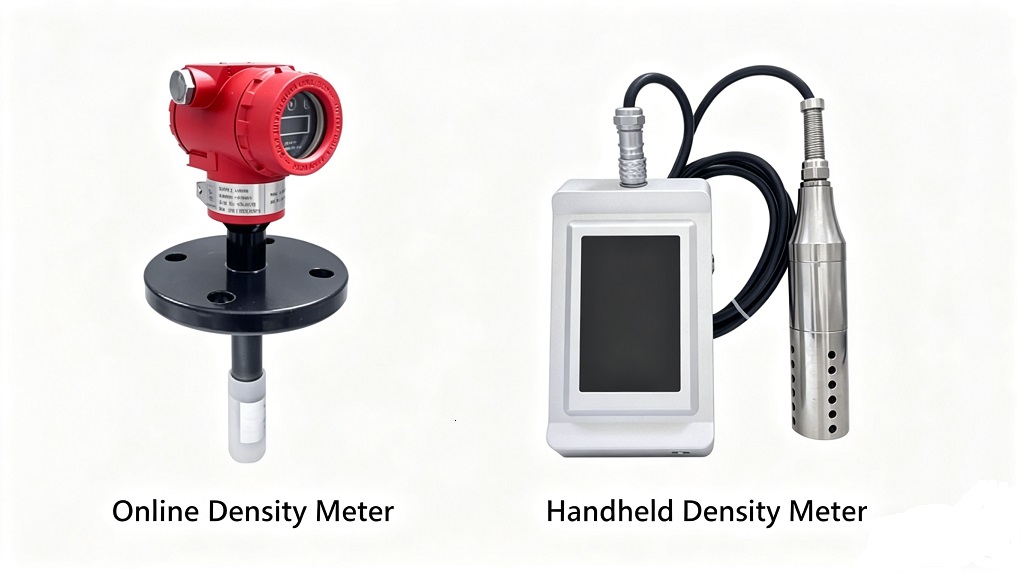
An inline tuning fork density meter works by vibrating a fork immersed in the fluid and measuring the resonant frequency. Heavier fluid (higher density) lowers the frequency. The meter converts that frequency into a density value. That part is fixed.
The firmware then does something extra if you ask it to: it maps the density to concentration using a stored curve for your fluid. For sulfuric acid, a density of 1.399 g/cm³ at 20°C becomes “50% H₂SO₄”. The sensor did not change. Only the output mapping did. So when a supplier sells you a “concentration meter,” check the spec sheet — it is usually a density meter with a specific calibration fluid and a preloaded conversion table.
When density alone is enough
You do not need concentration output if:
The spec is written in density units. Petroleum uses API gravity. Many custody transfer agreements use specific gravity at 15°C. If the contract says density, output density.
You are monitoring a trend, not an absolute value. Watching whether the density drifts tells you if the feedstock changed, even if you never convert to concentration.
The fluid composition is fixed and you only need to confirm it has not shifted. A density check is faster and needs no conversion curve.
When you actually need concentration
You want concentration output when the process is controlled in concentration terms: blending to a target acid strength, holding a syrup at a target Brix, hitting a specified % solids in a slurry. Operators think in “50% acid,” not “1.399 g/cm³.” If the control loop and the quality spec are both in concentration units, configure the meter to output concentration and skip the mental math.
|
Worked example — sulfuric acid at 20°C: 1.066 g/cm³ → 10% H₂SO₄ 1.219 g/cm³ → 30% H₂SO₄ 1.399 g/cm³ → 50% H₂SO₄ 1.614 g/cm³ → 70% H₂SO₄ 1.836 g/cm³ → 98% H₂SO₄
A density meter reads 1.399 g/cm³. With the H₂SO₄ conversion table loaded, it outputs 50% directly. No second instrument. The concentration is just the density, mapped through the table. |
The conversion trap
Three things break a clean density-to-concentration conversion:
It is fluid-specific. The H₂SO₄ table does not apply to NaOH, and neither applies to ethanol. Load the wrong curve and every reading is wrong by design.
Some relationships are non-linear. Sugar solutions and alcohol-water mixtures bend. Linear interpolation between two calibration points can be off by 1–2%. Use the full curve, not a straight line.
Multi-component mixtures are ambiguous. Density alone cannot resolve concentration if more than one component is changing. A 50/50 blend of two liquids with the same density reads identically to either pure fluid. You need a second sensing principle (sound velocity, refractive index) to separate them.
“Do I need both?” — the real answer
Usually no. One density meter with concentration output covers both needs. The exceptions: custody transfer where density is the legal unit (output both, from one meter), and two-component systems where density alone is ambiguous (then add a second principle, not a second density box). If you are tempted to buy two instruments, ask first whether one meter configured two ways does the job.
A four-step way to decide
1. Is your fluid a single-component solution or a well-defined mixture? If no (unknown multi-component), you need more than density — stop and call us.
2. Is the density-concentration relationship documented for your fluid? If yes, a density meter with that conversion covers it. If no, you must build and validate the curve first.
3. Is your spec written in concentration or density? Configure the meter output to match. You can usually output both on separate channels.
4. Still unsure? Send LONNMETER your fluid and target range. We will tell you whether one meter is enough.
Questions we get on this
Is a concentration meter more accurate than a density meter?
No. The concentration reading carries the density measurement error plus the conversion error. If the density meter is ±0.001 g/cm³ and the conversion curve is ±0.2%, the concentration output inherits both. A “concentration meter” does not bypass this — it just hides the step.
Can one meter output density and concentration at the same time?
Yes. Most inline density meters output density on one channel (4-20 mA) and concentration on another (Modbus RTU or a second analog channel). You get both numbers from one sensor, which is cheaper and gives a cleaner data trail than two boxes.
What if the mixture composition changes during the run?
If the same components stay present and only the ratio changes, density still tracks concentration as long as the conversion table spans the range. If a third component shows up, the density-concentration relationship shifts and the reading drifts. Watch for that with a periodic lab check.
Why do some suppliers list density and concentration meters as separate products?
Mostly packaging. The sensor is the same; the difference is the firmware, the calibration fluid used at the factory, and the output configuration. Some suppliers tune the conversion table for one industry (sugar, acid) and label it for that market. The hardware is often interchangeable — which is why one meter usually does both jobs.
For custody transfer, which reading is legal — density or concentration?
Depends on the commodity and the contract. Petroleum uses density (API gravity) as the legal basis. Chemicals sold by concentration use the concentration spec. Configure the meter to output the legal unit and log the other as supporting data.
Post time: Jul-15-2026


