

Density measurement in a chemical plant is harder than it looks. Not because the physics is complicated — a tuning fork in a liquid still measures density the same way it does anywhere. The difficulty is that chemical service attacks the instrument from three directions at once: the fluid is corrosive, the temperature swings, and the composition is rarely a clean single-component solution.
Most failed chemical-plant density installations were not failed measurements. They were failed assumptions — assuming the fluid was single-component when it was not, assuming 316L would survive when it would not, or assuming the density reading could be converted to concentration without checking the conversion curve. This article walks through the three difficulties in order and shows how each is handled in practice.
The short version up front: pick the wetted material for the worst-case chemical, verify the single-solute assumption before trusting a density-to-concentration conversion, and correct density to a fixed reference temperature. Get those three right and a density meter is one of the most reliable instruments in a chemical plant.
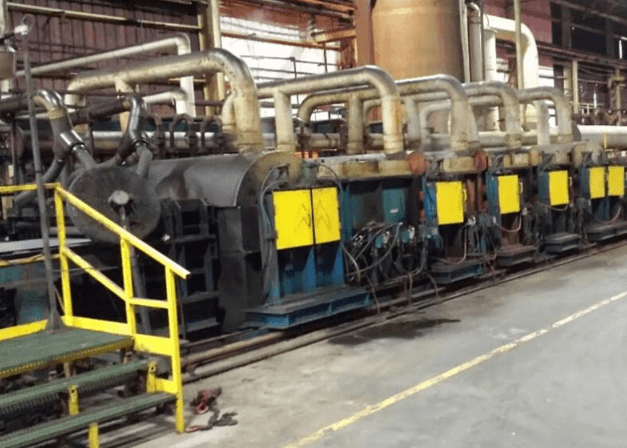
Difficulty 1: the fluid is trying to eat the sensor
Corrosion is the number one cause of premature density meter failure in chemical service. A corroded tuning fork changes its resonant characteristics — mass loss from pitting shifts the frequency, and the density reading drifts even though the fluid is unchanged. Worse, corrosion failures often happen invisibly: the fork looks acceptable to the naked eye while microscopic pitting has already changed the calibration.
The wetted material must be selected for the worst case, not the average case — meaning the highest concentration and the highest temperature the sensor will ever see, including during cleaning and upsets. A selection based on normal operating conditions fails during the first CIP cycle or acid excursion.
| Service | Recommended wetted material | Notes |
| H₂SO₄ < 95% | Hastelloy C-276 | 316L fails quickly in H₂SO₄ even at moderate concentration |
| HCl any concentration | Tantalum, PTFE-lined, or zirconium | HCl is aggressive to most metals; wetted parts need refractory metals or linings |
| NaOH / KOH | 316L (cold), nickel alloy (hot) | 316L fine below ~60°C; hot caustic causes stress corrosion cracking |
| Organic solvents | 316L (most), Hastelloy (chlorinated) | Chlorinated solvents require higher alloy; check gasket compatibility |
| HNO₃ | 316L (passivates) | 316L passivates in nitric; avoid reducing contaminants |
| Wet Cl₂ / hypochlorite | Titanium (dry), Hastelloy C-276 (wet) | Titanium burns in dry Cl₂; service boundary must be checked |
Rule of thumb from our field experience: if the plant’s piping for the same service uses Hastelloy, the density meter wetted parts should too. If the pipe is lined (PTFE, PFA), specify a lined or tantalum sensor option. Do not let a 316L sensor become the weakest material in the line — it will be the first thing to fail, and it fails into the process.
Difficulty 2: density only converts to concentration for one solute
Density is a bulk property. It sums up everything dissolved in the liquid. If the process stream contains exactly one solute in a known solvent, density maps cleanly to concentration through a calibration table. The moment a second solute appears — or the solvent composition drifts — the same density reading can correspond to two different concentrations, or to a concentration that no longer means what the table claims.
Where this bites in practice:
Reaction mixtures. Mid-reaction, the mixture contains reactant, product, catalyst, and byproducts. Density is useful for tracking conversion only if the density difference between reactant and product is large and the other components stay constant. Otherwise the density trend may be driven by byproduct formation, not conversion.
Solvent recovery columns. A distillation column separating a solvent from water gives a clean binary density curve — fine. But if the feed contains two solvents with similar boiling points, the bottoms density no longer tracks a single composition.
Waste streams. Effluent composition changes with upstream operations. A density-based concentration reading on a variable-composition waste stream is only indicative, not quantitative.
The discipline: before commissioning a density-to-concentration measurement, take at least ten process samples across the expected operating range and verify that the lab concentration correlates with density within the required accuracy. If it does not, the stream is multi-component and needs a second measurement parameter — conductivity, refractive index, or a composition model — rather than a single density meter.
| Single-solute check — do this before you buy
1. Collect samples spanning the full expected operating range (low, normal, high) 2. Measure each sample: lab concentration (titration, drying, GC) AND density 3. Plot concentration vs density. Check for a monotonic, tight relationship 4. If scatter exceeds your accuracy requirement → stream is multi-component 5. If the relationship is clean → build the conversion table from real plant data rather than textbook values — plant solvent composition is never exactly the textbook mixture
A 5 g/L acid reading from a density meter is only trustworthy if the lab correlation says it is. Verify, then trust. |
Difficulty 3: temperature is moving underneath the reading
Chemical processes are rarely isothermal. Reactors heat up, exotherms spike, heat exchangers drift, and batch processes cycle through temperature profiles. Every one of those temperature changes moves the density reading — by 0.0002 g/cm³ per °C for water-like fluids, and by 0.0007–0.0012 g/cm³ per °C for hydrocarbons and many organics. A 30°C temperature swing on an organic stream shifts density by 0.02–0.04 g/cm³ — an error far larger than the meter’s own accuracy.
The fix is temperature compensation with the right coefficient for the actual fluid. Every density meter compensates; the question is whether the coefficient in the configuration matches the fluid in the pipe. Default coefficients tuned for water are wrong for most chemical streams. Set the α coefficient from the plant’s own density-vs-temperature data, not from a generic table.
Also check where the temperature sensor sits. A density meter compensates using its own temperature element, which must be at the same temperature as the fluid at the fork. On a hot line with poor thermal contact, or in a stagnant pocket, the compensation temperature can lag the true fluid temperature by several degrees — silently degrading the corrected reading.
Where inline density pays for itself in a chemical plant
Three measurement stations have the clearest return in chemical service:
1. Acid and caustic dilution / concentration stations. A density meter on the dilution water line closes the loop on acid strength. The payback is quality consistency plus safety — an over-strength acid batch downstream is a hazard, not just a defect. Typical accuracy requirement: ±0.005 g/cm³, which resolves roughly ±0.5% H₂SO₄ in the 90–98% range.
2. Reactor feed verification. Confirming feed composition before it enters the reactor catches blend errors that lab sampling would find only after the batch is ruined. Density at the feed header is the cheapest insurance against stoichiometry errors.
3. Solvent recovery and recycle. Density on the recovered solvent stream verifies purity before recycle. Reusing off-spec solvent propagates contamination through every subsequent batch — a failure mode that is expensive and hard to trace.
In each station, the density meter replaces grab sampling with continuous visibility. The economic argument is not the meter cost — it is the cost of the batches that a continuous measurement prevents from going off-spec.
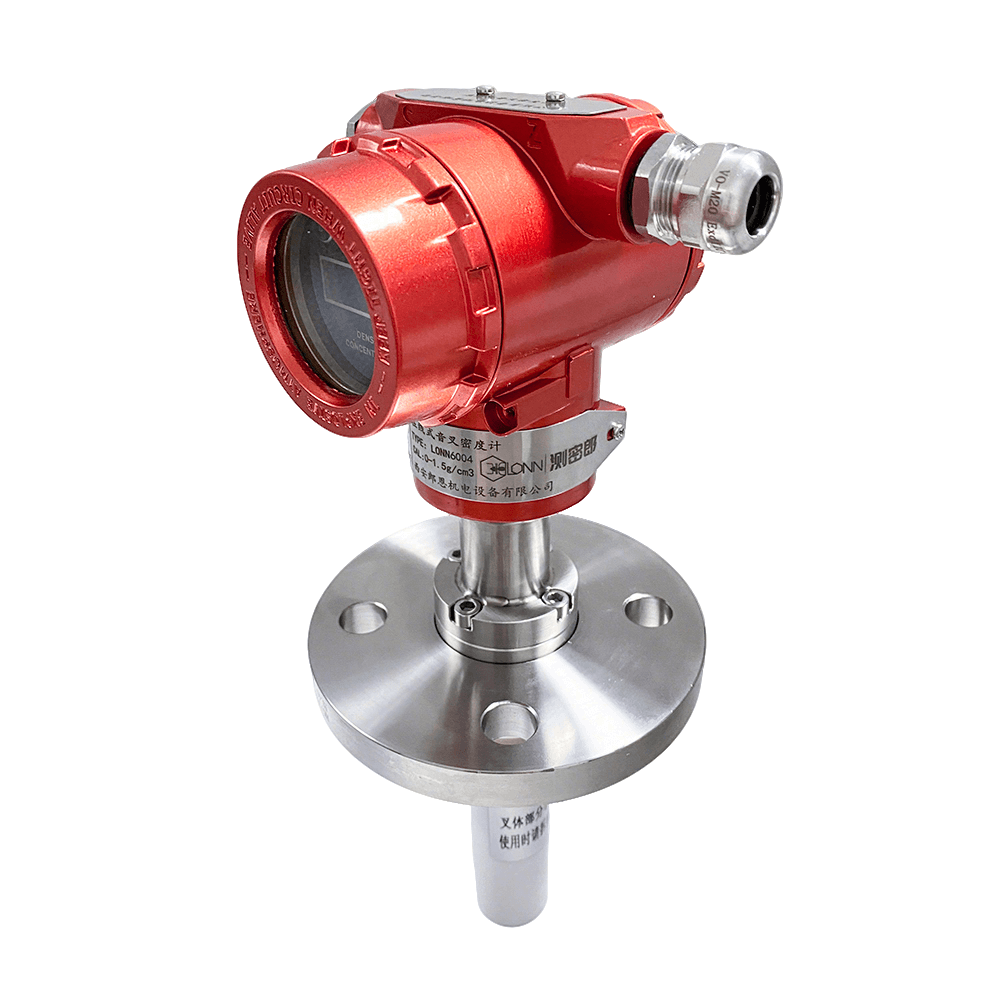
Specifying for chemical service with LONNMETER
The LONN-6004 tuning fork density meter covers 0.60–2.50 g/cm³ in standard configuration, with accuracy to ±0.001 g/cm³ in clean service. For chemical plants the meaningful options are the wetted materials — 316L, Hastelloy C-276, tantalum, or PTFE-lined versions — and the temperature rating, which extends to 150°C in high-temperature builds. Hazardous area versions carry ATEX/IECEx Zone 1 certification with gas group IIB or IIC depending on the build.
When you send us the fluid name, concentration range, temperature range, and pressure, we will confirm the material selection and the conversion table — and tell you honestly if your stream is too multi-component for a single density measurement. That honesty saves both of us a failed installation.
Common questions on density measurement in chemical service
Can a 316L density meter handle 30% hydrochloric acid?
No. 316L is not suitable for hydrochloric acid service at any meaningful concentration — general corrosion and pitting proceed rapidly. For HCl you need tantalum, zirconium, or a PTFE-lined sensor configuration. The same applies to hot concentrated sulfuric acid: 316L fails, Hastelloy C-276 is the standard choice. Match the wetted material to the worst-case chemical exposure, and confirm with the manufacturer’s corrosion data before purchase.
Why does my density-based concentration reading drift when the reactor feed changes?
Because the feed contains more than the single solute your conversion table assumes. When the solvent composition, catalyst level, or byproduct profile changes, the density-to-concentration relationship shifts. Run the single-solute check described above across your actual operating envelope. If the stream is genuinely multi-component, either install a second measurement parameter or use the density reading as a trend indicator rather than an absolute concentration.
How much does temperature affect a sulfuric acid density reading?
For concentrated H₂SO₄ (90–98%), density changes by roughly 0.0006–0.0008 g/cm³ per °C. Over a 20°C temperature swing, that is 0.012–0.016 g/cm³ of uncompensated shift — enough to move the inferred concentration by about 0.5–1%. Modern inline meters compensate automatically using a temperature element at the sensor, but the compensation coefficient must match the acid concentration range, because the coefficient itself varies with concentration. Verify the setting against plant data.
What accuracy do I actually need for acid strength control?
It depends on the process tolerance, but as a practical baseline: ±0.005 g/cm³ density accuracy resolves roughly ±0.5% H₂SO₄ in the 90–98% range and about ±0.2–0.3% NaOH in the 20–50% range. If your process needs tighter control than the conversion curve allows, remember the accuracy limit is set by the steepness of the density-concentration curve at your operating point — not just by the meter specification. Confirm the sensitivity at your concentration before selecting the meter accuracy class.
How often should I verify a density meter in aggressive chemical service?
More often than in benign service. Start with monthly verification against a lab measurement of a grab sample, plus a visual inspection of the wetted parts during any maintenance window. Watch the diagnostic frequency reading — a slow frequency drift between verifications is the earliest sign of corrosion or coating. If pitting is found, the sensor must be replaced, not recalibrated: corrosion changes the fork geometry permanently, and no calibration can restore it.
Post time: Sep-14-2026


