

Why Density Matters in Battery Electrolyte
If you have spent any time on a battery production line, you already know this: electrolyte concentration drives everything that comes after. Get it wrong at the mixing stage and the finished cell will not meet specification, no matter how good the separator or the cathode material.
In lithium-ion production, the electrolyte is typically a lithium salt — LiPF₆ most commonly — dissolved in a mixture of organic carbonates. The concentration of that salt directly determines the ionic conductivity of the electrolyte. Too dilute and internal resistance climbs. Too concentrated and you risk precipitation or poor wetting of the electrodes.
The practical way most plants track this is by measuring density. Density correlates with concentration in a well-characterized way for these solutions, and an inline density meter gives you that number in real time, without pulling samples.

Lithium-Ion Electrolyte: Typical Density Ranges
A 1M LiPF₆ solution in EC/DMC (ethylene carbonate / dimethyl carbonate) typically lands around 1.15 to 1.25 g/cm³ at room temperature. The exact number shifts depending on the solvent blend ratio — and that ratio is itself a formulation parameter worth monitoring.
During mixing, the density rises as the salt goes into solution. A density meter placed in the mixing loop lets the operator see that curve in real time. When the reading stabilizes at the target value, mixing is complete. That is the basic workflow in most electrolyte preparation rooms.
Temperature matters here more than most people expect. The density of these carbonate blends has a temperature coefficient on the order of -0.001 g/cm³ per °C. If your process runs at 40°C and your reference table is at 25°C, you will be reading consistently low. Integrated temperature compensation is not optional in this application.
|
Electrolyte Type |
Density Range |
Temperature |
Notes |
|
LiPF₆ in EC/DMC (1M) |
1.15 – 1.25 g/cm³ |
20 – 40°C |
Most common commercial blend |
|
LiPF₆ in EC/DEC |
1.18 – 1.28 g/cm³ |
20 – 40°C |
DEC increases density slightly |
|
LCO / NMC electrolyte |
1.20 – 1.30 g/cm³ |
25 °C (reference) |
Formulation-specific |
|
Lead-acid (H₂SO₄) |
1.05 – 1.28 g/cm³ |
20 – 50°C |
Correlates with SoC |
Lead-Acid: Density as a State-of-Charge Indicator
Lead-acid is a different story. Here, density measurement pulls double duty. It confirms the acid concentration during production, and it also serves as a state-of-charge indicator in the finished battery.
A fully charged lead-acid cell with 1.28 g/cm³ electrolyte will read closer to 1.05 g/cm³ when discharged. That correlation is linear enough to be useful, and it is why every lead-acid plant has density measurement somewhere in the process.
During formation — the controlled charging step that activates the plates — density drops as sulfuric acid is consumed to form lead sulfate. Monitoring that density drop tells you when formation is complete. Some lines still do this with hydrometers. Others have moved to inline density meters in the formation circulation loop.
Why Inline Density Measurement in Battery Production
You can measure electrolyte density in the lab. Plenty of plants still do. But inline measurement changes the timing of the information.
With a lab sample, you know what the density was twenty minutes ago. With an inline meter, you know what it is now. For a mixing process that needs to hit a tight density window, that real-time signal lets you stop the mixer at the right moment instead of discovering after the fact that you overshot.
The other reason is consistency across batches. When the density meter is in the loop, every batch gets the same endpoint criterion. When the operator decides by taking periodic samples and checking them with a hydrometer or a lab densitometer, batch-to-batch variation creeps in — sometimes enough to push cells out of specification.
What to Look for in a Density Meter for Electrolyte Service
Electrolyte fluids are not the most aggressive chemicals in the plant, but they are corrosive enough to matter. LiPF₆ decomposes in the presence of moisture and generates HF as a byproduct. That means the wetted parts of your density meter need to handle not just the carbonate solvents but also trace hydrofluoric acid.
316L stainless steel is the standard for most electrolyte applications. For longer life in high-concentration or high-temperature service, Hastelloy is a common upgrade. The key is to confirm material compatibility against the actual formulation, not just the primary solvent.
Temperature compensation needs to be calibrated for the specific electrolyte blend. A generic coefficient will get you close, but the accuracy requirement in battery production is tight enough that a formulation-specific calibration pays for itself.
Sanitary design matters if the meter is in a filling loop or anywhere the electrolyte contacts the product directly. Look for cleanable designs with no dead legs where precipitate can accumulate.
Response time. In a mixing application, you want the density signal to settle faster than the mixing time. A meter with a slow response will still be drifting after the mixer stops, and you will think the density is still changing when it is not.
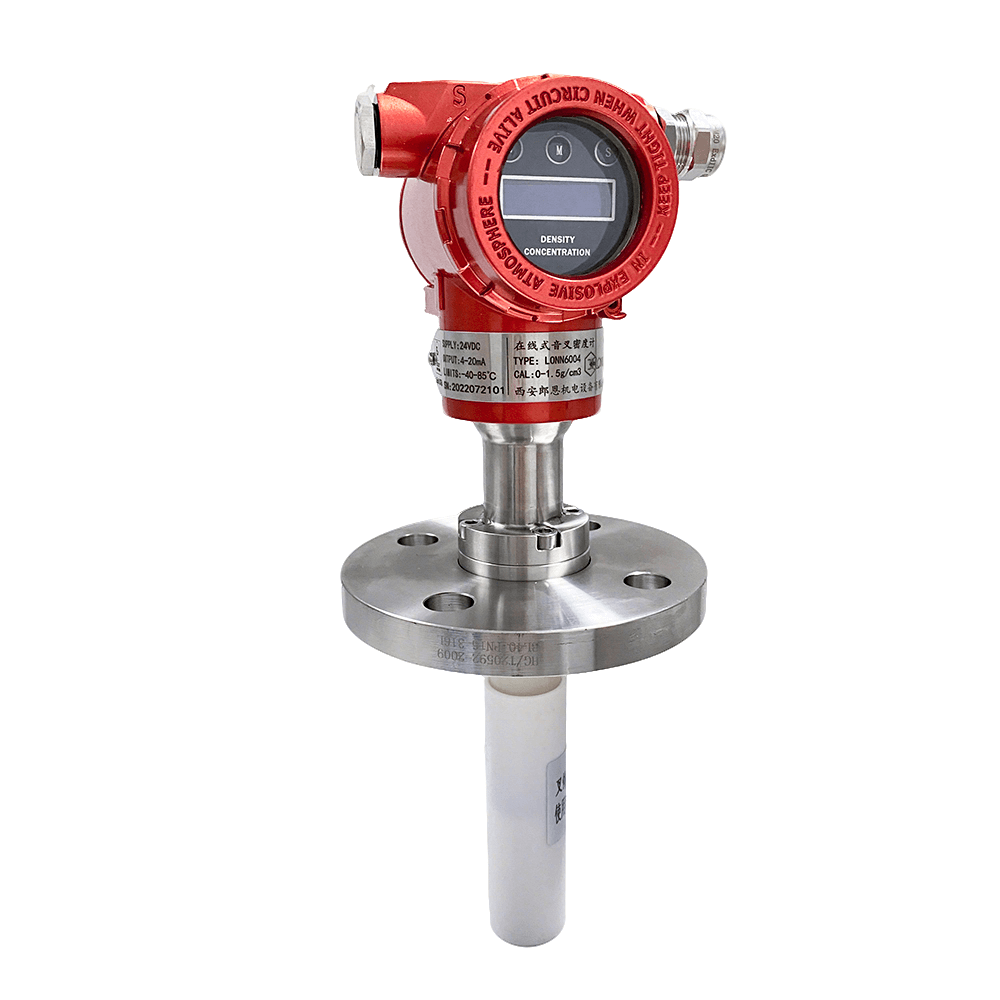
LONNMETER Density Meters in Battery Electrolyte Applications
The LONNMETER LONN700 tuning fork density meter is specified for electrolyte density monitoring in both lithium-ion and lead-acid production. The tuning fork design handles the viscosity range of these fluids without the drift issues that affect some optical methods in cloudy or colored electrolytes.
For lithium-ion electrolyte, the LONN700 is typically calibrated against a reference density curve established with the specific solvent blend. That calibration is stored in the meter, so the output reading is concentration directly — no separate conversion step required.
In lead-acid formation loops, the same instrument tracks the density drop through the formation cycle and can be configured to trigger a completion signal when the density reaches the target value for that formulation.
If you are specifying density measurement for a battery electrolyte application and want to discuss calibration approach or material selection, the LONNMETER technical team can review your process conditions and recommend a configuration.
Post time: Jun-22-2026


