

Sugar Processing Is a Density Story from Start to Finish
Walk through a sugar mill and every process step changes the density of the material. From the dilute mixed juice coming out of the mill to the thick syrup feeding the pans, concentration increases steadily. If you want to know where you are in that curve, you measure density. Or Brix. Or solids content. They are all the same measurement problem.
For the record: Brix and density are not identical, but they are directly convertible for sucrose solutions. The ICUMSA tables give you the standard relationship. Most inline density meters used in sugar mills output Brix directly, configured with the standard conversion curve.
Many mills still measure density the old way — a hydrometer and a bucket. The problem with that approach is timing. The lab result comes back 15 to 30 minutes after the sample is taken. For a process that changes continuously, you are always managing to yesterday’s conditions.

| Process Stage | Typical Brix | Density | Temp | Key Control |
| Mixed juice (mill exit) | 10–15°Bx | 1.04–1.06 | 25–35°C | Juice extraction |
| Clarified juice | 12–18°Bx | 1.05–1.07 | 70–85°C | Clarifier operation |
| Evaporator feed | 15–20°Bx | 1.06–1.08 | 80–90°C | Evaporator entry Brix |
| Evaporator exit / syrup | 55–70°Bx | 1.26–1.35 | 60–70°C | Evaporator endpoint |
| Pan boiling (massecuite) | 88–92°Bx | 1.46–1.50 | 60–75°C | Pan cut cycle |
Evaporator Control: Where Inline Brix Pays the Fastest Return
The multiple-effect evaporator is the heart of a sugar mill. It removes about 80% of the water from clarified juice. The target output Brix is typically 65° to 70°Bx. Getting that number right means the pan station runs efficiently. Getting it wrong means energy waste or downstream process issues.
An inline density meter at the evaporator outlet gives the operator continuous visibility of the syrup Brix. That signal can be used to adjust steam flow to the evaporator or the feed rate. Without it, the operator has to take a manual sample and wait for a lab reading, then adjust based on where the process was ten minutes ago.
The challenge at this stage is temperature. Evaporator syrup exits at 60 to 70°C. The density meter needs integrated temperature compensation to convert the density reading to standard Brix. Without that compensation, a manually applied correction factor introduces 0.3 to 0.5°Bx uncertainty. With the right compensation, the inline reading matches the lab within ±0.1°Bx.
Mixed Juice: The Low-Concentration Challenge
At the other end of the process, mixed juice density is between 1.04 and 1.06 g/cm³ (10–15°Bx). That is a narrow measurement range. A density meter that is accurate to ±0.001 g/cm³ gives you a Brix resolution of about ±0.1°Bx at this concentration. That is fine for process control, but it puts a premium on base accuracy and temperature compensation.
Mixed juice also contains suspended solids — bagasse particles, sand, and other insoluble material. Depending on the milling equipment and cane preparation, the insoluble solids can be up to 1% by weight. These solids contribute to the total density reading but are not part of the soluble Brix content. The density meter sees them as extra density, and the Brix conversion overstates the true sugar content.
Some mills compensate by applying a fixed offset based on their historical insoluble solids level. Others install a filter or centrifuge upstream of the density meter. For most purposes, the insoluble content is consistent enough within a season that the offset approach works well enough. Between seasons, recalibrate.
Pan Boiling: The Critical Cut Point
Crystallization pans boil syrup to supersaturation, nucleating sugar crystals. The operator’s goal is to add the crystallized sugar at the right time. The decision to cut the pan depends on Brix and crystal content.
A density meter in the pan circulation loop tracks the massecuite density as it rises from 70°Bx to above 90°Bx. The slope of that density curve tells the experienced operator how crystallization is progressing. A steep curve means rapid nucleation. A flat curve means slow growth. Automated pan control systems use the density signal to regulate the syrup feed rate and steam flow.
The measurement at this stage is challenging because the massecuite contains sugar crystals, not just dissolved solids. The density meter sees both. But since the crystal content and the syrup content have a predictable relationship at each stage of the boiling cycle, the density trace is a reliable indicator of batch progress when the installation is done correctly.
Density Meter vs Refractometer: Which One for Which Stage
In the sugar industry, both inline density meters and inline refractometers are used for Brix measurement. They work on different principles and have different sweet spots.
| Factor | Inline Density Meter | Inline Refractometer | Best for |
| Accuracy | ±0.001 g/cm³ | ±0.1°Bx | Comparable at high Brix |
| Crystal sensitivity | Not affected | Affected by crystals | Density: pan boiling |
| Color tolerance | Not affected | Affected by dark juice | Density: mixed juice |
| Viscosity range | Up to 10,000 mPa·s | Sensitive above 500 | Density: thicker syrups |
| Maintenance | Low | Prism cleaning needed | Density: low-maintenance |
In practice, many sugar mills use both: density meters for the evaporator outlet and pan boiling, and refractometers for the clear juice and final product. The density meter wins on maintenance and robustness; the refractometer wins on direct Brix measurement without conversion uncertainty. Choose based on which factor matters more at your specific installation point.
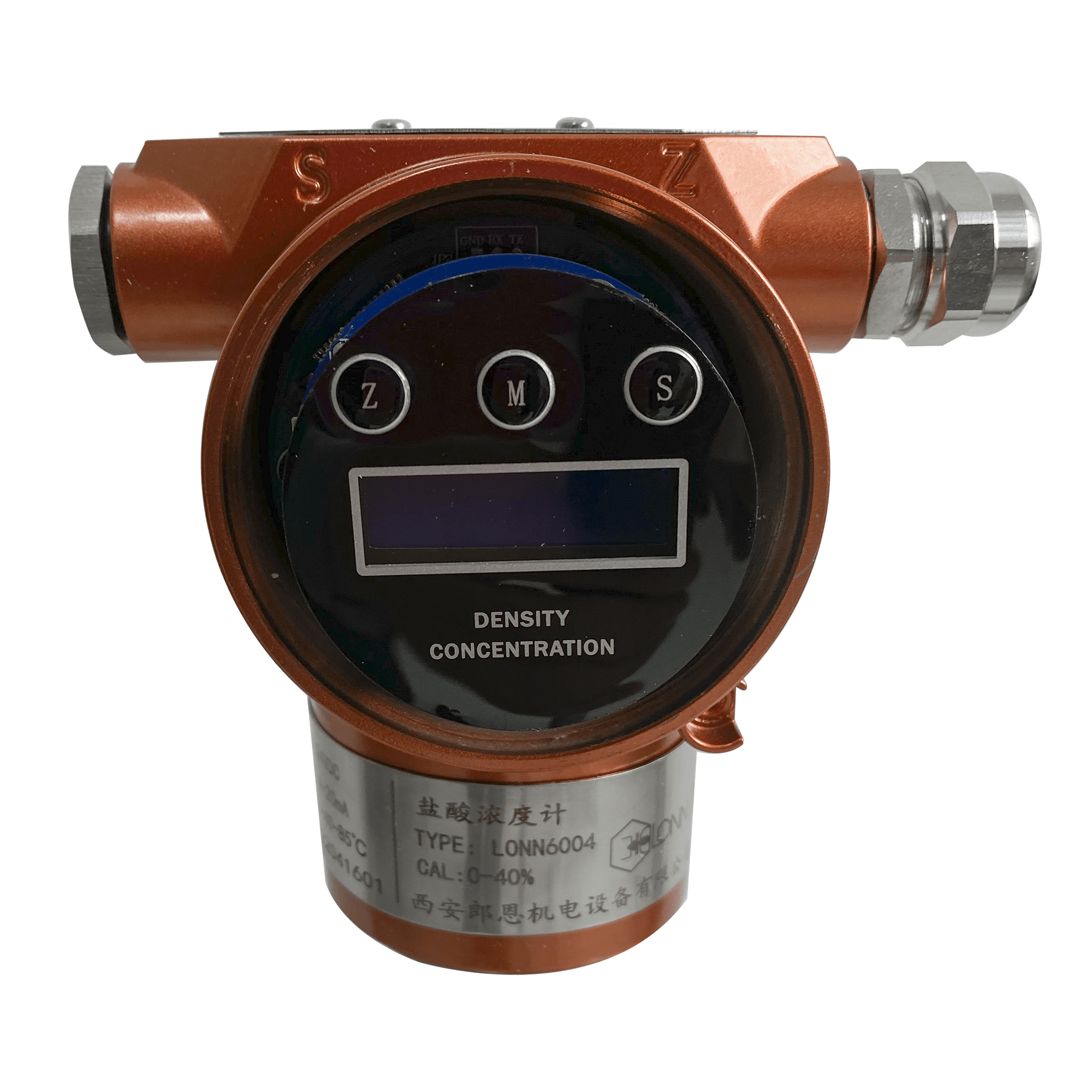
LONNMETER Instruments for Sugar Mills
The LONNMETER LONN700 density meter is used in sugar mills for evaporator outlet Brix monitoring and pan boiling control. It handles the temperature range (up to 100°C) and has a Brix conversion table built in. The meter outputs 4-20 mA or Modbus RTU, which is compatible with most sugar mill control systems.
For mixed juice measurement, the LONN-C concentration meter provides the accuracy needed at the low end of the Brix range. The sensor is calibrated for the specific juice characteristics of the mill, compensating for the known insoluble solids level.
If you are specifying density measurement for a sugar mill and want to discuss installation location or calibration against the ICUMSA tables, the LONNMETER technical team can review your process conditions and recommend a configuration.
Post time: Jun-30-2026


