

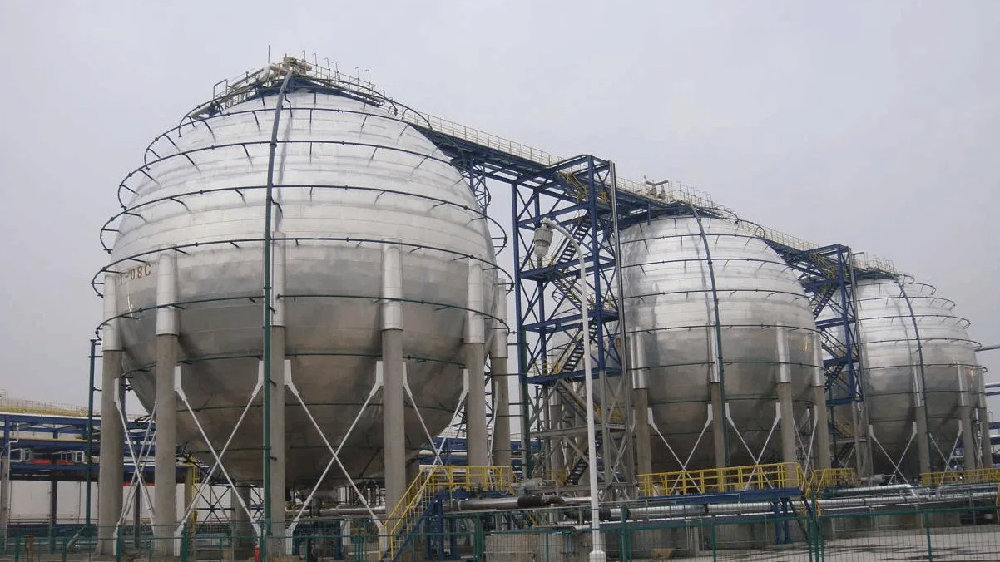
A liquefied natural gas vessel sits at minus one hundred sixty-two degrees. A liquid nitrogen dewar at a wafer fab runs near minus two hundred. At those temperatures ordinary level instruments either freeze their seals, lose their echo in a steam that is not air, or simply cannot see an interface whose permittivity barely clears unity. That is the world where guided wave radar earns its keep.
We build guided wave radar transmitters for low-temperature liquids, and we have stood next to LNG receiving tanks, air separation and oxygen-service plants, and semiconductor-grade nitrogen dewars during commissioning. The technology is quieter than it looks. This note explains where it wins, where it does not, and the installation details that separate a reading you trust from a reading you explain away.
1. What “cryogenic” does to a level measurement
Cold is only half the problem. The other half is what sits above the fluid.
Most level technologies measure across a steam gap. At cryogenic temperatures that gap is not air. It is boil-off gas — methane over LNG, nitrogen over LN2, oxygen over LOX — and it is cold, dense, and moving. Ultrasonic fails here because sound speed collapses and the gap is not a stable medium. Capacitance and tuning fork struggle because the permittivity of the steam and the condensation on the probe drift with load. A float freezes to the wall.
Guided wave radar ignores almost all of that, and the reason is the probe.
2. Time-domain reflectometry, without the hand-waving
Guided wave radar fires a nanosecond electromagnetic pulse down a probe — a rigid rod or a cable — immersed in the fluid. The pulse travels at near light speed through the dielectric of whatever surrounds the probe. At the fluid interface the impedance changes, part of the pulse reflects, and the transmitter times the round trip against an internal reference pulse sent down a short unloaded section of the same line.
Distance to interface is:
where d is the level path, t is the round-trip time, and v is the pulse velocity on the probe. The trick that makes the method reliable across a changing dielectric is the reference pulse. The velocity v depends on the dielectric of the environment, but because the transmitter compares the interface echo against a reference taken in the same medium near the head, the dielectric cancels out of the level calculation. That is why guided wave radar reads correctly even when the surrounding dielectric is low and changing.
3. Why cryogenic liquids favor this method
Free-space radar also uses pulses, but it fires them through the open vapor gap. On a high-dielectric fluid that is fine. On a low-dielectric cryogenic fluid it is an issue: the surface reflects only a small fraction of the energy, the echo is weak, and a vessel of liquid nitrogen or a refrigerant with a dielectric around 1.43 barely returns enough echo for a free-space unit to lock on.
Guided wave radar confines the pulse to the probe. The echo does not spread into the gap; it travels along the rod or cable and reflects at the surface regardless of how low the dielectric is. We routinely measure LN2 and LOX where free-space radar would hunt for a ghost.
The gases are the clincher. Boil-off gas, condensation, and stratification in the vapor space confuse open-path methods. The probe sits in the fluid and the vapor above it is irrelevant to the timing. For a cryogenic vessel that single property decides the purchase.
4. The dielectric floor, stated honestly
Nothing is free. Guided wave radar still needs a measurable impedance step at the surface, and that step shrinks as the fluid dielectric approaches that of the vapor. Liquid helium, at roughly 1.05, is the edge case in a research laboratory: the step is so small that standard probes become marginal, and we either specify a specialized high-sensitivity probe or move the conversation to a different method. Liquid hydrogen sits in the same uncomfortable band. Carbon dioxide, propane, butane, ammonia, and ethane sit in the same comfortable band as the common cryogens.
For the typical cryogens the step is comfortable: LNG around 1.6 to 2.0, LN2 about 1.43, LOX about 1.49, LAr about 1.50. All read reliably on a standard probe. We warn customers with helium or hydrogen duties up front rather than discovery at commissioning.
5. Reading the datasheet like a commissioning engineer
The numbers that decide a cryogenic install:
| Parameter | What it really means | Typical value (LONN-GWR class) |
| Measuring range | Probe length from flange to tip | 0.5 – 30 m (cable), up to 6 m rod |
| Process temperature | Probe and seal rating, not just head | -196 to +200 °C |
| Process pressure | Tank pressure the seal withstands | Vacuum to 40 bar |
| Dielectric range | Lowest liquid dielectric it locks | ≈ 1.4 and above |
| Accuracy | Of measured span | ±3 mm to ±10 mm |
| Probe type | Rod, coaxial, or cable | Rod for clean, cable for long |
| Output | Signal and protocol | 4–20 mA + HART, or Modbus |
| Hazard rating | Head certification | ATEX / IECEx, SIL 2 |
The accuracy line bears repeating. Cryogenic tanks are tall and the absolute accuracy in millimeters matters for inventory and for custody. A transmitter quoted at ±10 mm on a forty-meter LNG vessel is a different animal from one quoted at ±3 mm, and the price follows. We ask for the span before quoting a number.
6. The probe, the seal, and the cold
The probe is the instrument in this instrument. A rigid rod suits clean liquids and short spans; a cable suits deep tanks and is more fragile during handling. For cryogenic duty the rod or cable is 316L or 304L, chosen for low-temperature toughness, and the process seal is the weak point everyone forgets.
A standard ASME flange seal rated at ambient will crack or weep at minus two hundred. The seal must be specified for the cryogenic temperature, and on an insulated, vacuum-jacketed, perlite, or multilayer vessel the probe passes through the insulation without creating a thermal short. We have seen a measurement that read perfectly undermined by a seal that leaked steam and iced the head.
Where condensation or frost on the probe is a risk — a vessel that breathes through a relief vent between cold and ambient — a stilling or a heated probe section near the head keeps the upper reference clean. The reference pulse is only as good as the unloaded section it travels.
7. Cable versus rod, and the weight of the liquid
For a deep LNG or ethylene vessel a cable probe reaches further than a rod and ships more easily. But a cable sags and swings under a moving fluid, and a heavy cryogenic fluid, sloshing during a purge, amplifies both. We specify a rod below about six meters and a cable above, and on a vessel with turbulent fill we add a bottom anchor or a guide to stop the cable from dancing. A dancing cable is a noisy level.
Coaxial probes shield the signal and read even lower dielectrics, at the cost of a fatter, more expensive assembly and tighter cleaning. For a low-dielectric cryogen in a fouling service we reach for coaxial; for a clean LN2 dewar a simple rod is enough.
8. Boil-off gas, stratification, and the vapor we ignore
A cryogenic vessel is never static. Heat leak boils fluid into gas, the gas stratifies, and during a draw or a fill the interface moves. None of this disturbs the probe timing, which is the whole point of the method. Where a free-space radar loses its echo in a boiling steam space, the guided wave radar keeps reading because the pulse never travels through that space.
The one place BOG matters is the head. The transmitter electronics cannot live at vessel temperature, so the head sits above the insulation and the probe carries the cold up to it through a thermal break. A poor thermal break frosts the head and drifts the reference. We treat the thermal break as a component, not a detail.
9. Sizing math, worked
A plant needs level on an LNG or propylene receiver vessel. Given: vessel height 40 m, probe type cable, process temperature -162 °C, dielectric about 1.7, vessel pressure up to 5 bar, hazard zone 0 (methane).
Probe length must reach from the flange, through the ullage, to near the bottom without resting on it: 40 m cable with a bottom anchor. Dielectric 1.7 is well above the 1.4 floor, so a standard probe locks. Pressure 5 bar is within the seal rating. Hazard zone 0 demands an ATEX/IECEx certified head, and an LNG duty adds a custody question — if the vessel feeds road tankers or an LNG carrier at a regasification terminal, OIML accuracy and a traceable calibration enter the spec.
The usable span runs the full cable minus a small dead band at each end. The low-level alarm sits clear of the bottom anchor, never inside it. We set the alarm in the transmitter, not the controller, so a communications loss cannot hide a low level during a transfer.
10. Mounting that survives the cold
Mount on the vessel top, vertically, with the probe clear of inlet streams and internal structures. A fill line dumping onto the probe creates a local level that the transmitter reads as the surface. For an insulated vessel the probe must pass through the insulation without shorting the cold path to the shell; a vacuum-jacketed or insulated riser does that.
Outdoor cryogenic tanks need the head protected from sun and rain, and the thermal break must stay dry. We have watched a head drift by a few millimeters on a sunny wall until a simple cover fixed it — the same lesson as on warmer tanks, only the penalty is a frozen seal if ignored.
11. Outputs, custody, and the safety interlock
The 4–20 mA loop carries the level; HART rides on top for configuration and diagnostics. For an LNG or ethylene vessel the loop usually feeds both a local indicator and a custody or inventory system. The high-high and low-low trips live in the transmitter, wired to relays, because a safety interlock that lives only in the controller is worthless when the network drops.
For custody transfer the relevant marks differ by jurisdiction: OIML for legal metrology in many regions, API chapter 3.1F style tank gauging practices for oil and gas, and a traceable factory calibration against a known length. We list exactly which certificate applies to which configuration; a customer who orders a non-custody unit for a custody vessel fails the audit, and the reverse wastes money.
12. Guided wave radar versus its brothers
A cryogenic vessel often suits more than one technology, and the boundaries are sharp:
- GWR vs free-space radar — free-space is cheaper and needs no probe, but on low-dielectric cryogens its echo is weak; GWR wins on LNG, LN2, LOX, LAr.
- GWR vs ultrasonic — ultrasonic does not work in a cryogenic or vacuum vapor space at all; this is not a close call.
- GWR vs hydrostatic tank gauging (HTG) — HTG reads true hydrostatic head and is the custody standard for big LNG tanks, but it needs stable density and multiple taps; GWR is simpler and reads the surface directly.
- GWR vs magnetostrictive or float — those are cheap for clean small tanks but a float freezes and a magnetostrictive wire fatigues in cryogenic cycling.
We do not push GWR into a helium or hydrogen servo duty, or a big custody LNG vessel where HTG is the regulated method. The honest boundary is the product.
13. What we actually build, and why it matters
The probe and the pulse timing circuit are the instrument. We draw, weld, and anneal our own rod and cable, match the permittivity of the probe assembly, and tune the timing firmware on our own test rig across a temperature sweep down to cryogenic ratings. A bought probe sets the dielectric floor and the thermal behavior we then have to live with.
The heads are assembled and burned in through a cold cycle before release, and the calibration is proved against a traceable length, not a label. That bench is the reason we can promise the span accuracy we quote, and it is the part a trading company cannot show you. For a cryogenic program we have supplied private-label guided wave radar with customer branding, custom probe lengths, and Modbus maps matching the customer’s register list — the product is standard, the configuration is not.
14. Mistakes we keep finding in the field
- Quoting a free-space radar on an LN2 or LOX vessel and discovering the echo will not lock.
- Specifying an ambient seal for a minus two hundred duty, then watching it weep and ice the head.
- Letting a cable probe swing in a turbulent fill, producing a level that wanders.
- Putting the low alarm inside the bottom dead band.
- Buying a non-custody unit for a custody LNG vessel, or skipping ATEX on a methane duty.
- Ignoring the thermal break, so the head frosts and the reference drifts.
Every one of these is a short conversation before the order. Most of the service calls we make are that conversation delivered late.
15. The short version for procurement
If the tank holds a low-dielectric cryogenic fluid — LNG, LN2, LOX, LAr — under a boil-off vapor, guided wave radar is the reliable answer: the probe confines the echo, the dielectric cancels through the reference pulse, and the vapor space is irrelevant to the timing. Confirm the dielectric is above the floor, specify the seal and the thermal break for the cold, choose rod or cable by span and turbulence, and put the safety trip in the device. For helium or hydrogen, or for a large custody LNG tank, stop and call hydrostatic tank gauging or a specialist probe. That is the whole decision.
We build the transmitter, we prove it on our own rig down to cryogenic ratings, and we tell you when our own product is the wrong one for your tank.
Post time: Oct-16-2026


