

You do not specify a Coriolis mass flow meter by model number. You specify it by answering a short list of ugly questions about your medium, your pipe, and the figure on the batch report that someone will eventually dispute. We machine the tubes, weld the headers, and calibrate every transmitter on our own mass benches before it ships, so the questions below are the ones our application desk asks before a single order is cut. This is a selection guide, not a physics lecture. If you need the measurement principle, that lives elsewhere; here we decide what fits your process and what will quietly fail on it.
The fastest way to waste a Coriolis budget is to size the unit like a volumetric instrument. A Coriolis device reads mass directly, which changes the sizing rules, the installation rules, and the failure rules. Read the velocity window in section 3 before you pick a bore, because that single decision decides whether the apparatus becomes a quiet workhorse or a pressure-drop complaint on a dairy, a refinery, or a paint plant.
1. Start with the application, not the catalog
A specifier who opens with “I need a Coriolis” has usually already lost an afternoon. The right opening question is narrower: what decision does this measurement drive, and on which kind of line?
- Billing or custody transfer. You are converting product to money, so accuracy and certification (OIML R117, API) dominate. Think a gasoline terminal, a milk buyer’s weighbridge, or an edible-oil loader where the tally is the invoice.
- Batch blending or recipe. You are dosing by mass into a tank, hence the density output and the zero stability through start-stop cycles matter more than peak accuracy. A syrup blender, a paint mixer, or a beer wort kettle all live here.
- Process control. You are feeding a PID loop, so response time, signal noise, and repeatability beat a headline accuracy figure you will never exercise. A CIP return, a compressor lube line, or a boiler feed sits in this bucket.
- Sanitary or food. You are cleaning the apparatus with caustic and acid while the rest of the facility runs, which is why cleanability, surface finish, and gasket chemistry decide whether it survives a year in a yogurt plant or a juice press.
Pick the row that describes your operation. Everything downstream — bore, alloy, tube shape, certification — follows from it. An instrument that is perfect for a custody-transfer skid can be the wrong shape for a dairy CIP loop, and nobody tells you that on a product page.
2. Which media a Coriolis handles — and where it quits
A Coriolis element will measure almost any single-phase liquid that fills the tube: water, milk, syrup, crude, gasoline, diesel, solvent, brine, liquefied gas, a slurry that stays fluid, even asphalt, ink, or adhesive. But “almost any” hides the edges that end careers in commissioning.
2.1 Entrained gas and two-phase flow
This is the wall. A Coriolis tube measures the inertia of what sits inside it. Introduce a gas pocket and the inertia signal collapses, because gas weighs almost nothing and moves the element in ways the transmitter cannot separate from flow. Most standard units hold accuracy with up to about 1 to 2 percent entrained gas by volume. Push past that and you get a reading that looks plausible and is wrong.
We have watched a beverage line read 8 percent low for a week because a deaeration step upstream had drifted and was pumping microbubbles through the device. The bench test was perfect. The floor was lying. The fix was upstream, not in the instrument.
If your stream routinely carries gas — flashing hydrocarbon at a refinery, aerated product in a brewery, poorly vented suction on a pigment slurry pump — you have three honest options. Degas it ahead of the meter with a properly sized de-gas vessel or a vertical run that vents. Choose a twin straight-tube design with entrained-gas compensation and accept a narrower accuracy band above roughly 5 percent gas. Or pick a different principle. Pretending the apparatus will sort it out is how you get a number nobody trusts.
2.2 Viscosity, density, and temperature
Viscosity matters less than people fear. Unlike a turbine or a positive-displacement device, a Coriolis unit has no rotor whose speed the liquid drags down, so a heavy oil and a light solvent size to nearly the same bore at the same mass rate. The catch is pressure loss: a high-viscosity medium at a given velocity needs more bore to keep the drop sane, which we handle in section 3.3.
Density sets the resonant frequency and therefore the useful density output range. An instrument rated to 0.001 g/cm3 density repeatability on a 0.7 to 1.2 g/cm3 food stream will not hold that on a 1.5 g/cm3 brine or a 1.8 g/cm3 pigment slip without checking the certificate. Density span and density accuracy are separate lines on the datasheet; read both.
Temperature sets the tube alloy and the seal. Food plants swing from 4 C cold milk to 72 to 95 C CIP return; that is a 90 C excursion the device sees every shift. A desalination brine loop or a crude preheat runs hotter still. Process temperatures above 150 C, or cryogenic below -50 C on an LNG or liquid-nitrogen fill, move you into special tube alloys and a different gasket table. State the temperature range, not the operating point.
3. Sizing: velocity window, bore, and pressure drop
Here is where Coriolis breaks from volumetric habits. A volumetric instrument (mag, turbine, ultrasonic) wants a velocity that keeps the liquid moving cleanly — often 1 to 5 m/s. A Coriolis tube wants a slower, tighter window because it is a vibrating element, not a pipe with a sensor strapped on.
3.1 The velocity window
For curved-tube and most U-tube Coriolis, the useful process velocity sits roughly between 0.3 and 3 m/s, with a sweet spot around 0.5 to 2 m/s. Drop below 0.3 m/s and the Coriolis signal gets small relative to drift; the unit still reads, but the low end of your range gets noisy. Climb above 3 m/s and you are fighting pressure loss and tube stress for no accuracy gain. Straight-tube designs tolerate a slightly higher ceiling, sometimes to 6 m/s, because they are stiffer and have less internal restriction.
The sizing mistake we see most: someone takes the peak volumetric flow, divides by the pipe area, and picks the nominal size that gives a “normal” 2 m/s. On a Coriolis that is often fine — but only if the low end of the duty still clears 0.3 m/s. A line that runs 1 to 10 m3/h through a DN50 will sit at 0.14 m/s at the low end. The instrument will complain every night it idles. Size to the full duty envelope, not the nameplate peak.
3.2 Worked sizing examples
Mass flow is what Coriolis actually measures, so size in mass and convert with density. Three real cases from our desk:
Case A — Skim milk, 8 t/h peak, 2 t/h low, density 1.03 g/cm3. At DN50 the peak sits at 1.10 m/s but the low end drops to 0.28 m/s, under the 0.3 floor. Step down to DN40 and the peak is 1.71 m/s with the low at 0.43 m/s — both inside the window. Verdict: DN40.
Case B — Edible syrup, 5 t/h, density 1.40 g/cm3, viscosity 2000 cP. DN40 lands at 0.79 m/s, fine on velocity, but the viscosity drives pressure loss, so check section 3.3. A confectionery or soft-drink blender lives exactly here.
Case C — Gasoline custody transfer, 20 t/h, density 0.74 g/cm3. DN80 holds 1.49 m/s peak and 0.37 m/s low — just inside the envelope. Verdict: DN80, with OIML R117 and ATEX.
The pattern: pick the smallest nominal size that keeps both the peak and the low end inside 0.3 to 3 m/s. A smaller bore means a stiffer signal, a cheaper tube, and a device that is honest across the whole duty. Oversizing is the silent killer.
3.3 Pressure drop you can defend
Coriolis tubes are restrictive by nature — liquid has to push through a vibrating loop. Pressure loss scales with velocity squared and with viscosity. A reasonable food-grade DN40 at 1.5 m/s on water drops maybe 0.1 to 0.3 bar. The same bore at 3 m/s on a 2000 cP syrup can drop 1 to 2 bar, which may starve a filling head or trip a minimum-pressure interlock. On a paint, asphalt, or adhesive run the numbers are worse, and the plant simply will not push.
We size syrup, oil, and adhesive runs one bore larger than the velocity window alone would dictate, explicitly to cap the loss. Tell the application desk your upstream pressure and your minimum acceptable downstream pressure, not just the flow. A unit that fits the window but caves the process is a failure dressed as a specification.
4. Tube geometry: straight vs curved, single vs twin
Two design forks decide cleanability, pressure loss, and gas tolerance.
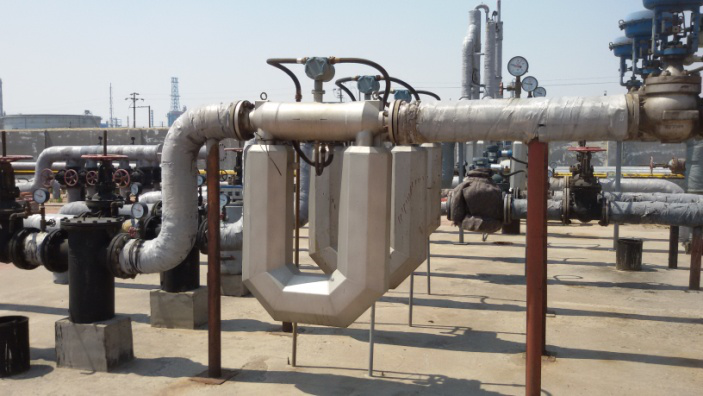
Curved (U-tube, mostly) is the legacy workhorse: cheap to make, proven, good accuracy, but it traps product in the bend and needs more care on CIP. Single straight tube is the cleanability champion — full-bore, almost no dead space, easy to drain — at some cost in sensitivity at very low flow and a higher price. Twin straight tube splits the charge across two vibrating elements and is the design we reach for when entrained gas or viscous product is expected, because the differential survives partial gas loading better than a single element.
For a yogurt system or a beer wort kettle, default to straight or twin straight unless budget forces a curved tube and the clean-in-place chemistry is mild. For crude loading or generic industrial service, a curved tube is usually the economical choice and nobody is cleaning it with caustic at 3 am.
5. Wetted materials and seals
The tube is the meter, so the metal is the spec. 316L stainless is the default for food and most water-like chemicals. Move to Hastelloy C-276 when chloride or reducing acid shows up — a coastal desalination slip or a brine loop will pit 316L faster than the warranty. Titanium for seawater and aggressive oxidizing media. Tantalum and zirconium for the nasty corners of a pigment plant or an acid-regen circuit, at a price that only makes sense when the alternative is a failed batch.
Seals fail before tubes do. EPDM covers most dairy CIP to about 120 C and is the cheap default. FKM (Viton) goes higher in temperature and shrugs off oils but cracks under some caustics. FFKM (Kalrez-type) survives the widest chemical and thermal range and is the choice for pharma and aggressive acid service, at a cost like the special part it is. PTFE envelopes the flange where nothing else is allowed to touch the product. Match the seal to the CIP temperature and the cleaning chemistry, not to the process fluid — the clean-in-place cycle is usually the harsher of the two.
One more material point that bites installers: pairing 316L tube ends with carbon-steel pipework invites galvanic corrosion at the joint, and a Tri-clamp crevice left unpolished becomes a crevice-corrosion site within a season. We spec the flange material to match the line and call out the surface finish at the ferrule face, not only on the bore.
6. Sanitary vs industrial: when the coupling standard is the spec
On a food plant the fitting is the specification. Tri-clamp (ISO 2852 / ASME BPE), DIN 11851, SMS, RJT, and IDF are not interchangeable, and a device with the wrong ferrule will not seat on your plant no matter how good the transmitter is. State the standard and the nominal in the order, not as an afterthought. A brewery runs Tri-clamp; a European dairy may demand DIN 11851; a pharmaceutical skid often wants ASME BPE.
Surface finish is the other half. Dairy and beverage want Ra 0.5 micrometer as a floor, often 0.25 micrometer on the wetted path, electropolished so product does not hang up and breed. The 3-A 02-02 standard and EHEDG design rules are the documents your quality auditor will cite; a unit that claims “sanitary” without a 3-A or EHEDG reference is a marketing claim, not a certification. We machine, polish, and document to 3-A and EHEDG on the food-grade line, and the cert number travels with the apparatus.
Industrial versions skip the polish and the ferrule and take a flanged or welded end rated to the pipe class. Do not pay for a Ra 0.25 surface on a solvent transfer skid or a paint plant. Pay for the alloy and the gasket that survive the solvent.
7. Accuracy, rangeability, and the density bonus
Read accuracy as a band, not a point. A typical food and industrial Coriolis holds ±0.1 to ±0.2 percent of rate for mass, with premium custody-transfer versions at ±0.05 percent. Density repeats to about ±0.001 to ±0.002 g/cm3 and reads to roughly ±0.001 to ±0.005 g/cm3 depending on span. Repeatability is often ±0.05 percent or better — tighter than the accuracy, which is why a unit that “drifts” is usually a zero issue, not a sensor fault.
Rangeability is the number buyers forget. Coriolis turns down about 20:1 on mass, sometimes a little more on the high-accuracy models. That beats a turbine but loses badly to a magmeter’s 100:1. If your plant runs from 1 to 50 m3/h, a 20:1 Coriolis covers 2.5 to 50 m3/h honestly and lies quietly below that. A magmeter would cover the whole span. Pick the principle for the duty, not the brochure.
The density bonus is why food and chemical buyers tolerate the price. The same vibrating element gives you a live density without a second instrument, which drives fat standardization on a dairy, Brix on a juice line, Plato on a brewery, and Baumé on a caustic regen. On a dairy operation that single output can replace a lab densitometer and a manual sample. Use it; it is already paid for.
8. Outputs and communication
The measurement is only useful if it reaches the system. The baseline is a 4-20 mA loop for flow and a second for density or temperature, plus a frequency or pulse output for totalization. For anything built this decade, add digital: HART rides the 4-20 mA pair and is the cheap retrofit; Modbus RTU or TCP is the workhorse for a PLC; Foundation Fieldbus or PROFIBUS PA for a process plant that already speaks them; EtherNet/IP or OPC UA when the device sits on a site network. A water utility, a refinery DCS, and a pharmaceutical skid each expect a different dialect.
Specify the protocol your DCS actually accepts, not the one the catalog leads with. We have re-terminated too many “Modbus” orders that turned out to need PROFIBUS, and the cost is a field rewire, not a setting.
9. Installation: the easy part (mostly)
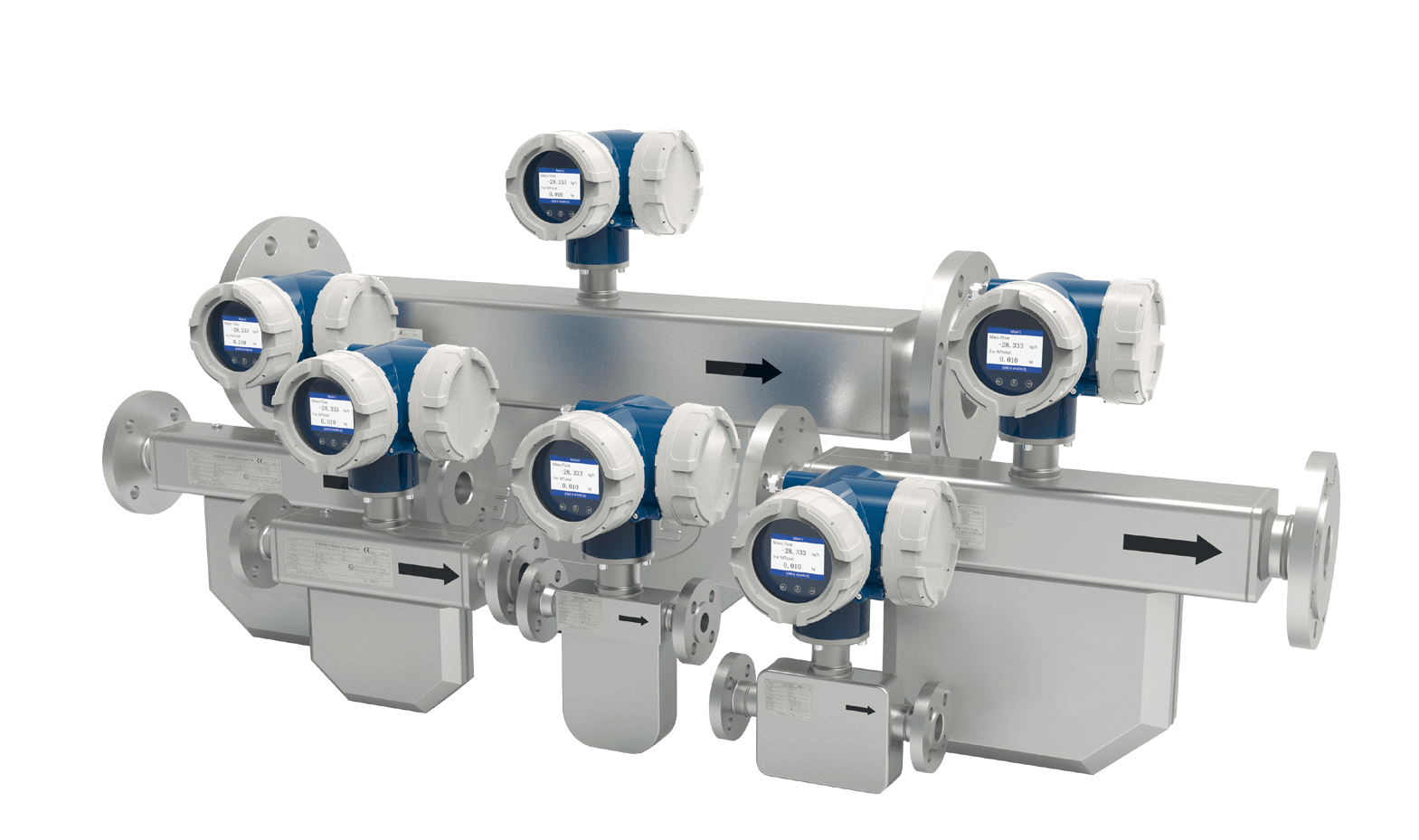
Coriolis installs easier than almost any other flow principle, and that is a real selection advantage. Because it measures mass, it does not care about the velocity profile, so you need no straight run upstream. No 10D-in, 5D-out rule. Put it behind a pump discharge, behind a bend, behind a reducer — the reading holds.
The rules that do matter: support the unit at both ends so line strain does not load the tube; keep the element full (a Coriolis half-full is a Coriolis lying, same as any instrument); vent high points so gas cannot pocket; and perform a zero (empty-tube re-zero) at commissioning and after any major rebuild. A re-zero takes minutes and removes the drift complaints that otherwise get blamed on the sensor. No grounding ring, no earthing stake — that headache belongs to the magmeter next to it.
Two installation details that are not about the tube but decide whether the signal is trusted: keep the transmitter away from variable-frequency drives and weld transformers so the 4-20 mA pair does not pick up conducted noise, and route the signal cable in its own tray away from power. A Coriolis is immune to the velocity-profile tricks that trap a magmeter, but it is not immune to a sloppy EMC layout or a shared ground loop that injects a wandering zero.
10. Certification and where it changes the shortlist
Certification is what turns a measurement into a legal one. For custody transfer of liquids, OIML R117 (and API Chapter 5.3 for hydrocarbon) is the gate; without it the figure is operational, not billable. For a gasoline terminal or a diesel loader, that certificate is the invoice. For food, 3-A and EHEDG open the audit. For hazardous area, ATEX and IECEx decide whether the transmitter can sit in the classified zone at all; a refinery or a solvent tank farm lives or dies on it. For safety-instrumented loops, an SIL 2 or SIL 3 rating on the assembly matters more than its accuracy.
For pharmaceutical and biotech duty, FDA 21 CFR and EC 1935/2004 food-contact compliance plus USP Class VI for wetted elastomers move the shortlist; for electronics mounted in a cabinet, NAMUR NE 21 and basic EMC immunity (IEC 61326) decide whether the transmitter behaves next to a VFD. RoHS and REACH enter the picture only if you ship into the EU and someone audits the bill of materials.
Do not spec a certificate you do not need — it adds cost and lead time — but do not discover you needed OIML R117 the week the tax authority questions the tank farm. Tell the application desk the regulatory frame and we will match the certification to it.
11. Total cost of ownership
A Coriolis costs more up front than a magmeter or turbine, often two to four times the volumetric equivalent at the same bore. The payback comes from what it removes: no moving parts to wear, no pressure loss on a water run (though viscosity changes that), no separate density instrument, and a mass reading that needs no temperature or pressure compensation. On a dairy or a chemical plant where a density output replaces a lab step, the labor saving alone can retire the premium inside a year.
Selection is a trade, not a trophy. Know which side of that line your application sits on before you champion Coriolis in the meeting.
12. How we build them (manufacturer note)
We are not a label on someone else’s tube. The wetted path is machined and welded in-house, the surface finished to the Ra the spec demands, and every transmitter is zeroed and checked on a mass calibration bench we own — traceable weights, not a vendor’s word. That is the part of “E-E-A-T” that is not a marketing phrase: the calibration record that ships with your unit was made by the same group that cut the tube.
For OEM and ODM programs we build to your nameplate, your ferrule standard, and your protocol list, and we hold the drawing and the cert through the run. When a device comes back with a question, the person who answers it can walk to the bench that calibrated it. That is the difference between a supplier and a manufacturer, and it is the reason a selection guide from us ends with a bench, not a brochure.
13. A selection checklist you can hand to procurement
Print this and fill it before you ask for a quote:
- What decision does the measurement drive — billing, blend, control, or audit?
- Medium and worst-case composition — single-phase, or gas and solids present?
- Density range and viscosity at process temperature.
- Full duty envelope in mass — peak, normal, and low flow, with density.
- Process temperature range, not just the operating point.
- Pressure available upstream and minimum acceptable downstream.
- Coupling standard and size — Tri-clamp, DIN, SMS, flange, weld.
- Surface finish and certification — 3-A, EHEDG, Ra target.
- Wetted alloy and seal chemistry, including the CIP cycle.
- Output and protocol the DCS actually accepts.
- Regulatory frame — OIML R117, API, ATEX, IECEx, SIL.
- Hazardous area classification, if any.
Hand that list to the application desk through the contact page and the sizing is a half-hour, not a week of emailed guesswork.
14. Common mistakes we see in the field
- Buying the polished sanitary finish for a solvent skid, or skipping it on a dairy line and failing the audit.
- Assuming the apparatus absorbs entrained gas because “Coriolis handles everything.” A pigment slurry or an aerated juice will prove you wrong.
- Specifying a protocol the plant does not run and eating a field rewire.
- Forgetting the re-zero at commissioning and blaming drift on the sensor.
- Choosing Coriolis for a simple watery flow with huge turndown where a magmeter is cheaper to buy and own.
Every one of these is a selection error, not a product defect. The instrument does what the spec says. Make the spec honest and the unit is quiet.
If your duty sits inside the window above and you want the bore checked against your real numbers, reach the application desk through the contact page. We will size it on paper with you, including whether Coriolis or another principle in our flow portfolio is the cheaper honest answer — not just the one with the nicest brochure.
Post time: Sep-30-2026


