

Automated Milk Density Measurement in Dairy Processing
The modern dairy industry is navigating a complex landscape defined by increasing consumer demands for quality, stricter regulatory standards, and intense pressure to optimize operational efficiency. A continuous, in-line milk density meter directly addresses the most significant operational pain points while simultaneously serving as a critical first step toward a fully data-driven manufacturing paradigm.
Automated measurement provides unparalleled process control, ensuring that product composition, such as fat and solids-non-fat content, is maintained with exceptional consistency, which is particularly critical in light of the seasonal and compositional variability of raw milk.
Indispensable Real-Time Density Measurement
Advanced, automated density measurement technology offers a direct and comprehensive solution to the critical challenges outlined in the previous part. The installation of a real-time, in-line milk density meter at the receiving bay provides a continuous mass measurement that is entirely immune to the inaccuracies caused by entrained air and foam. By eliminating the need for time-consuming truck scales, it provides a true, auditable record of the milk received while simultaneously improving throughput and operational efficiency.
The value of continuous measurement extends well beyond the initial receiving stage. By continuously monitoring density, automated systems can precisely control the fat content during standardization and blending, ensuring the product is consistently within specification. This proactive approach eliminates the costly scenarios of product give-away and rework, directly safeguarding the plant's profitability and reputation for quality. An in-line density meter for food, equipped with temperature compensation features, is uniquely positioned to address the issue of seasonal and compositional variability. It provides an immediate and accurate measurement regardless of the ambient conditions or the natural fluctuations in the milk's composition, ensuring a uniform final product throughout the year.
The Operational Case: Optimizing Throughput and Reducing Waste
The implementation of automated density measurement and other smart sensors fundamentally alters a dairy plant's operational model. By eliminating the need for manual sample collection, preparation, and analysis, automation frees up personnel for higher-value tasks and accelerates the overall production process. This reduction in labor intensiveness and human error contributes directly to increased throughput and lower operational costs.
Additionally, the provision of immediate feedback allows for real-time adjustments to the process, which prevents product from ever going out of specification. This capability to continuously monitor and correct deviations minimizes the need for costly rework and the scrapping of entire batches, leading to significant savings in raw materials and energy consumption. The following table provides a concise summary of how automated density measurement bridges the gap between traditional challenges and modern solutions.
|
Process Stage |
Traditional Method Challenge |
Automated Solution's Value |
|
Raw Material Reception |
Inaccurate volume from entrained air; slow truck scale process; logistical bottlenecks. |
Provides a continuous, direct mass measurement that is immune to air/foam errors; eliminates tanker queuing; ensures accurate billing and traceability. |
|
Separation & Standardization |
Costly "product give-away" or "rework" due to inaccurate fat content measurement. |
Ensures precise fat content control with real-time feedback, maximizing yield and product quality; eliminates waste and need for reprocessing. |
|
Blending & Product Formulation |
Inconsistent final product due to incorrect component ratios. |
Ensures the precise ratio of ingredients is maintained based on real-time density measurements. |
|
Final Quality Assurance |
Flawed or inconsistent results from manual checks susceptible to human error. |
Provides a final, verifiable, and accurate check of product composition before packaging, enhancing traceability and compliance. |
Advanced Automation Instrumentation
Ultrasonic Density Measurement for Dairy
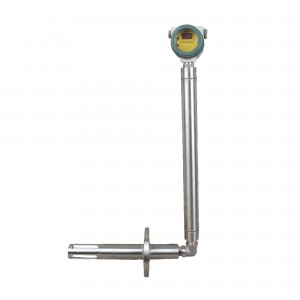
Among the various technologies available for in-line density measurement, ultrasonic sensors present a uniquely powerful solution for the dairy environment. The fundamental principle of operation is based on the relationship between a liquid's density and the speed at which a sound wave propagates through it. The sensor works by emitting high-frequency sound waves and measuring the propagation time between a fixed transmitter and a receiver. This information is then used to calculate the sound velocity, which in turn allows for the precise determination of the liquid’s density or concentration.
The advantages of this technology are particularly pronounced in a dairy setting. First and foremost, ultrasonic sensors are inherently robust. Their measurement is not affected by common sources of interference in a plant, such as vibration, noise, flow rate, or the color of the fluid. This makes them an ideal choice for the often turbulent and foamy conditions of a dairy processing line, a significant advantage over technologies that are sensitive to entrained air. Furthermore, the design is both non-invasive and highly hygienic. Since the technology has no moving parts, there are no consumables or parts that require regular replacement, and it is not prone to scaling or clogging, which significantly reduces maintenance requirements and costs. A final critical advantage is safety and environmental compliance. Unlike radiometric methods that rely on nuclear sources and require complex environmental controls, special handling, and the potential for radiation exposure, ultrasonic sensors are non-nuclear and non-invasive, simplifying installation and operation.
Have questions about optimizing production processes?
Comparative Analysis of Measurement Principles
An informed decision requires a comprehensive evaluation of the leading in-line density meter for food technologies. The following table provides a direct comparison of the key measurement principles and their suitability for dairy applications.
|
Feature |
Ultrasonic |
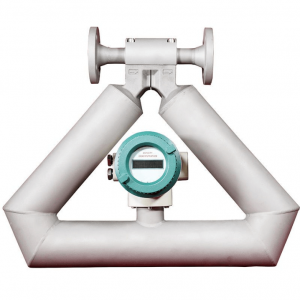
Coriolis |
Tuning Fork |
Radiometric |
|
Measurement Principle |
Sound wave propagation time. |
Vibration frequency change due to fluid mass. |
Resonant frequency change due to fluid mass. |
Gamma radiation attenuation. |
|
Accuracy |
High: ±0.0005g/cm3. |
Very High: ±0.05% mass accuracy. |
High. |
High. |
|
Robustness to Foam/Air |
High. Measurement is not affected by air or foam. |
Low. Can be highly affected by entrained air. |
Moderate. Can be affected by buildup or vibration. |
High. Measurement is unaffected by fluid properties. |
|
Maintenance |
Low. No moving parts, not prone to scaling. |
Moderate. Sensitive to corrosion and wear. |
Moderate. Prone to scaling and vibration-related issues. |
Low. Non-contact, but requires source handling protocols. |
|
Safety & Environment |
Safe, non-nuclear. |
Hygienic, 3A-certified. |
Hygienic. |
Requires complex safety and environmental controls due to nuclear source. |
|
Key Applications |
Density, concentration, Brix, solids content. |
Mass flow and density; ideal for billing and blending. |
Density, concentration. |
Abrasive, viscous, or corrosive media. |
Learn About More Density Meters


More Online Process Meters

Seamless Integration: The Path to a Connected Plant
The strategic value of advanced instrumentation extends beyond a single, isolated measurement point; it lies in its ability to integrate seamlessly with existing plant infrastructure and to contribute to a comprehensive, data-driven system. While traditional sensors often rely on simple, single-variable analog signals like 4-20mA, which are susceptible to electromagnetic interference and transmit limited data, modern instruments leverage powerful digital communication protocols. Protocols like Modbus RS485 and Hart allow for the transmission of multiple variables—such as density, temperature, and diagnostic information—over a single cable. This not only simplifies wiring and reduces installation costs but also provides higher-resolution data and enables remote configuration and troubleshooting, enhancing the overall system's robustness.
The shift from an analog to a digital communication platform represents a profound paradigm change. Analog signals are inherently limited, transmitting only a single, "dumb" value. Digital signals, in contrast, are "smart." A single milk density meter can now transmit not only the primary measurement but also its own health status and diagnostics, enabling a fundamental shift in maintenance strategy. Instead of relying on a time-based or reactive approach where a sensor is replaced only after it fails and causes a line shutdown, the system can now proactively alert operators to a potential issue based on diagnostic data. This enables a predictive maintenance model, significantly reducing unexpected downtime, increasing machine availability, and extending equipment lifespan. This modular and scalable approach allows a plant to begin with a single critical measurement point and scale up to a fully connected, data-driven operation by integrating with existing SCADA, DCS, and PLC systems.
Density Measurement in IIoT and Data-Driven Manufacturing
The value of automated density measurement is most fully realized when it is viewed not as an isolated component but as a foundational element of a modern, intelligent dairy plant. In-line density meter for food and other smart sensors are the data points that enable the Industrial Internet of Things (IIoT). When this sensor data is integrated into cloud-based platforms and analyzed with artificial intelligence (AI), it can provide deep, real-time insights that go beyond simple process control. This enables a proactive, self-optimizing system that can make intelligent decisions about quality control, production scheduling, and predictive maintenance.
This data-driven approach also addresses the critical need for end-to-end traceability and transparency. Automated data capture from sensors throughout the process provides a comprehensive, auditable record for every batch, from the moment it is received to the final packaging. The adoption of automated density measurement at the plant is a critical step in this broader digital transformation, creating a more efficient, transparent, and profitable ecosystem from "cow to carton." Contact Lonnmeter and grab more profits.


